Quality Hill in Kansas City in Jackson County, Missouri — The American Midwest (Upper Plains)
MISSING
SEE LOCATION SECTION
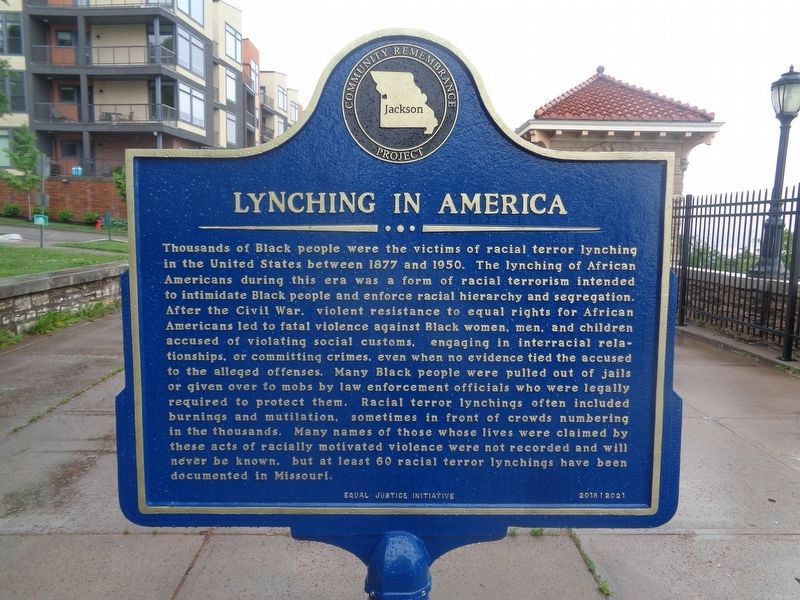
Lynching in America
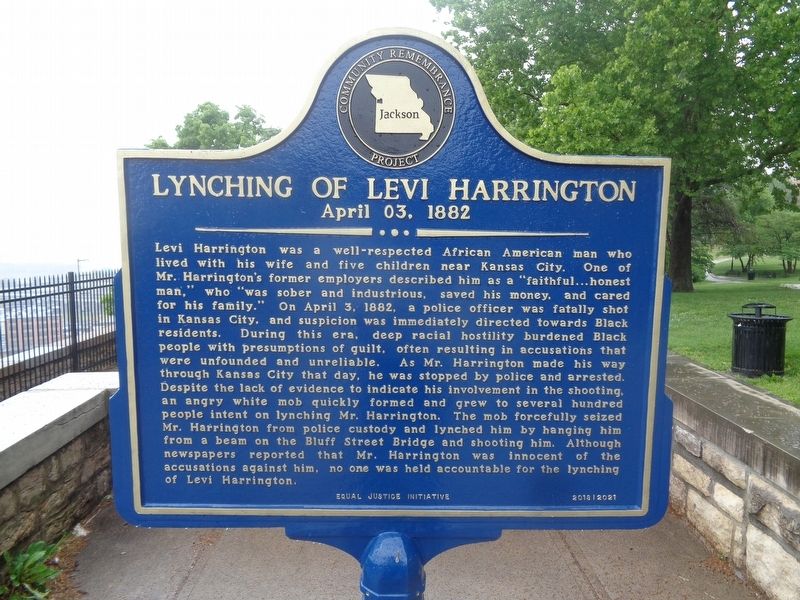
⎯⎯⎯ Lynching of Levi Harrington
April 03, 1882
Community Remembrance Project
Photographed by Jason Voigt, May 25, 2022
1. Lynching in America / Lynching of Levi Harrington Marker
Inscription.
Lynching in America, also, Lynching of Levi Harrington. / April 03, 1882.
Lynching in America.. Thousands of Black people were the victims of racial terror lynching in the United States between 1877 and 1950. The lynching of African Americans during this era was a form of racial terrorism intended to intimidate Black people and enforce racial hierarchy and segregation. After the Civil War, violent resistance to equal rights for African Americans led to fatal violence against Black women, men, and children accused of violating social customs, engaging in interracial relationships, or committing crimes, even when no evidence tied the accused to the alleged offenses. Many Black people were pulled out of jails or given over to mobs by law enforcement officials who were legally required to protect them. Racial terror lynchings often included burnings and mutilation, sometimes in front of crowds numbering in the thousands. Many names of those whose lives were claimed by these acts of racially motivated violence were not recorded and will never be known, but at least 60 racial terror lynchings have been documented in Missouri.,
Lynching of Levi Harrington April 03, 1882.. Levi Harrington was a well-respected African American man who lived with his wife and five children near Kansas City. One of Mr. Harrington's former employers described him as a "faithful honest man," who "was sober and industrious, saved his money, and cared for his family." On April 3, 1882, a police officer was fatally shot in Kansas City, and suspicion was immediately directed towards Black residents. During this era, deep racial hostility burdened Black people with presumptions of guilt, often resulting in accusations that were unfounded and unreliable. As Mr. Harrington made his way through Kansas City that day, he was stopped by police and arrested. Despite the lack of evidence to indicate his involvement in the shooting, an angry white mob quickly formed and grew to several hundred people intent on lynching Mr. Harrington. The mob forcefully seized Mr. Harrington from police custody and lynched him by hanging him from a beam on the Bluff Street Bridge and shooting him. Although newspapers reported that Mr. Harrington was innocent of the accusations against him, no one was held accountable for the lynching of Levi Harrington.
Lynching in America.
Thousands of Black people were the victims of racial terror lynching in the United States between 1877 and 1950. The lynching of African Americans during this era was a form of racial terrorism intended to intimidate Black people and enforce racial hierarchy and segregation. After the Civil War, violent resistance to equal rights for African Americans led to fatal violence against Black women, men, and children accused of violating social customs, engaging in interracial relationships, or committing crimes, even when no evidence tied the accused to the alleged offenses. Many Black people were pulled out of jails or given over to mobs by law enforcement officials who were legally required to protect them. Racial terror lynchings often included burnings and mutilation, sometimes in front of crowds numbering in the thousands. Many names of those whose lives were claimed by these acts of racially motivated violence were not recorded and will never be known, but at least 60 racial terror lynchings have been documented in Missouri.
Lynching of Levi Harrington April 03, 1882.
Levi Harrington was a well-respected African American man who lived with his wife and five children near Kansas City. One of Mr. Harrington's former employers described
Click or scan to see this page online
him as a "faithful honest man," who "was sober and industrious, saved his money, and cared for his family." On April 3, 1882, a police officer was fatally shot in Kansas City, and suspicion was immediately directed towards Black residents. During this era, deep racial hostility burdened Black people with presumptions of guilt, often resulting in accusations that were unfounded and unreliable. As Mr. Harrington made his way through Kansas City that day, he was stopped by police and arrested. Despite the lack of evidence to indicate his involvement in the shooting, an angry white mob quickly formed and grew to several hundred people intent on lynching Mr. Harrington. The mob forcefully seized Mr. Harrington from police custody and lynched him by hanging him from a beam on the Bluff Street Bridge and shooting him. Although newspapers reported that Mr. Harrington was innocent of the accusations against him, no one was held accountable for the lynching of Levi Harrington.
Erected 2021 by Equal Justice Initiative.
Topics and series. This historical marker is listed in these topic lists: African Americans • Civil Rights. In addition, it is included in the Lynching in America series list. A significant historical date for this entry is April 3, 1882.
Location. Marker is missing. It was located near
Photographed by Jason Voigt, May 25, 2022
2. Lynching in America / Lynching of Levi Harrington Marker
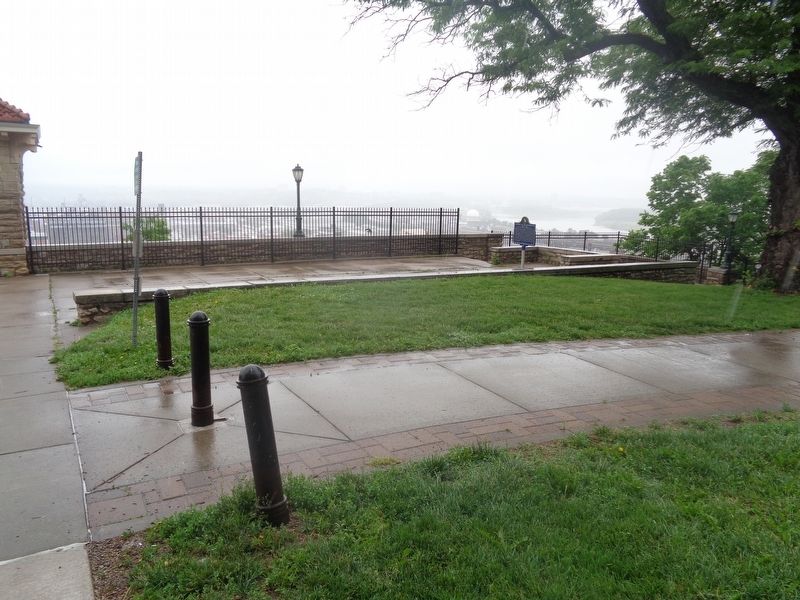
39° 6.168′ N, 94° 35.597′ W. Marker was in Kansas City, Missouri, in Jackson County. It was in Quality Hill. It could be reached from the intersection of Summit Street and West 10th Street. Located at the SW corner of Chase Park. Touch for map. Marker was at or near this postal address: 1031 Summit St, Kansas City MO 64105, United States of America. Touch for directions.

Regionally, this marker was in the American Midwest, in the Lewis & Clark Corridor, in the Corn Belt, and on the Santa Fe Trail Corridor. Globally, it was in North America, the Western Hemisphere, the Western World, and the Anglosphere. Historically, it found itself in what was once the territory of the Mississippian Culture, the Louisiana Purchase, and the Antebellum South.
3. Lynching in America / Lynching of Levi Harrington Marker
Marker is at the southwest corner of Chase Park.
report about it. [Source: Kansas City Star](Submitted on March 22, 2026, by Mark Hilton of Montgomery, Alabama.)
Photographed by Brandon D Cross
4. Lynching of Levi Harrington Marker
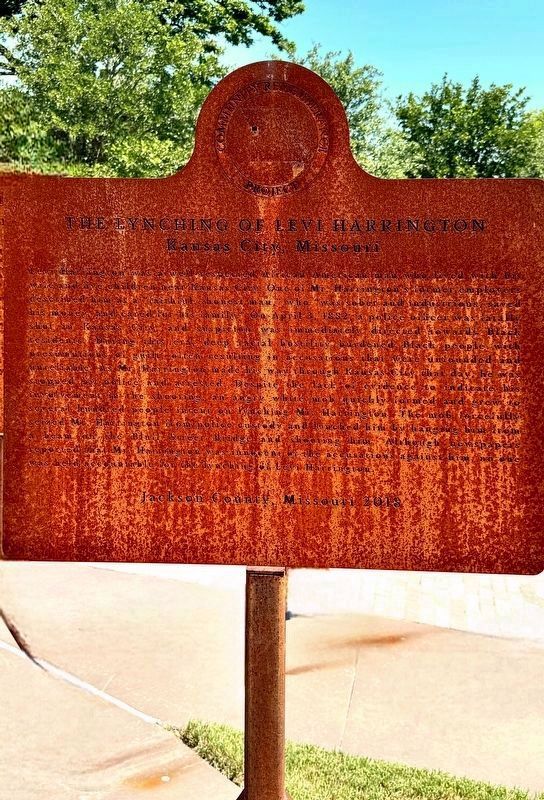
A Replica marker of one side is located at the Equal Justice Initiatives' National Memorial for Peace and Justice in Montgomery, Alabama. The Equal Justice Initiative supports efforts to locally memorialize documented victims of racial violence and to educate communities about the history of racial injustice. Mark Hilton
Credits. This page was last revised on March 22, 2026. It was originally submitted on May 28, 2022, by Jason Voigt of Glen Carbon, Illinois. This page has been viewed 1,325 times since then and 45 times this year. Last updated on March 12, 2026, by Gianluca De Fazio of Harrisonburg, Virginia. Photos:1, 2, 3. submitted on May 28, 2022, by Jason Voigt of Glen Carbon, Illinois. 4. submitted on October 16, 2024, by Brandon D Cross of Flagler Beach, Florida. • Devry Becker Jones was the editor who published this page.