
Downtown in Des Moines in Polk County, Iowa — The American Midwest (Upper Plains)
Ronald W. Reagan
Photographed by McGhiever, November 16, 2025
1. Ronald W. Reagan Marker
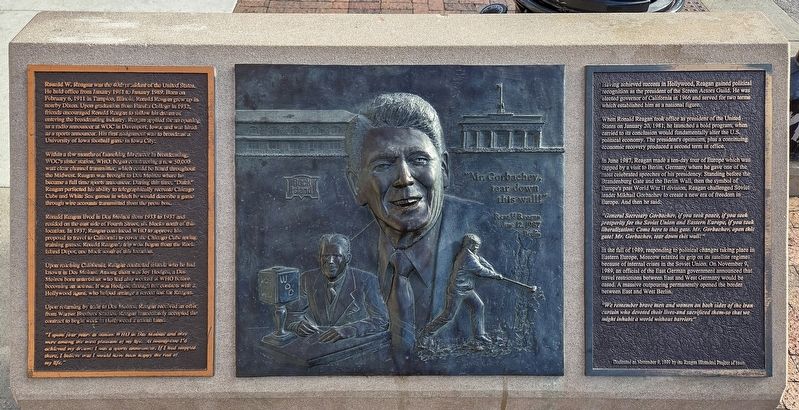
Ronald W. Reagan was the 40th president of the United States. He held the office from January 1981 to January 1989. Born February 6, 1911 in Tampico, Illinois, Reagan grew up in nearby Dixon. Upon graduation from Eureka College in 1932, friends encouraged Ronald Reagan to follow his dream of entering the broadcasting industry. Reagan applied for an opening as a radio announcer at WOC in Davenport, Iowa, and was hired as a sports announcer. His first assignment was to broadcast a University of Iowa football game in Iowa City.
Within a few months of launching his career in broadcasting, WOC's sister station, WHO, began constructing a new 50,000 watt clear channel transmitter, which could be heard throughout the Midwest. Reagan was brought to Des Moines where he became a full time sports announcer. During this time, "Dutch" Reagan perfected his ability to telegraphically recreate Chicago Cubs and White Sox games in which he would describe a game through wire accounts transmitted from the press box.
Ronald Reagan lived in Des Moines from 1933 to 1937 and resided on the east side of Fourth Street, six blocks north of
this page online
Upon reaching California, Reagan contacted friends who he had known in Des Moines. Among them was Joy Hodges, a Des Moines born entertainer who had also worked at WHO before becoming an actress. It was Hodges, through her contacts with a Hollywood agent, who helped arrange a screen test for Reagan.
Upon returning by train to Des Moines, Regan received an offer from Warner Brothers Studios. Reagan immediately accepted the contract to begin work in Hollywood a month later
I spent four years at station WHO in Des Moines and they were among the most pleasant of my life. At twenty-two I'd achieved my dream: I was a sports announcer. If I had stopped there, I believe that I would have been happy the rest of my life."
"Mr. Gorbachev, tear down this wall!"
Ronald Reagan
June 12, 1987
Berlin
Having achieved success in Hollywood, Reagan gained political recognition as president of the Screen

Photographed by McGhiever, November 16, 2025
2. Ronald W. Reagan Marker at the northwest corner of Court Avenue and 4th Street
When Ronald Reagan took office as president of the United States on January 20, 1981, he launched a bold program, when carried to its conclusion would fundamentally alter the U.S. political economy. The president's optimism, plus a continuing economic recovery produced a second term in office.
In June 1987, Reagan made a ten-day tour of Europe which was capped by a visit to Berlin, Germany where he gave one of the most celebrated speeches of his presidency. Standing before the Brandenburg Gate and the Berlin Wall, then the symbol of Europe's post World War II division, Reagan challenged Soviet leader Mikhail Gorbachev to create a new era of freedom in Europe. And then he said:
"General Secretary Gorbachev, if you seek peace, if you seek prosperity for the Soviet Union and Eastern Europe, if you seek liberalization: Come here to this gate, Mr. Gorbachev, open this gate! Mr. Gorbachev, tear down this wall!"
In the fall of 1989, responding to political changes taking place in Eastern Europe, Moscow relaxed its grip on its satellite regimes because of internal crises in the Soviet Union. On November 9, 1989, an official of the East German government announced that travel restrictions between East and West Germany would be eased. A massive outpouring permanently opened the border between East and West Berlin.
"We remember brave men and women on both sides of the iron curtain who devoted their lives-and sacrificed them-so that we might inhabit a world without barriers."
Dedicated on November 9, 1999 by the Reagan Historical Project of Iowa
Erected 1999 by the Reagan Historical Project of Iowa.
Topics and series. This historical marker is listed in these topic lists: Communications • Government & Politics • Sports • War, Cold. In addition, it is included in the Former U.S. Presidents: #40 Ronald Reagan series list. A significant historical year for this entry is 1932.
Location. 41° 35.105′ N, 93° 37.31′ W. Marker is in Des Moines, Iowa, in Polk County. It is in Downtown. It is at the intersection of Court Avenue and 4th Street, on the right when traveling west on Court Avenue. Touch for map. Marker is at or near this postal address: 405 Court Avenue, Des Moines IA 50309, United States of America. Touch for directions.

Regionally, this marker is in the American Midwest and in the Corn Belt. Globally, it is in North America, the Western Hemisphere, the Western World, and the Anglosphere. Historically, it finds itself in what was once the territory of the Mississippian Culture and also the Louisiana Purchase.
Other nearby markers. At least 8 other markers are within walking distance of this marker: Hawkeye Insurance Co. (within shouting distance of this marker); Homestead Building (approx. 0.2 miles away); The Savery Hotel (approx. 0.2 miles away); Civil Rights Victory (approx. ¼ mile away); The Iowa Commission for the Blind Building (approx. 0.3 miles away); A Monumental Journey (approx. 0.3 miles away); Birthplace of Des Moines (approx. 0.3 miles away); The First Public Schoolhouse (approx. 0.3 miles away). Touch for a list and map of all markers in Des Moines.
Credits. This page was last revised on March 12, 2026. It was originally submitted on March 12, 2026, by McGhiever of Minneapolis, Minnesota. This page has been viewed 28 times since then. Photos: 1, 2. submitted on March 12, 2026, by McGhiever of Minneapolis, Minnesota.
