Johnson City in Washington County, Tennessee — The American South (East South Central)
The Limestone Cave

Photographed by Mark Parker, March 12, 2026
1. The Limestone Cave Marker
The limestone cave has existed since the Pleistocene period, or Ice Age, of two million to ten thousand years ago. Biological deposits from an ancient sea that once covered this area formed the sedimentary rock. The newly formed limestone became exposed as sea levels receded. Over time, acidic ground water seeped into the rock to erode and form the cave before you that contains two sizeable rooms, small passageways, and cave formations. Erosion has also exposed fossils of ancient sea shells and bone breccia or bones of ancient vertebrates that are imbedded in the limestone walls.
In 2005, the discovery of a fossilized tooth was identified by a paleontologist as that of the dire wolf. This prehistoric wolf has been extinct for over ten thousand years and was similar to the modern gray wolf except that it had a larger, broader head. These wolf tooth that was and shorter, sturdier legs. The dire wolf had fairly large teeth and is considered to have had the strongest bite force of any canine specie.
The cave was also used as a shelter for humans throughout history. Parties of prehistoric peoples and local Native American
this page online
[Captions:]
This mid twentieth century photograph shows Samuel Simerly, Jr. pointing out the Tipton-Haynes historic cave entrance to W.C. Phipps, Mary McCown (a Tipton descendant) and Mac McDermott.
The fossilized dire wolf tooth that was discovered near the mouth of the cave. The tooth is currently being preserved at the Gray Fossil Site.
This survey of the limestone cave was done by the Geosciences Department of East Tennessee State University in 2017.
Erected by Tennessee Historical Commission.
Topics. This historical marker is listed in these topic lists: Animals • Exploration • Indigenous Peoples and Communities • Paleontology. A significant historical year for this entry is 2005.
Location. 36° 17.609′ N, 82° 19.984′ W. Marker is in Johnson City, Tennessee, in Washington County. It is on South Roan Street south of Bonita Drive, on the right when traveling south.

Photographed by Mark Parker, March 12, 2026
2. The Limestone Cave Marker. Cave entrance is in the background

Regionally, this marker is in East Tennessee and in the Tri-Cities Area. It is also in the American South, specifically in the Upper South, in Appalachia, and specifically in Southern Appalachia. Globally, it is in North America, the Western Hemisphere, the Western World, and the Anglosphere. Historically, it finds itself in what was once the original Cherokee Nation, the territory of the Mississippian Culture, one of the Confederate States of America, the State of Franklin, and the Antebellum South.
Other nearby markers. At least 8 other markers are within walking distance of this marker: Still House (a few steps from this marker); The Journey of André Michaux (within shouting distance of this marker); Springhouse (within shouting distance of this marker); Pig Sty (about 300 feet away, measured in a direct line); Corn Crib (about
Photographed by Mark Parker, March 12, 2026
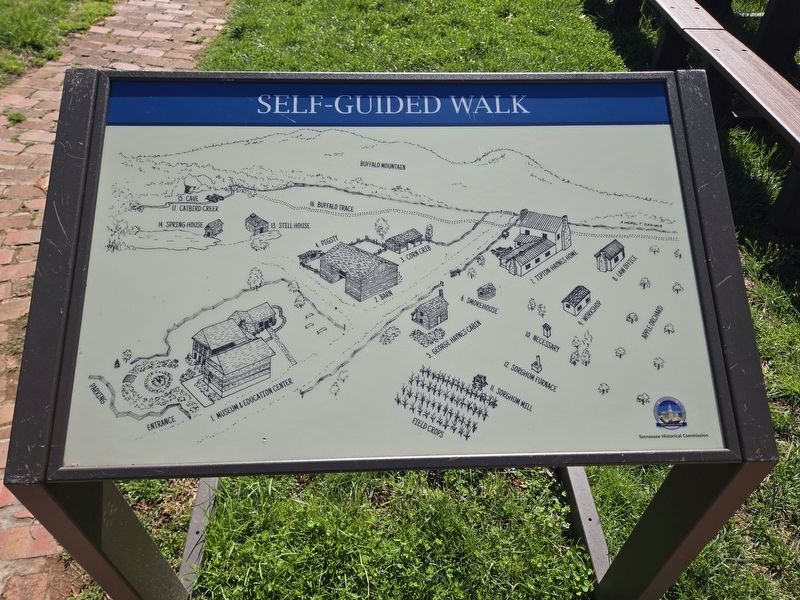
3. Self-guided Walk Map showing location of the marker (no. 15)
Credits. This page was last revised on March 14, 2026. It was originally submitted on March 12, 2026, by Mark Parker of Hickory, North Carolina. This page has been viewed 32 times since then. Photos: 1, 2, 3. submitted on March 12, 2026, by Mark Parker of Hickory, North Carolina. • Devry Becker Jones was the editor who published this page.
