Downtown in Northwest Washington in Washington, District of Columbia — The American Northeast (Mid-Atlantic)
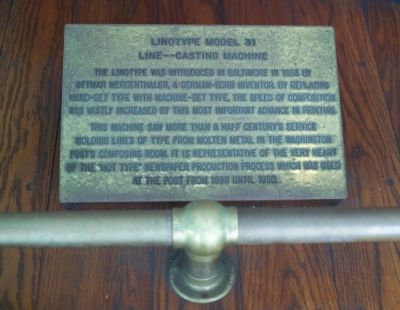
Linotype Model 31
Line-Casting Machine
Photographed by Tom Fuchs, April 3, 2010
1. Linotype Model 31 Marker
The Linotype was introduced in Baltimore in 1883 by Ottmar Mergenthaler, a German-born inventor. By replacing hand-set type with machine-set type, the speed of composition was vastly increased by this important advance in printing.
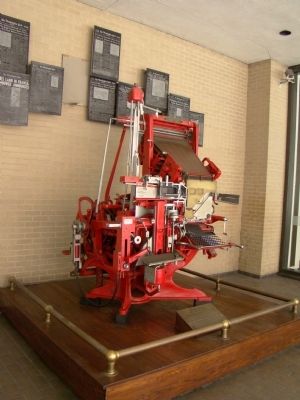
This machine saw more than a half century’s service molding lines of type from molten metal in the Washington Post’s composing room. It is representative of the very heart of the “hot type” newspaper production process which was used at the Post from 1888 to 1980.
Topics. This historical marker is listed in these topic lists: Communications • Industry & Commerce • Labor Unions. A significant historical year for this entry is 1883.
Location. Marker has been permanently removed. It was located near 38° 54.268′ N, 77° 2.088′ W. Marker was in Northwest Washington in Washington, District of Columbia. It was in Downtown. It was on 15th Street Northwest north of L Street Northwest, on the left when traveling north. Touch for map. Marker was at or near this postal address: 1150 15th Street
this page online
We have been informed that this marker is no longer there and will not be replaced. This page is an archival view of what was.
Regionally, this marker was in the Washington Metropolitan Area. It was also in the American Northeast, in the Upper South, in the Mid-Atlantic, in the Tidewater, and in the Chesapeake Bay Region. Globally, it was in North America, the Western Hemisphere, the Western World, and the Anglosphere.

Other nearby markers. At least 8 other markers are within walking distance of this location: Saint Augustine Catholic Church (within shouting distance of this marker); Katharine Graham (about 300 feet away, measured in a direct line); Metropolitan AME Church (about 400 feet away); Metropolitan African Methodist Episcopal Church (about 400 feet away); Metropolitan African Methodist Episcopal (A.M.E.) Church (about 400 feet away); "Party Animals" (about 400 feet away); The University Club (about 400 feet away); William Howard Taft (about 500 feet away).
Photographed by J. J. Prats, April 3, 2010
2. Linotype Model 31 and Marker
Brass plaque is mounted on the wooden platform.
More about this marker. The marker was removed when the Washington Post was demolished at the site.
Related marker. Click here for another marker that is related to this marker. This link is to a marker for a the Ottmar Mergenthaler house in Baltimore.
Also see . . .
1. James O. Clephane, the Father of the Linotype Machine. Wikipedia entry. “ ‘I want to bridge the gap between the typewriter and the printed page’ he declared in 1872, and began to pursue the invention of a machine for typesetting. Along with Charles T. Moore, he devised a machine which cast type from papier-mâché matrices indented by mechanically assembled characters, but it had numerous defects which they were unable to rectify. Moore approached August Hahl in 1876, with whom Ottmar Mergenthaler was working at the time. Mergenthaler immediately suggested casting the type from a metal matrix instead, and set to work on a typesetting machine, spending a year redesigning it until
Photographed by J. J. Prats, April 3, 2010
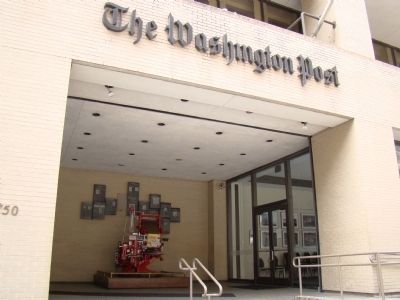
3. Linotype Model 31 On Display
“It produced print by lithography, which was problematic. Clephane made the suggestion of using stereography instead, and Mergenthaler began to research this approach, for which Clephane provided financial backing. By 1879, it was still in development. Mergenthaler designed a line casting machine, but then tore up the plans in frustration. Clephane encouraged him to continue; he remained confident in the value of the invention despite all the scepticism and financial embarrassments that accompanied it.
“By 1883, the machine was perfected and patented in 1884. Meanwhile Clephane had formed the National Typographic Company for manufacturing it, with a capitalization of $1 million and named Mergenthaler as manager of its Baltimore factory. The company became the Mergenthaler Printing Company in 1885. It had its first ‘commercial demonstration’ on July 3, 1886, before Whitelaw Reid of the New York Tribune, who exclaimed ‘Ottmar, you’ve done it again! A line o’ type!’
Photographed by J. J. Prats, April 3, 2010
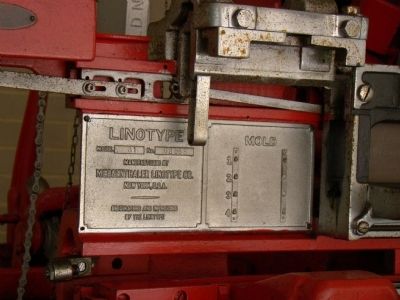
4. Linotype Model and Serial Number Plate
2. Eldon Meeks runs a Linotype machine. “October 16, 2007 — Eldon Meeks, 82, runs a Model 8 Linotype machine, vintage World War II, for the Wapsipinicon Almanac at Route Three Press in rural Anamosa, Iowa, in October 2007. Eldon was born deaf, and is also mute. Video shot by The Gazette’s Dave Rasdal.”
“This is a video of my deaf father at the linotype machine. Many years ago he used to work for the local Anamosa, Iowa newspaper. His former boss used to say Eldon would always know in advance when one of the machines was going to break down. With being deaf, he could feel the change in the vibration that the machines were producing.” (Submitted on April 11, 2010, by J. J. Prats of Powell, Ohio.)
3. A Place of Their Own. 1989 book by John Vickrey Van Cleve and Barry A. Crouch on Amazon.com. “As satisfying as it may be, however, the story of deaf people’s
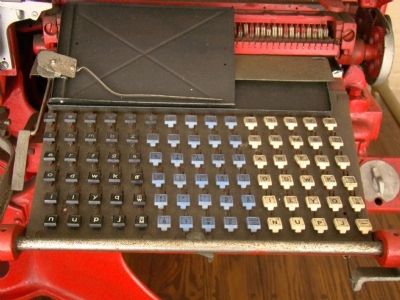
Photographed by J. J. Prats, April 3, 2010
5. Linotype Keyboard and Copy Holder
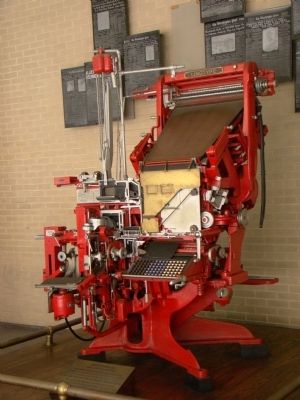
Photographed by J. J. Prats, April 3, 2010
6. Linotype Model 31
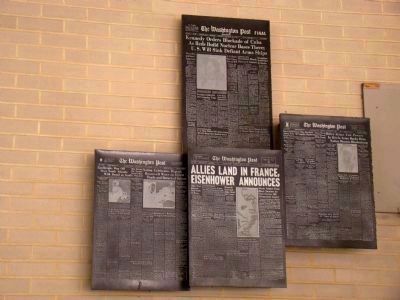
Photographed by J. J. Prats, April 3, 2010
7. Washington Post Front Pages Composed with Linotype
Displayed behind the Linotype machine. 1962: “Kennedy Orders Blockade of Cuba as Reds Build Nuclear Bases There; U.S. Will Sink Defiant Arms Ships” 1933: “Nation Celebrates Repeal; Roosevelt Wars on Illicit Trade and Return of Saloon” 1944: “Allies Land in France, Eisenhower Announces” 1937: Hitler Seizes Full Powers In Reich; Army Backs Him; Nation Mourns Hindenburg”
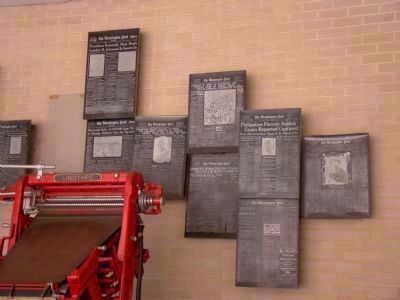
Photographed by J. J. Prats, April 3, 2010
8. Washington Post Front Pages Composed with Linotype
Displayed behind the Linotype machine. 1963: “President Kennedy Shot Dead; Lyndon B. Johnson is Sworn In” 1963: “Mammoth Rally of 200,000 Jams Mall In Solemn, Orderly Plea for Equality” 1927: “Lindbergh Wildly Hailed at Paris for 3,800-Mile Flight in 33½ Hours; Airman Tells Own Story of Trip” 1924: “Johnson is Hero as Nationals Win Decisive Game of World Series 4–3; City in Carnival, Celebrates Victory” 1918: “Armistice Signed; Fighting Ceases; Reds Rule in Berlin;” 1941: “Phillippines Fierecely Raided; Guam Reportedly Captured. War Declaration Signed by Roosevelt” 1898: “Maine Wrecked and Burned” 1906: “On a Sun-Kissed Day in Room Abloom, the Eyes of the World Beholding, Alice Roosevelt, the President’s Fair Daughter, Becomes Mrs. Nicholas Longworth”

Photographed by J. Makali Bruton, December 1, 2024
9. Site of the Linotype Model 31 Marker
Credits. This page was last revised on December 1, 2024. It was originally submitted on April 4, 2010, by Tom Fuchs of Greenbelt, Maryland. This page has been viewed 3,131 times since then and 182 times this year. Photos: 1. submitted on April 4, 2010, by Tom Fuchs of Greenbelt, Maryland. 2, 3, 4, 5, 6, 7. submitted on April 10, 2010, by J. J. Prats of Powell, Ohio. 8. submitted on April 11, 2010, by J. J. Prats of Powell, Ohio. 9. submitted on December 1, 2024, by J. Makali Bruton of Washington, District of Columbia. • J. J. Prats was the editor who published this page.
