Erlangen, Bavaria, Germany — Central Europe
Ilse Mayer
Photographed by James Hulse, February 25, 2026
1. Ilse Mayer Marker

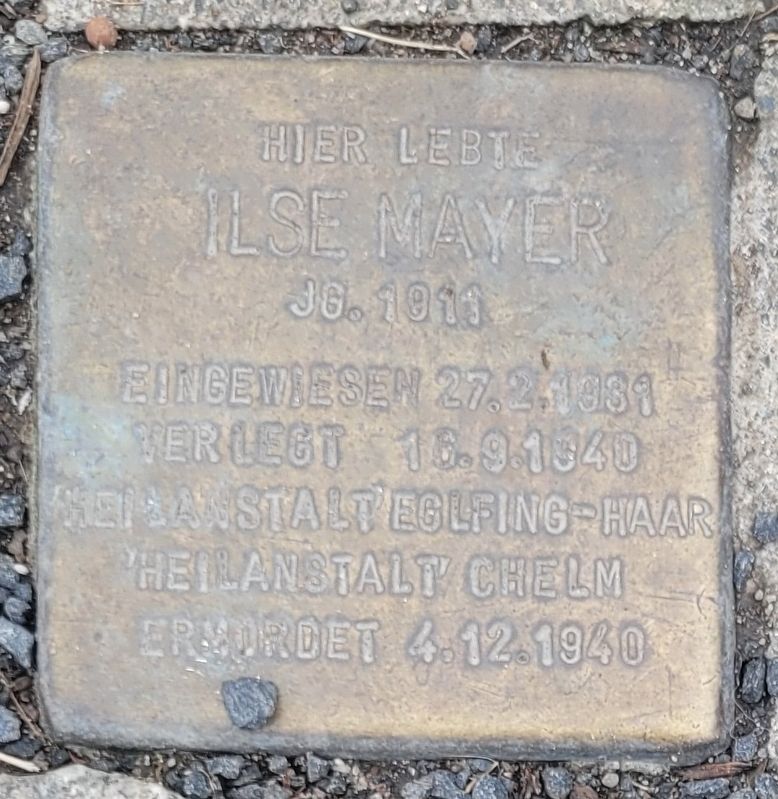
Hier lebte
Ilse Mayer
Jg. 1911
Eingewiesen 27.2.1931
Verlegt 16.9.1940
‘Heilanstalt’ Eglfing-Haar
‘Heilanstalt’ Chełm
Ermordet 4.12.1940
Ilse Mayer, born in 1911, lived here. She was committed on 27 Feb. 1931, transferred on 16 Sept. 1940 to the “Heilanstalt” Eglfing-Haar and later to the “Heilanstalt” in Chełm, where she was murdered on 4 Dec. 1940.
Topics and series. This historical marker is listed in these topic lists: War, World II • Women. In addition, it is included in the Stolpersteine series list. A significant historical date for this entry is February 27, 1931.
Location. 49° 36.039′ N, 11° 0.636′ E. Marker is in Erlangen, Bayern (Bavaria). It is on Maximilianspl. just west of Ulmenweg, on the left when traveling east. Touch for map. Marker is at or near this postal address: Maximilianspl 2, Erlangen BY 91054, Germany. Touch for directions.

Regionally, this marker is in German Franconia. Globally, it is in Europe, the European Union, Atlantic Europe, Central Europe, the Schengen Area, Western Europe, and the Western World. Historically, it finds itself in what was once the Holy Roman Empire and also the former West Germany.
Other nearby markers. At least 8 other markers are within walking distance of this marker: Martin Liebermann (here, next to this marker); Franziska Reinmund (here, next to this marker); Julius Heller (here, next to this marker); Gertrud Hirschmann (here, next to this marker); Mathilde Tuteur (here, next to this marker); Walter Rosenblatt (here, next to this marker); Emil Walz (here, next to this marker); Ludwig Jakobssohn
this page online
Also see . . . Stolperstein. Wikipedia
A Stolperstein (in English "stumbling block") is a ten-centimetre (four-inch) concrete cube bearing a brass plate inscribed with the name and life dates of victims of Nazi extermination or persecution. The Stolpersteine project, initiated by the German artist Gunter Demnig in 1992, aims to commemorate persons at the last place that they chose freely to reside, work or study (with exceptions possible on a case-by-case basis) before they fell victim to Nazi terror, forced euthanasia, eugenics, deportation to a concentration or extermination camp, or escaped persecution by emigration or suicide. As of June 2023, 100,000 Stolpersteine have been laid, making the Stolpersteine project the world's largest decentralized memorial.(Submitted on March 19, 2026, by James Hulse of Medina, Texas.)
Additional keywords. Holocaust
Photographed by James Hulse, February 25, 2026
2. Ilse Mayer Marker
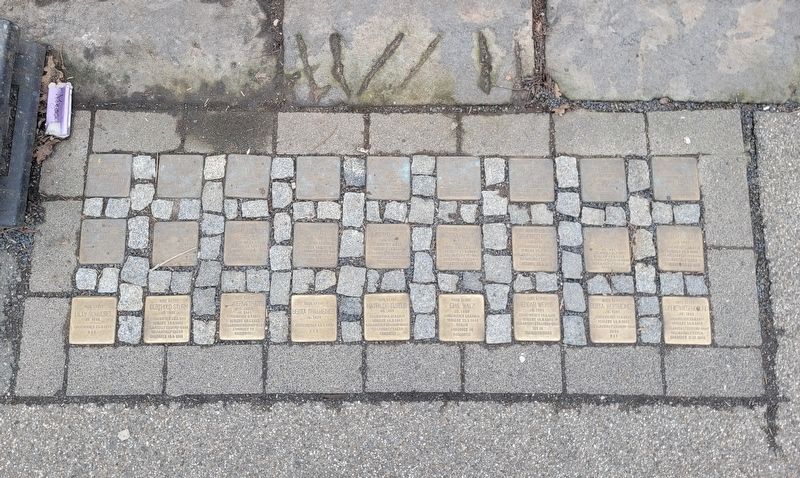
First from the right in the top row of the group. The Stolpersteine markers are located in front of the university hospital building in a large group of 27 commemorating the euthanasia victims.
Photographed by James Hulse, February 25, 2026
3. Ilse Mayer Marker
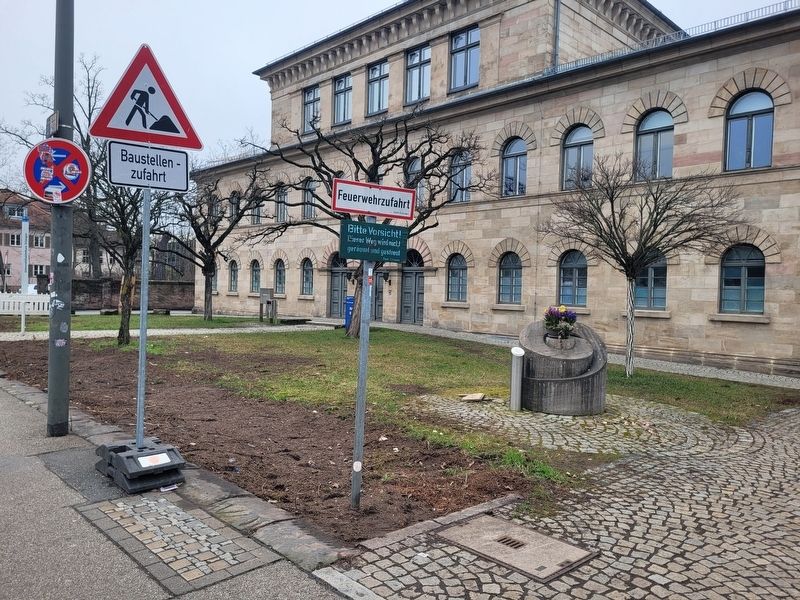
The view of the markers in front of the university hospital building.
Credits. This page was last revised on March 21, 2026. It was originally submitted on March 19, 2026, by James Hulse of Medina, Texas. This page has been viewed 23 times since then. Photos: 1, 2, 3. submitted on March 21, 2026, by James Hulse of Medina, Texas.
