Beallsville in Montgomery County, Maryland — The American Northeast (Mid-Atlantic)
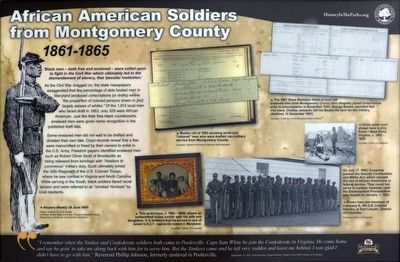
African American Soldiers from Montgomery County
1861-1865
Photographed by Allen C. Browne, July 26, 2015
1. African American Soldiers from Montgomery County Marker
Black men — both free and enslaved — were called upon to fight in the Civil War which ultimately led to the dismantlement of slavery, that ‘peculiar institution.’
As the Civil War dragged on, the state newspapers exaggerated that the percentage of able bodied men in Maryland produced conscriptions (or drafts) where “the proportion of colored persons drawn in [sic] largely excess of whites.” Of the 1,913 local men who faced draft in 1863, only 329 were African American. Just like their free black counterparts, enslaved men were given name recognition in the published draft lists.
Some enslaved men did not wait to be drafted and dictated their own fate. Court records reveal that a few were manumitted or freed by their owners to enlist in the U.S. Army. Freedom papers identified enslaved men such as Robert Oliver Scott of Brookeville as being released from bondage with “freedom to commence” military duty. Scott ultimately joined the 30th Regiment of the U.S. Colored Troops, where he saw combat in Virginia and North Carolina. While serving in the South, black soldiers faced racial tension and were referred to as “smoked Yankees”
this page online
“I remember when the Yankee and Confederate soldiers both came to Poolesville. Capn Sam White he join the Confederate in Virginia. He come home and say he goin' to take me along back with him for to serve him. But the Yankees came and he left very sudden and leave me behind I was glad I didn't have to go with him.” Reverend Phillip Johnson, formerly enslaved in Poolesville.September 14,1937 Oral Interview. Federal Writers Project of WPA. Library of Congress
On July 17, 1862, Congress passed the Second Confiscation and Militia Act, which allowed the use of African Americans in federal service. They could not serve in combat, however, until the Emancipation Proclamation was issued on January 1, 1863.
Erected by Montgomery Parks.
Topics and series. This historical marker is listed in these topic lists: African Americans • War, US Civil. In addition, it is included in the Maryland, Montgomery Parks series list. A significant historical month for this entry is January 1838.
Location. 39° 11.429′ N, 77° 25.114′ W. Marker is in Beallsville, Maryland, in Montgomery County. It can be reached from Darnestown Road (Maryland
Photographed by Allen C. Browne, July 26, 2015
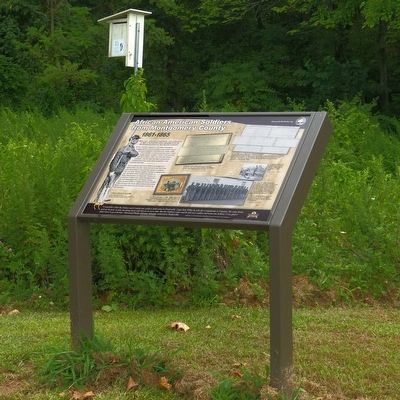
2. African American Soldiers from Montgomery County Marker

Regionally, this marker is in the Washington Metropolitan Area. It is also in the American Mid-Atlantic. Globally, it is in North America, the Western Hemisphere, the Western World, and the Anglosphere. Historically, it finds itself in what was once one of the original Thirteen Colonies and also the Antebellum South.
Other nearby markers. At least 8 other markers are within walking distance of this marker: Equestrian Heritage (about 400 feet away, measured in a direct line); Brewer Farmstead (about 600 feet away); Washington's Farm (approx. ¾ mile away); In Loving Memory (approx. ¾ mile away); The Country Store (approx. 0.8 miles away); The Darby Store (approx. 0.8 miles away); The Darby Family (approx. 0.8 miles away); Beallsville (approx. 0.8 miles away). Touch for a list and map of all markers in Beallsville.
Library of Congress
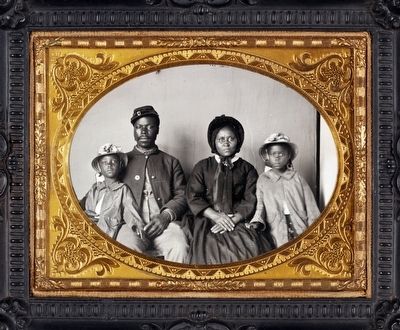
3. Unidentified Union Soldier and Family
This ambrotype, c. 1863 - 1865, shows an unidentified Union soldier with his wife and daughters. It is believed that he served in one of seven U.S.C.T. regiments raised in Maryland.LOC photo used on marker
Library of Congress
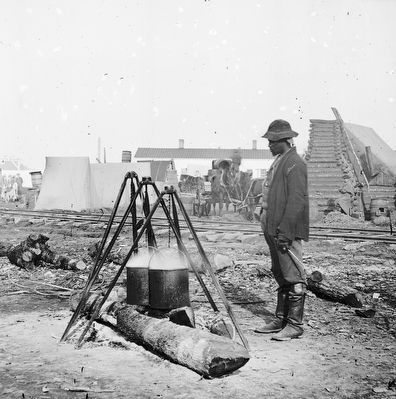
4. Union Army Cook
Union army cook shown here in City Point - West Point, Virginia, c. 1861 - 1865.LOC photo used on marker
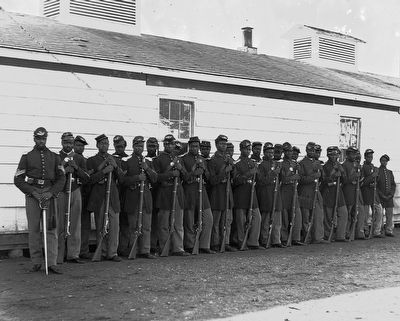
Library of Congress
5. Company E. 4th USCI at Fort Lincoln
Shown here are members of Company E, 4th U.S. Colored Infantry, at Fort Lincoln, District of Columbia.LOC of photo used on marker
Credits. This page was last revised on March 20, 2026. It was originally submitted on August 8, 2015, by Allen C. Browne of Silver Spring, Maryland. This page has been viewed 1,378 times since then and 60 times this year. Last updated on March 20, 2026, by Carl Gordon Moore Jr. of North East, Maryland. Photos: 1, 2, 3, 4, 5. submitted on August 8, 2015, by Allen C. Browne of Silver Spring, Maryland. • Devry Becker Jones was the editor who published this page.
