Camden in Greater London, England, United Kingdom — Northwestern Europe (the British Isles)
Earlham Street
Photographed by Andrew Ruppenstein, February 25, 2026
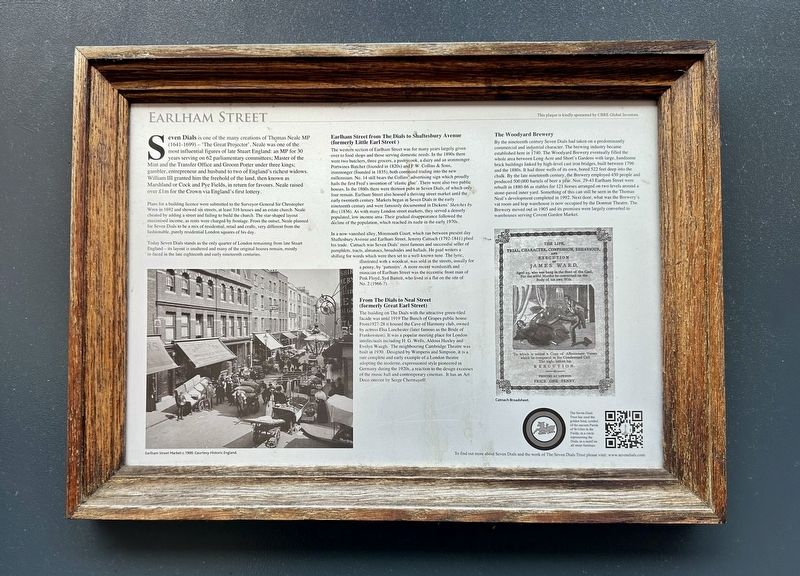
1. Earlham Street Marker
Seven Dials is one of the many creations of Thomas Neale MP (1641-1699) - ‘The Great Projector’. Neale was one of the most influential figures of late Stuart England: an MP for 30 years serving on 62 parliamentary committees; Master of the Mint and the Transfer Office and Groom Porter under three kings; gambler, entrepreneur and husband to two of England's richest widows. William III granted him the freehold of the land, then known as Marshland or Cock and Pye Fields, in return for favours. Neale raised over £1m for the Crown via England's first lottery.
Plans for a building licence were submitted to the Surveyor-General Sir Christopher Wren in 1692 and showed six streets, at least 316 houses and an estate church. Neale cheated by adding a street and failing to build the church. The star-shaped layout maximised income, as rents were charged by frontage. From the outset, Neale planned for Seven Dials to be a mix of residential, retail and crafts, very different from the fashionable, purely residential London squares of his day.
Today Seven Dials stands as the only quarter of London remaining from late Stuart
this page online
Earlham Street from The Dials to Shaftesbury Avenue (formerly Little Earl Street)
The western section of Earlham Street was for many years largely given over to food shops and those serving domestic needs. In the 1890s there were two butchers, three grocers, a pastrycook, a dairy and an ironmonger. Portwines Butcher (founded in 1820s) and F.W. Collins & Sons, ironmonger (founded in 1835), both continued trading into the new millennium. No. 14 still bears the Collins' advertising sign which proudly hails the first Fred's invention of 'elastic glue'. There were also two public houses. In the 1860s there were thirteen pubs in Seven Dials, of which only four remain. Earlham Street also housed a thriving street market until the early twentieth century. Markets began in Seven Dials in the early nineteenth century and were famously documented in Dickens' Sketches by Boz (1836). As with many London street markets, they served a densely populated, low income area. Their gradual disappearance
Photographed by Andrew Ruppenstein, February 25, 2026
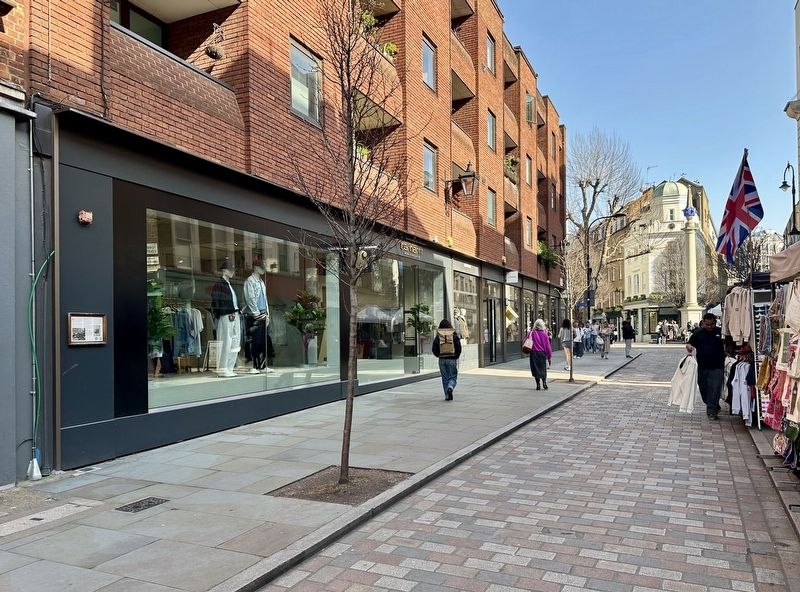
2. Earlham Street Marker - wide view
Looking east along Earlham Street, the marker is visible on the left, while the reconstructed Seven Dials pillar is visible in the background on the right.
In a now-vanished alley, Monmouth Court, which ran between present day Shaftesbury Avenue and Earlham Street, Jemmy Catnach (1792-1841) plied his trade. Catnach was Seven Dials' most famous and successful seller of pamphlets, tracts, almanacs, broadsides and ballads. He paid writers a shilling for words which were then set to a well-known tune. The lyric, illustrated with a woodcut, was sold in the streets, usually for a penny, by patterers'. A more recent wordsmith and musician of Earlham Street was the eccentric front man of Pink Floyd, Syd Barrett, who lived in a flat on the site of No. 2 (1966-7).
From The Dials to Neal Street (formerly Great Earl Street)
The building on The Dials with the attractive green-tiled facade was until 1919 The Bunch of Grapes public house. From 1927-28 it housed the Cave of Harmony club, owned by actress Elsa Lanchester (later famous as the Bride of Frankenstein). It was a popular meeting place for London intellectuals including H. G. Wells, Aldous Huxley and Evelyn Waugh. The neighbouring Cambridge
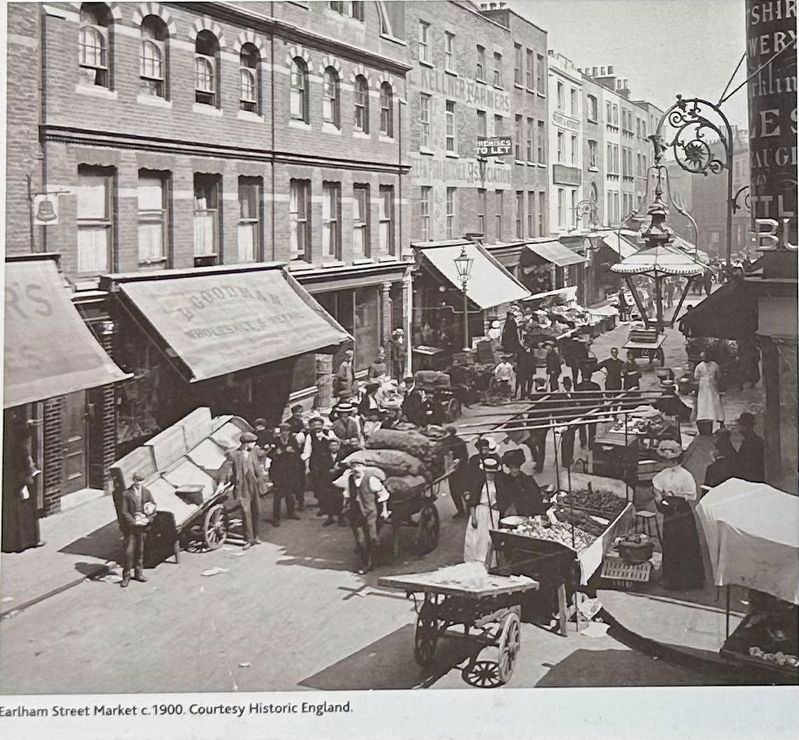
circa 1900
3. Marker photo: Earlham Street Market
The Woodyard Brewery
By the nineteenth century Seven Dials had taken on a predominantly commercial and industrial character. The brewing industry became established here in 1740. The Woodyard Brewery eventually filled the whole area between Long Acre and Short's Gardens with large, handsome brick buildings linked by high-level cast iron bridges, built between 1796 and the 1880s. It had three wells of its own, bored 522 feet deep into the chalk. By the late nineteenth century, the Brewery employed 450 people and produced 500,000 barrels of beer a year. Nos. 29-43 Earlham Street were rebuilt in 1880-86 as stables for 121 horses arranged on two levels around a stone-paved inner yard. Something of this can still be seen in the Thomas Neal's development completed in 1992. Next door, what was the Brewery's vat room and hop warehouse is now occupied by the Donmar Theatre. The Brewery moved out in 1905 and its premises were largely converted to warehouses serving Covent Garden Market.
Erected by Seven Dials Trust.
Topics and series. This historical marker is listed in these topic lists: Arts, Letters, Music • Entertainment • Industry & Commerce • Roads & Vehicles. In addition, it is included in the Seven Dials Trust series list. A significant historical year for this entry is 1692.
Location. 51° 30.825′ N, 0° 7.661′ W. Marker is in Camden, England, in Greater London. It is on Earlham Street west of Seven Dials, on the right when traveling west. Touch for map. Marker is at or near this postal address: 17 Earlham Street, Camden, England WC2H, United Kingdom. Touch for directions.

Regionally, this marker is in London and in the Greater South East. Globally, it is on the Atlantic Ocean, in the North Atlantic Region, in Europe, in Atlantic Europe, on one of the British Isles, in the Western World, and in the Anglosphere. Historically, it finds itself in what was once the Roman Empire.
Other nearby markers. At least 8 other markers are within walking distance of this marker: Seven Dials (within shouting distance of this marker); Mercer Street (within shouting distance of this marker); Roger Keith ‘Syd’ Barrett (1946-2006) (within shouting distance of this marker); Short’s Gardens (within shouting distance of this marker); John and Charles Wesley (within shouting distance of this marker); The Kip (about 90 meters away, measured in a direct line); Charles Boon (about 90 meters away); The Ivy (about 90 meters away). Touch for a list and map of all markers in Camden.
More about this marker. This is one of five Street History Plaques issued by the Seven Dials Trust.
Credits. This page was last revised on March 20, 2026. It was originally submitted on March 20, 2026, by Andrew Ruppenstein of Lamorinda, California. This page has been viewed 14 times since then. Photos: 1, 2, 3. submitted on March 20, 2026, by Andrew Ruppenstein of Lamorinda, California.
