Ararat in Patrick County, Virginia — The American South (Mid-Atlantic)
Confederate and Union Calvary
Photographed by C. Ryan Dodson, October 4, 2025
1. Confederate and Union Calvary Marker
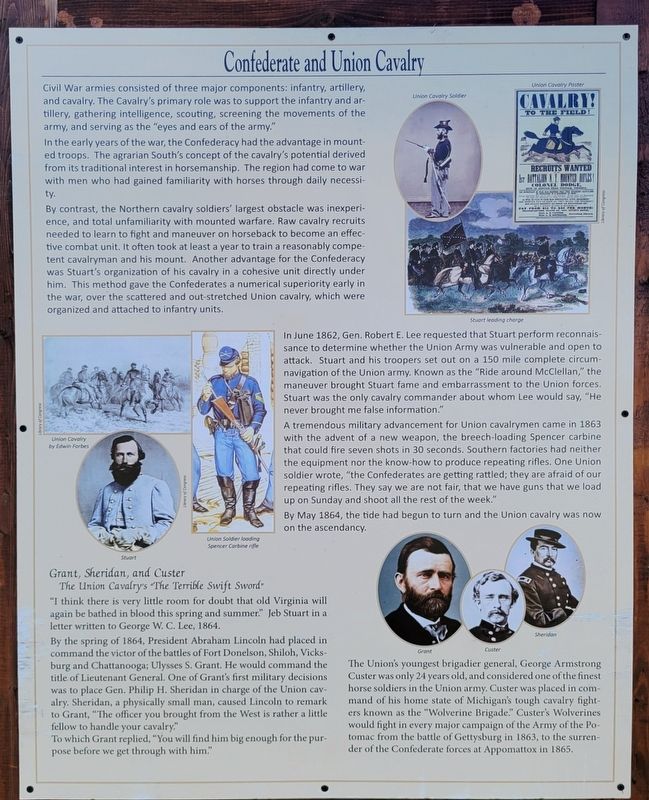
Civil War armies consisted of three major components: infantry, artillery, and cavalry. The Cavalry's primary role was to support the infantry and artillery, gathering intelligence, scouting, screening the movements of the army, and serving as the "eyes and ears of the army."
In the early years of the war, the Confederacy had the advantage in mounted troops. The agrarian South's concept of the cavalry's potential derived from its traditional interest in horsemanship. The region had come to war with men who had gained familiarity with horses through daily necessity.
By contrast, the Northern cavalry soldiers' largest obstacle was inexperience, and total unfamiliarity with mounted warfare. Raw cavalry recruits needed to learn to fight and maneuver on horseback to become an effective combat unit. It often took at least a year to train a reasonably competent cavalryman and his mount. Another advantage for the Confederacy was Stuart's organization of his cavalry in a cohesive unit directly under him. This method gave the Confederates a numerical superiority early in the war, over the scattered and out-stretched Union
this page online
In June 1862, Gen. Robert E. Lee requested that Stuart perform reconnaissance to determine whether the Union Army was vulnerable and open to attack. Stuart and his troopers set out on a 150 mile complete circumnavigation of the Union army. Known as the "Ride around McClellan," the maneuver brought Stuart fame and embarrassment to the Union forces. Stuart was the only cavalry commander about whom Lee would say, "He never brought me false information."
A tremendous military advancement for Union cavalrymen came in 1863 with the advent of a new weapon, the breech-loading Spencer carbine that could fire seven shots in 30 seconds. Southern factories had neither the equipment nor the know-how to produce repeating rifles. One Union soldier wrote, "the Confederates are getting rattled; they are afraid of our repeating rifles. They say we are not fair, that we have guns that we load up on Sunday and shoot all the rest of the week."
By May 1864, the tide had begun to turn and the Union cavalry was now on the ascendancy.
Grant, Sheridan, and Custer
The Union Cavalry's
Photographed by C. Ryan Dodson, October 4, 2025
2. Confederate and Union Calvary Marker
"I think there is very litle room for doubt that old Virginia will again be bathed in blood this spring and summer." Jeb Stuart in a letter written to George W. C. Lee, 1864.
By the spring of 1864, President Abraham Lincoln had placed in command the victor of the battles of Fort Donelson, Shiloh, Vicksburg and Chattanooga; Ulysses S. Grant. He would command the title of Lieutenant General. One of Grant's first military decisions was to place Gen. Philip H. Sheridan in charge of the Union cavalry. Sheridan, a physically small man, caused Lincoln to remark to Grant, "The officer you brought from the west is rather a little fellow to handle your cavalry."
To which Grant replied, "You will find him big enough for the purpose before we get through with him."
The Union's youngest brigadier general, George Armstrong Custer was only 24 years old, and considered one of the finest horse soldiers in the Union army. Custer was placed in command of his home state of Michigan's tough cavalry fighters known as the "Wolverine Brigade." Custer's Wolverines would fight in every major campaign of the Army of the Potomac
Photographed by C. Ryan Dodson, October 4, 2025
3. Confederate and Union Calvary Marker
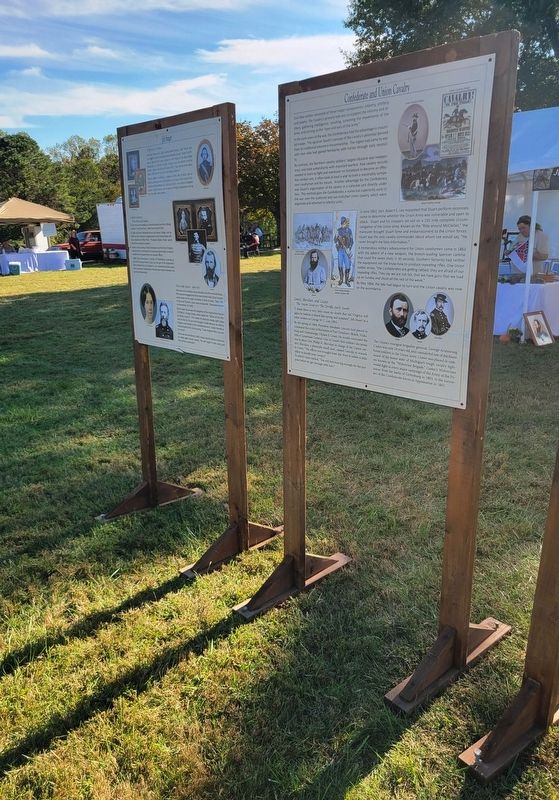
This Marker is 1 of a series of 10 interpretive panels.
Erected by Jeb Stuart Birthplace Preservation Trust. (Marker Number 2.)
Topics. This historical marker is listed in this topic list: War, US Civil. A significant historical year for this entry is 1862.
Location. 36° 33.82′ N, 80° 33.2′ W. Marker is in Ararat, Virginia, in Patrick County. It can be reached from Ararat Highway (Virginia Route 773) 0.3 miles west of State Line Road, on the right when traveling west. The Marker is located on the grounds of the Jeb Stuart Birthplace (Laurel Hill). . Touch for map. Marker is at or near this postal address: 1091 Ararat Hwy, Ararat VA 24053, United States of America. Touch for directions.

Regionally, this marker is in Southern Virginia and in the Blue Ridge Highlands. It is also in the American South, specifically in the Upper South, in Appalachia, and specifically in Southern Appalachia. Globally, it is in North America, the Western Hemisphere, the Western World, and the Anglosphere. Historically, it finds itself in what was once the territory of the Mississippian Culture, one of the original Thirteen Colonies, one of the Confederate States of America, and the Antebellum South.
Other nearby markers. At least 8 other markers are within walking distance of this marker: Jeb Stuart (here, next to this marker); May 1864, Union Overload Campaign (here, next to this marker); The Death of Jeb Stuart (here, next to this marker); The Wounding of Jeb Stuart (here, next to this marker); Beaver Dam Station (here, next to this marker); The Legacy of Jeb Stuart (here, next to this marker); The Death of Col. Henry Clay Pate (here, next to this marker); Mountain Road (here, next to this marker). Touch for a list and map of all markers in Ararat.
More about this marker. This Marker is 1 of a series of 10 interpretive panels.
Also see . . . Laurel Hill - Birthplace of General J.E.B. Stuart, CSA. J.E.B. Stuart Birthplace Preservation Trust Inc. (Submitted on March 27, 2026.)
Credits. This page was last revised on March 27, 2026. It was originally submitted on March 21, 2026, by C. Ryan Dodson of Danville, Virginia. This page has been viewed 23 times since then. Photos: 1, 2, 3. submitted on March 21, 2026, by C. Ryan Dodson of Danville, Virginia. • Bernard Fisher was the editor who published this page.
