Dambach in Fürth, Bavaria, Germany — Central Europe
Ruth Weiss and Jakob Wasserman
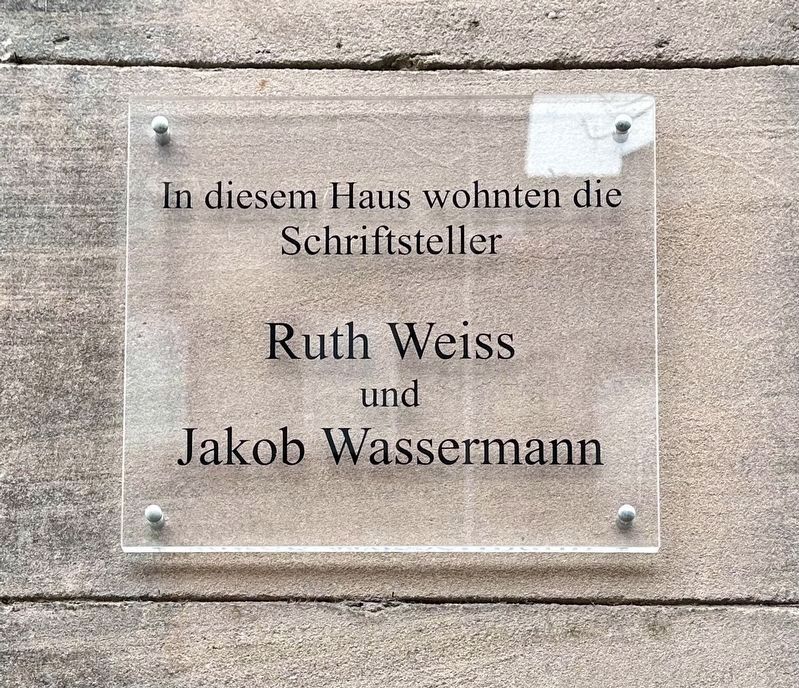
Photographed by Andrew Ruppenstein, February 6, 2026
1. Ruth Weiss and Jakob Wassermann Marker

Topics. This historical marker is listed in these topic lists: Arts, Letters, Music • Women.
Location. 49° 28.549′ N, 10° 59.081′ E. Marker is in Fürth, Bayern (Bavaria). It is in Dambach. It is on Theaterstraße south of Blumenstrasse, on the left when traveling south. Touch for map. Marker is at or near this postal address: Theaterstraße 17, Fürth BY 90762, Germany. Touch for directions.

Regionally, it is in Europe, the European Union, Atlantic Europe, Central Europe, the Schengen Area, Western Europe, and the Western World. Historically, it finds itself in what was once the Holy Roman Empire.
Other nearby markers. At least 8 other markers are within walking distance of this marker: Jakob Wassermann (within shouting distance of this marker); Dr. Henry Kissinger (within shouting distance of this marker); Ehemalige Sparkasse / Former Savings Bank (about 240 meters away, measured in a direct line); Dr. Jakob Schönberg
this page online
Also see . . .
1. Ruth Weiss (writer) (Wikipedia). Overview:
Ruth Weiss (née Löwenthal; 26 July 1924 – 5 September 2025) was a German-born South African journalist and writer who focused on anti-racism in all its forms. She grew up as a Jew in Germany, emigrating to South Africa in 1936 where she became a self-taught journalist alongside her future husband. She was a well-known anti-apartheid journalist and activist, exiled by South Africa and Rhodesia for her writings. She worked in London for The Guardian, in Germany for Deutsche Welle, and in Zimbabwe, writing in both English and German. She finally lived in Denmark. Her historical fiction books for young adults and her memoirs reflect her battles against racism in Germany and Africa.(Submitted on March 22, 2026.)
2. Jakob Wassermann (Britannica).
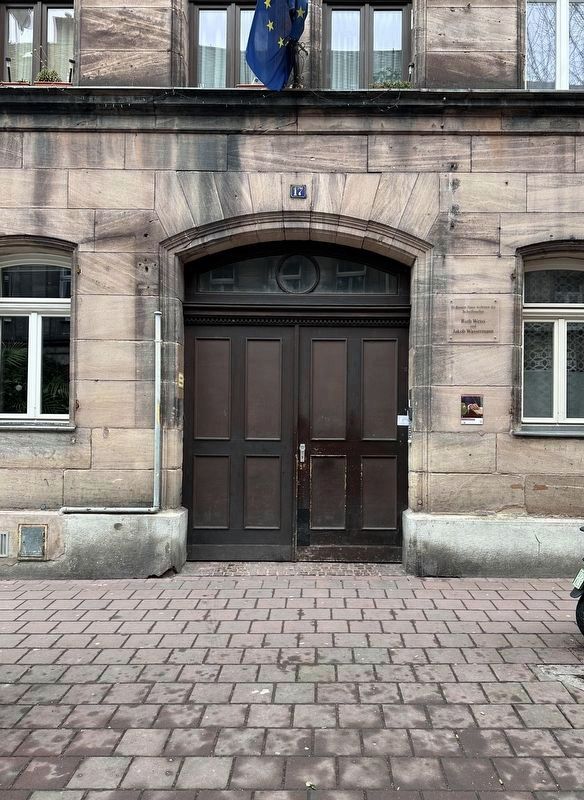
Photographed by Andrew Ruppenstein, February 6, 2026
2. Ruth Weiss and Jakob Wassermann Marker - wide view
Perhaps Wassermann’s most enduring work is Der Fall Maurizius (1928; The Maurizius Case), which treats the theme of justice with the carefully plotted suspense of a detective story. It introduced the character Etzel Andergast, whose questioning of the judgment of his cold-hearted jurist father and whose own detective work eventually prove the innocence of a man his father had condemned. Etzel became a symbol of post-World War I German youth by rejecting the authority of the past and finding his own truth by trial-and-error, doggedly following elusive clues. This work was extended into a trilogy including Etzel Andergast (1931) and Joseph Kerkhovens dritte Existenz (1934; Kerkhoven’s Third Existence). Mein Weg als Deutscher und Jude (1921; My Life as German and Jew) is Wassermann’s autobiography.(Submitted on March 22, 2026.)
Additional keywords. Jewish
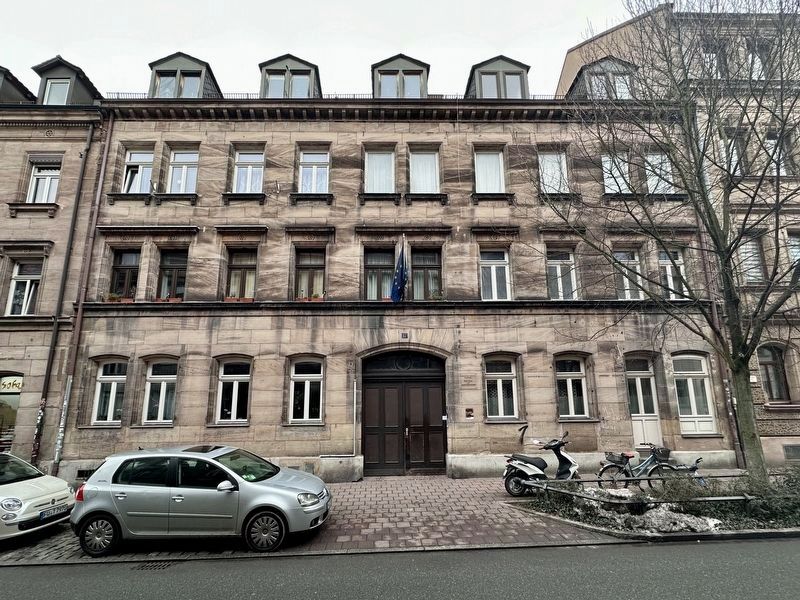
Photographed by Andrew Ruppenstein, February 6, 2026
3. Ruth Weiss and Jakob Wassermann Marker - wider view
Credits. This page was last revised on March 22, 2026. It was originally submitted on March 21, 2026, by Andrew Ruppenstein of Lamorinda, California. This page has been viewed 27 times since then. Photos: 1, 2, 3. submitted on March 21, 2026, by Andrew Ruppenstein of Lamorinda, California.
