Pullman in Chicago in Cook County, Illinois — The American Midwest (Great Lakes)
People-Powered
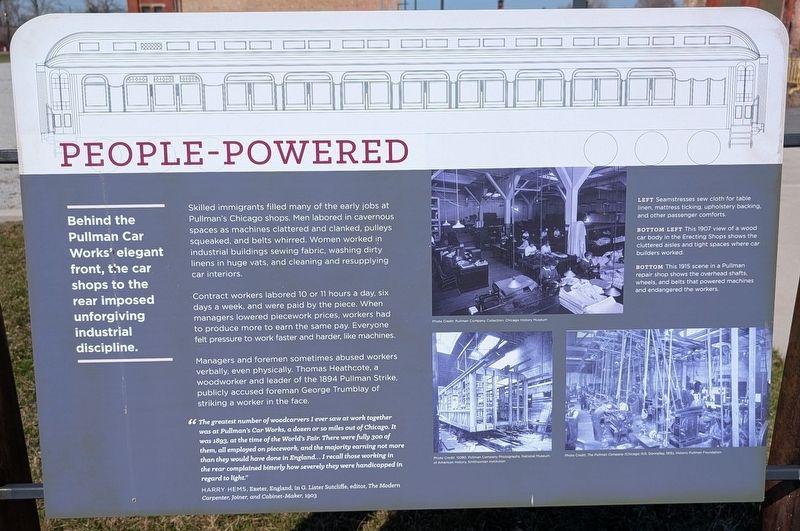
Photographed by Daniel Barriball, March 21, 2026
1. People-Powered Marker
Behind the Pullman Car Works' elegant front, the car shops to the rear imposed unforgiving industrial discipline.
Skilled immigrants filled many of the early jobs at Pullman's Chicago shops. Men labored in cavernous spaces as machines clattered and clanked, pulleys squeaked, and belts whirred. Women worked in industrial buildings sewing fabric, washing dirty linens in huge vats, and cleaning and resupplying car interiors.
Contract workers labored 10 or 11 hours a day, six days a week, and were paid by the piece. When managers lowered piecework prices, workers had to produce more to earn the same pay. Everyone felt pressure to work faster and harder, like machines.
Managers and foremen sometimes abused workers verbally, even physically. Thomas Heathcote, a woodworker and leader of the 1894 Pullman Strike, publicly accused foreman George Trumblay of striking a worker in the face.
"The greatest number of woodcarvers I ever saw at work together was at Pullman's Car Works, a dozen or so miles out of Chicago. It was 1893, at the time of the World's Fair. There were fully 300 of them, all employed on piecework, and the majority earning not more than they would have done in England... I recall those working in the rear complained bitterly how severely they were handicapped in regard to light."
HarryHems, Exeter, England, in G. Lister Sutcliffe, editor, The Modern Carpenter, Joiner, and Cabinet-Maker, 1903
Click or scan to see
this page online
[Captions:]
Left Seamstresses sew cloth for table linen, mattress ticking, upholstery backing, and other passenger comforts.
Bottom left This 1907 view of a wood car body in the Erecting Shops shows the cluttered aisles and tight spaces where car builders worked.
Bottom This 1915 scene in a Pullman repair shop shows the overhead shafts, wheels, and belts that powered machines and endangered the workers.
Topics. This historical marker is listed in these topic lists: Industry & Commerce • Labor Unions • Railroads & Streetcars. A significant historical year for this entry is 1894.
Location. 41° 41.598′ N, 87° 36.511′ W. Marker is in Chicago, Illinois, in Cook County. It is in Pullman. It can be reached from South Cottage Grove Avenue. This marker is located in Pullman National Historical Park. Touch for map. Marker is at or near this postal address: 11057 S Cottage Grove Ave, Chicago IL 60628, United States of America. Touch for directions.

Regionally, this marker is in the American Midwest. Globally, it is in North

Photographed by Daniel Barriball, March 21, 2026
2. People-Powered Marker in context
The south side of the Administration Building is in the background.
Other nearby markers. At least 8 other markers are within walking distance of this marker: From Wood to Steel (here, next to this marker); The Workers' Main Gate (within shouting distance of this marker); Machines and Workers (within shouting distance of this marker); Welcome to Pullman (within shouting distance of this marker); The Town of Pullman (within shouting distance of this marker); Image and Reality (within shouting distance of this marker); Lake Vista (within shouting distance of this marker); a different marker also named Welcome to Pullman (within shouting distance of this marker). Touch for a list and map of all markers in Chicago.
Credits. This page was last revised on March 22, 2026. It was originally submitted on March 22, 2026, by Daniel Barriball of Chesterton, Indiana. This page has been viewed 20 times since then. Photos: 1, 2. submitted on March 22, 2026, by Daniel Barriball of Chesterton, Indiana. • Devry Becker Jones was the editor who published this page.
