Pullman in Chicago in Cook County, Illinois — The American Midwest (Great Lakes)
The Town of Pullman
Photographed by Daniel Barriball, March 21, 2026
1. The Town of Pullman Marker
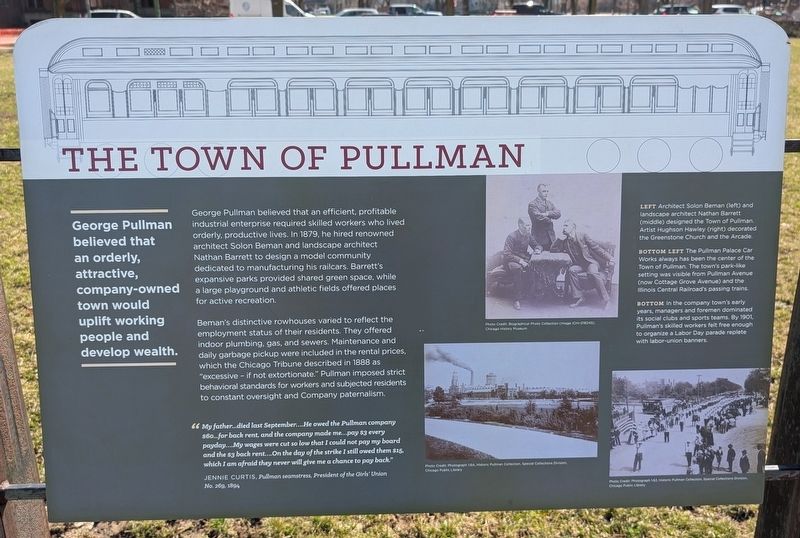
George Pullman believed that an orderly, attractive, company-owned town would uplift working people and develop wealth.
George Pullman believed that an efficient, profitable industrial enterprise required skilled workers who lived orderly, productive lives. In 1879, he hired renowned architect Solon Beman and landscape architect Nathan Barrett to design a model community dedicated to manufacturing his railcars. Barrett's expansive parks provided shared green space, while a large playground and athletic fields offered places for active recreation.
Beman's distinctive rowhouses varied to reflect the employment status of their residents. They offered indoor plumbing, gas, and sewers. Maintenance and daily garbage pickup were included in the rental prices, which the Chicago Tribune described in 1888 as "excessive—if not extortionate." Pullman imposed strict behavioral standards for workers and subjected residents to constant oversight and Company paternalism.
"My father died last September....He owed the Pullman company $60...for back rent, and the company made me...pay $3 every payday. My wages were cut so low that I could not pay my board and the $3 back rent....On the day of the strike I still owed them $15, which I am afraid they never will give me a chance to pay back."
JennieCurtis, Pullman seamstress, President of the Girls' Union No. 269, 1894
Click or scan to see
this page online
[Captions:]
Left Architect Solon Beman (left) and landscape architect Nathan Barrett (middle) designed the Town of Pullman. Artist Hughson Hawley (right) decorated the Greenstone Church and the Arcade.
Bottom Left The Pullman Palace Car Works always has been the center of the Town of Pullman. The town's park-like setting was visible from Pullman Avenue (now Cottage Grove Avenue) and the Illinois Central Railroad's passing trains.
Bottom In the company town's early years, managers and foremen dominated its social clubs and sports teams. By 1901, Pullman's skilled workers felt free enough to organize a Labor Day parade replate with labor-union banners.
Topics. This historical marker is listed in these topic lists: Architecture • Industry & Commerce • Labor Unions • Settlements & Settlers. A significant historical year for this entry is 1879.
Location. 41° 41.596′ N, 87° 36.543′ W. Marker is in Chicago, Illinois, in Cook County. It is in Pullman. It can be reached from South Cottage Grove Avenue. This marker is located within Pullman National

Photographed by Daniel Barriball, March 21, 2026
2. The Town of Pullman Marker in context

Regionally, this marker is in the American Midwest. Globally, it is in North America, on the Great Lakes, in the Western Hemisphere, in the Western World, and in the Anglosphere. Historically, it finds itself in what was once the Viceroyalty of New France, the territory of the Mississippian Culture, and the Northwest Territory.
Other nearby markers. At least 8 other markers are within walking distance of this marker: Image and Reality (a few steps from this marker); Lake Vista (a few steps from this marker); Welcome to Pullman (within shouting distance of this marker); People-Powered (within shouting distance of this marker); From Wood to Steel (within shouting distance of this marker); Machines and Workers (within shouting distance of this marker); The Workers' Main Gate (within shouting distance of this marker); a different marker also named Welcome to Pullman (within shouting distance of this marker). Touch for a list and map of all markers in Chicago.
Credits. This page was last revised on March 22, 2026. It was originally submitted on March 22, 2026, by Daniel Barriball of Chesterton, Indiana. This page has been viewed 19 times since then. Photos: 1, 2. submitted on March 22, 2026, by Daniel Barriball of Chesterton, Indiana. • Devry Becker Jones was the editor who published this page.
