
Where do Big Horn Sheep Live?
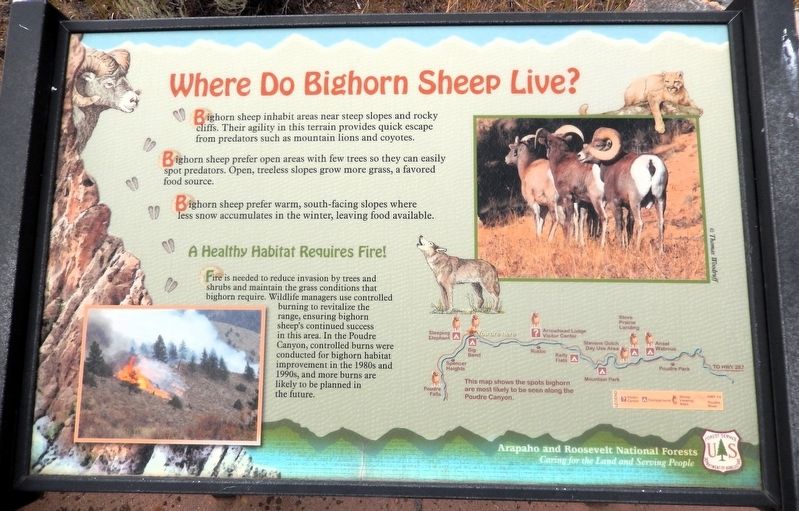
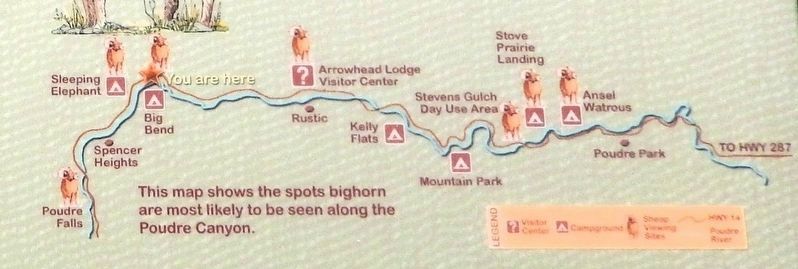
Bighorn sheep inhabit areas near steep slopes and rocky cliffs. Their agility in this terrain provides quick escape from predators such as mountain lions and coyotes.
Bighorn sheep prefer open areas with few trees so they can easily spot predators. Open, treeless slopes grow more grass, a favored food source.
Bighorn sheep prefer warm, south-facing slopes where less snow accumulates in the winter, leaving food available.
A Healthy Habitat Requires Fire!
Fire is needed to reduce invasion by trees and shrubs and maintain the grass conditions that bighorn require. Wildlife managers use controlled burning to revitalize the range, ensuring bighorn sheep's continued success in this area. In the Poudre Canyon, controlled burns were conducted for bighorn habitat improvement in the 1980s and 1990s, and more burns are likely to be planned in the future.
Arapaho and Roosevelt National Forests
Caring for the Land and Serving People
Erected by United States Forest Service, Department of Agriculture.
Topics. This historical marker is listed in these topic lists: Animals • Horticulture & Forestry • Parks & Recreational Areas.
Location. 40° 42.565′ N,
this page online

Regionally, this marker is in Colorado’s Front Range. It is also in the American Mountain West. Globally, it is in North America, the Rocky Mountains, the Western Hemisphere, the Western World, and the Anglosphere. Historically, it finds itself in what was once the Louisiana Purchase.
Other nearby markers. At least 8 other markers are within 16 miles of this marker, measured as the crow flies: An Ancient Connection (here, next to this marker); Bighorn's Brighter Future (here, next to this marker); Arrowhead Visitor Center (approx. 4.7 miles away); Get to Know your Native Greenback Cutthroat Trout (approx. 14.4 miles away); Poudre Pioneer Tourism (approx.
Related markers. Click here for a list of markers that are related to this marker.
Also see . . .
1. U.S. Forest Service-Arapaho & Roosevelt Natl Forests Pawnee Natl Grassland (facebook).
Excerpt: The Pingree Hill portion of the Elkhorn-Pingree Hill Prescribed Burn located in the Poudre Canyon northeast of Rustic has been completed. Burning started on this project in 2014, with burning also taking place from 2016 to 2019. With 1,350 acres burned this spring, all 1,913 acres are now complete, promoting landscape restoration, reducing the risk of wildfire and improving wildlife habitat for bighorn sheep. Over the life of this project many partners assisted the Arapaho and Roosevelt National Forests and Pawnee National Grassland staff.(Submitted on March 23, 2026, by Cosmos Mariner of Cape Canaveral, Florida.)
2. Bighorn Sheep (Wikipedia).
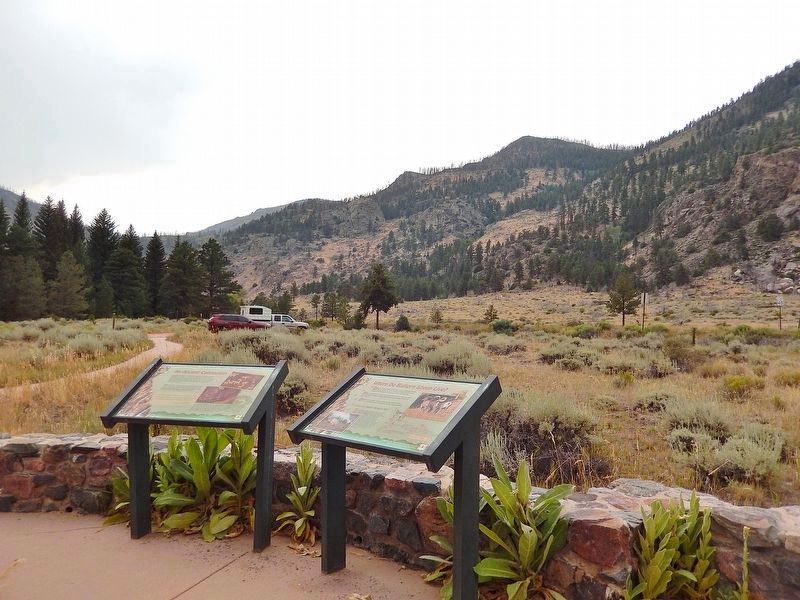
Excerpt: Sheep originally crossed to North(Submitted on March 23, 2026, by Cosmos Mariner of Cape Canaveral, Florida.)America over the Bering Land Bridge from Siberia; the population in North America peaked in the millions, and the bighorn sheep entered into the mythology of Native Americans. By 1900, the population had crashed to several thousand due to diseases introduced through European livestock and overhunting.Photographed by Cosmos Mariner, July 31, 20253. Where do Big Horn Sheep Live? MarkerLooking southeast from the Big Bend Sheep Viewing Area. The parking lot is in the background. This marker is the rightmost of two related interpretive panels at this location.The Rocky Mountain and Sierra Nevada bighorn sheep occupy the cooler mountainous regions of Canada and the United States. Bighorn sheep inhabit alpine meadows, grassy mountain slopes, and foothill country near rugged, rocky cliffs and bluffs. Since bighorn sheep cannot move through deep snow, they prefer drier slopes, where the annual snowfall is less than about 60 inches per year. Bighorn sheep of all ages are threatened by black bears, grizzly bears, wolves, and especially mountain lions, which are perhaps best equipped with the agility to prey on them in uneven, rocky habitats. Fire suppression techniques may limit visibility through shrublands and therefore increase cover and predation rates by mountain lions. Bighorn sheep are considered good indicators of land health because the species is sensitive to many human-induced environmental
problems. In addition to their aesthetic value, bighorn sheep are considered desirable game animals by hunters.
Credits. This page was last revised on March 24, 2026. It was originally submitted on March 22, 2026, by Cosmos Mariner of Cape Canaveral, Florida. This page has been viewed 22 times since then. Photos: 1, 2, 3. submitted on March 23, 2026, by Cosmos Mariner of Cape Canaveral, Florida.
