
Bighorn's Brighter Future
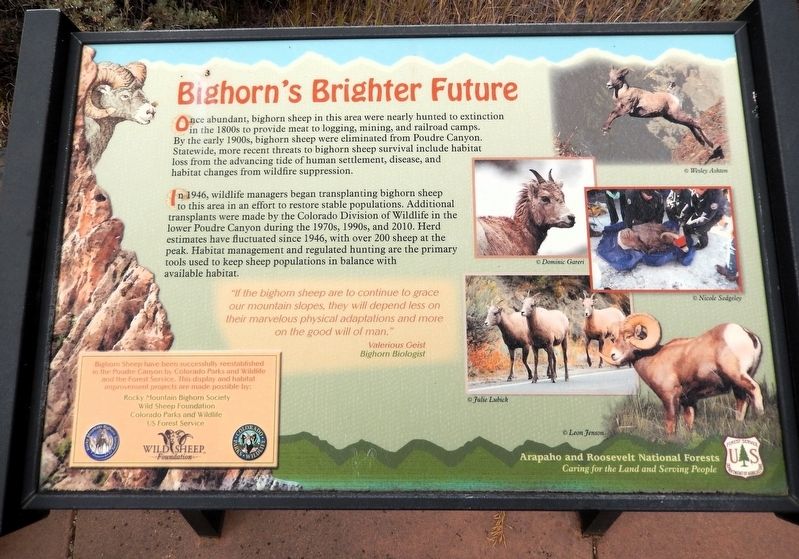
Once abundant, bighorn sheep in this area were nearly hunted to extinction in the 1800s to provide meat to logging, mining, and railroad camps. By the early 1900s, bighorn sheep were eliminated from Poudre Canyon. Statewide, more recent threats to bighorn sheep survival include habitat loss from the advancing tide of human settlement, disease, and habitat changes from wildfire suppression.
In 1946, wildlife managers began transplanting bighorn sheep to this area in an effort to restore stable populations. Additional transplants were made by the Colorado Division of Wildlife in the lower Poudre Canyon during the 1970s, 1990s, and 2010. Herd estimates have fluctuated since 1946, with over 200 sheep at the peak. Habitat management and regulated hunting are the primary tools used to keep sheep populations in balance with available habitat.
“If the bighorn sheep are to continue to grace our mountain slopes, they will depend less on their marvelous physical adaptations and more on the good will of man.”
—Valerious Geist
Bighorn Biologist
Bighorn Sheep have been successfully reestablished in the Poudre Canyon by Colorado Parks and Wildlife and the Forest Service. This display and habitat improvement projects are made possible by:
Wild Sheep Foundation
Colorado Parks and Wildlife
US Forest Service
Arapaho and Roosevelt National Forests
Caring for the Land and Serving People
Erected by United
this page online
Topics. This historical marker is listed in these topic lists: Animals • Parks & Recreational Areas. A significant historical year for this entry is 1946.
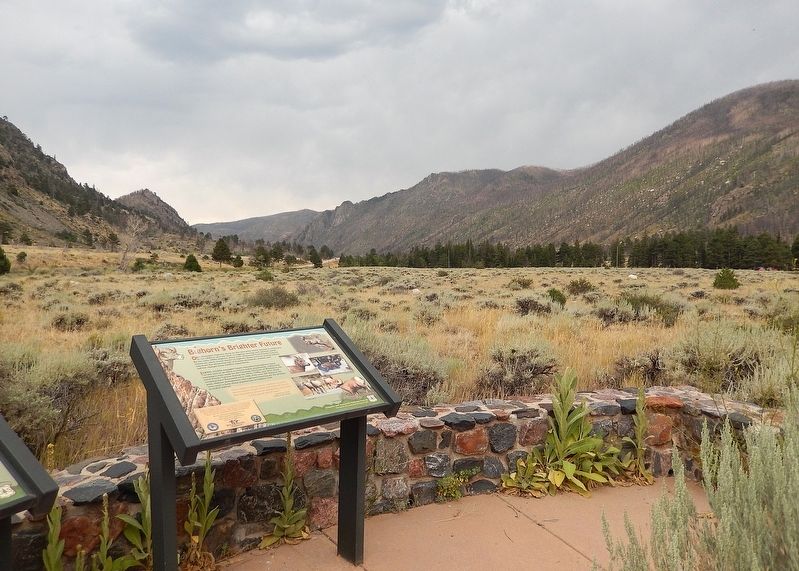
Location. 40° 42.565′ N, 105° 43.539′ W. Marker is in Kinikinik, Colorado, in Larimer County. It can be reached from the intersection of Poudre Canyon Road (State Highway 14 at milepost 83) and Forest Road 297.1, on the right when traveling east. The marker is located at the Big Bend Sheep Viewing Area in Roosevelt National Forest, near Big Bend Campground. Touch for map. Marker is in this post office area: Bellvue CO 80512, United States of America. Touch for directions.

Regionally, this marker is in Colorado’s Front Range. It is also in the American Mountain West. Globally, it is in North America, the Rocky Mountains, the Western Hemisphere, the Western World, and the Anglosphere. Historically, it finds itself in what was once the Louisiana Purchase.
Other nearby markers. At least 8 other markers are within 16 miles of this marker, measured as the crow flies: Where do Big Horn Sheep Live? (here, next to this
Related markers. Click here for a list of markers that are related to this marker.
Also see . . . Restoration of Bighorn Sheep Metapopulations in and near 15 National Parks (USGS).
Excerpt: Prior to the arrival of Europeans, bighorn sheep were seemingly widespread in nearly all steep habitats in the mountains, foothills, river breaks, and prairie badlands of the western United States. However, since catastrophic declines in the late 1800s and early 1900s, most extant populations have existed as small, isolated groups in a highly fragmented distribution. Three different subspecies of bighorn sheep were eliminated from 14 of 18 National Park System (NPS) units in the 6-state Intermountain Region of the western United States.(Submitted on March 24, 2026, by Cosmos Mariner of Cape Canaveral, Florida.)In 1990, when this restoration was initiated, only 4 of 22 discrete park populations or metapopulations were considered large enough (300-500 animals) to be secure for long-term management. Five other populations numbered 100-299 animals and 3 populations numbered 75-99 animals. Restoration prior to 1991-96 was largely completed in one NPS unit but was incomplete in the remaining units. Most bighorn sheep are not federally listed as endangered or threatened species. The bighorn sheep is a rare or uncommon species that is declining in many parts of its range but is abundant in other areas and still relatively easy to study and manage. The Secretary of the Department of the Interior, Bruce Babbitt, directed the Biological Resources Division of the U.S. Geological Survey in 1993 to research and recover species that were declining to avoid expensive and controversial federal listing. Because the capture and moving of the species are still relatively uncomplicated and because some source stocks are available, aggressive restoration in 15 National Park System units in the former Rocky Mountain Region was recommended in 1990.
Credits. This page was last revised on March 24, 2026. It was originally submitted on March 22, 2026, by Cosmos Mariner of Cape Canaveral, Florida. This page has been viewed 15 times since then. Photos: 1, 2. submitted on March 24, 2026, by Cosmos Mariner of Cape Canaveral, Florida.
