11 in Minato City, Tokyo, Japan — 日本国 (East Asia)
Ako Gishi Graves
⎯⎯⎯
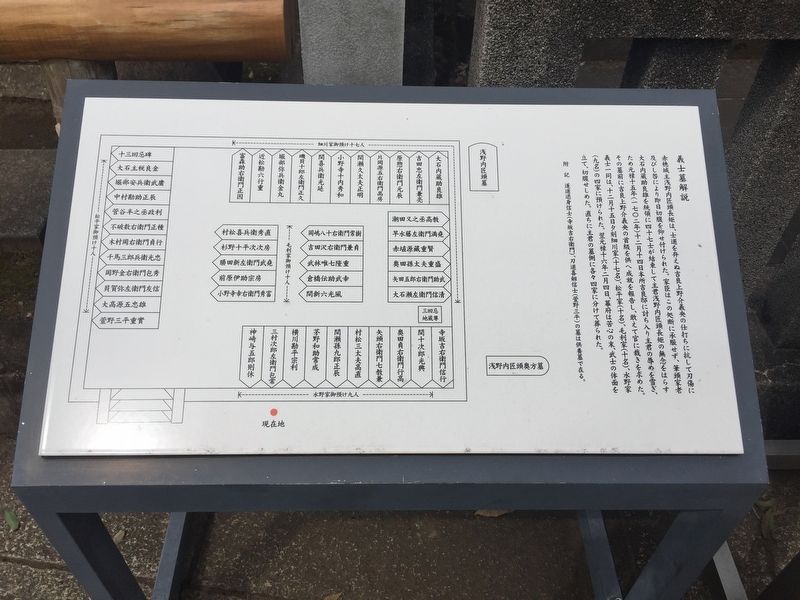
義士墓解説
August 12, 2018
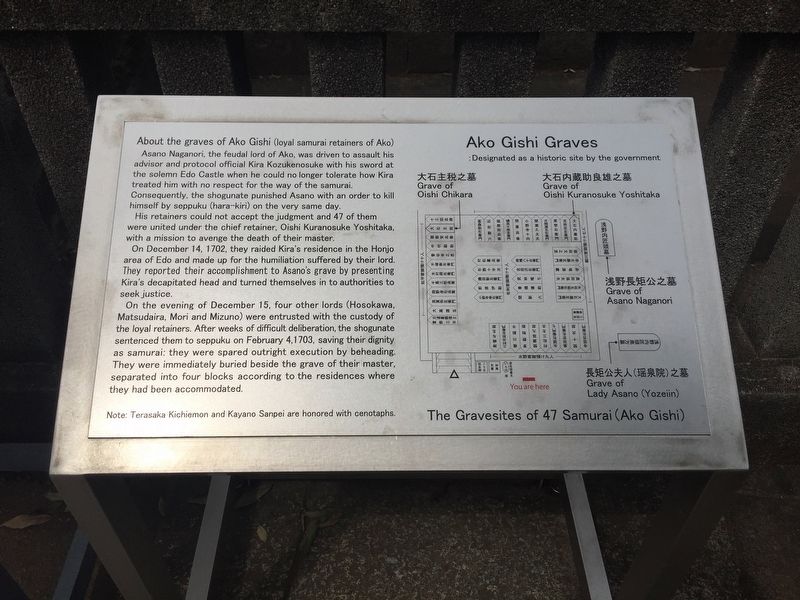
1. Ako Gishi Graves Marker

Ako Gishi Graves
Designated as a historic site by the government
About the graves of Ako Gishi (loyal samural retainers of Ako)
Asano Naganori, the feudal lord of Ako, was driven to assault his advisor and protocol official Kira Kozukenosuke with his sword at the solemn Edo Castle when he could no longer tolerate how Kira treated him with no respect for the way of the samurai.
Consequently, the shogunate punished Asano with an order to kill himself by seppuku (hara-kiri) on the very same day.
His retainers could not accept the judgment and 47 of them were united under the chief retainer, Oishi Kuranosuke Yoshitaka, with a mission to avenge the death of their master.
On December 14, 1702, they raided Kira's residence in the Honjo area of Edo and made up for the humiliation suffered by their lord. They reported their accomplishment to Asano's grave by presenting Kira's decapitated head and turned themselves in to authorities to seek justice.
On the evening of December 15, four other lords (Hosokawa, Matsudaira, Mori and Mizuno) were entrusted with the custody of the loyal
this page online
Note: Terasaka Kichiemon and Kayano Sanpei are honored with cenotaphs.
義士墓解説
赤穂城主浅野内匠頭長矩は、士道を弁えぬ吉良上野介義央の仕打ちに抗して刃傷に及びし咎により即日切腹を仰せ付けられた。家臣はこの処断に承服せず、筆頭家老大石内蔵助良雄を統領に四十七士が結束して主君浅野内匠頭長矩の無念をはらすため元禄十五年(一七〇二年)十二月十四日本所吉良邸に討ち入り主君の辱めを雪ぎ、その墓前に吉良上野介義央の首級を供へ成就を報告し、敢えて官に裁きを求めた。義士一同は、十二月十五日夕刻細川家(十七名)、松平家(十名)、毛利家(十名)、水野家(九名)の四家に預けられた。翌元禄十六年二月四日、幕府は苦心の末、武士の体面を立て、切腹せしめた。直ちに主君の墓側に各々四家に分けて葬られた。
附 記 遂道退身信士(寺坂吉右衛門)、刃道喜剱信士(萱野三平)の墓は供養墓で在る。
Topics.
August 12, 2018
2. Ako Gishi Graves Marker
Location. 35° 38.226′ N, 139° 44.204′ E. Marker is in Minato City, Tokyo. It is in 11. It can be reached from 11-1, Takanawa 2-chōme. Touch for map. Marker is at or near this postal address: 11-1 Takanawa 2-chōme, Minato City, Tokyo 108-0074, Japan. Touch for directions.

Regionally, it is in Asia, specifically in East Asia, in the Pacific Ocean, in North Pacific, on the Ring of Fire, on the Pacific Rim, and in the Western World.
Other nearby markers. At least 2 other markers are within 10 kilometers of this marker, measured as the crow flies: グラント将軍植樹碑 (approx. 9.3 kilometers away); Takatora Tōdō's Tea Ceremony House (approx. 9.5 kilometers away).
Also see . . . Forty-seven rōnin (Wikipedia). Overview:
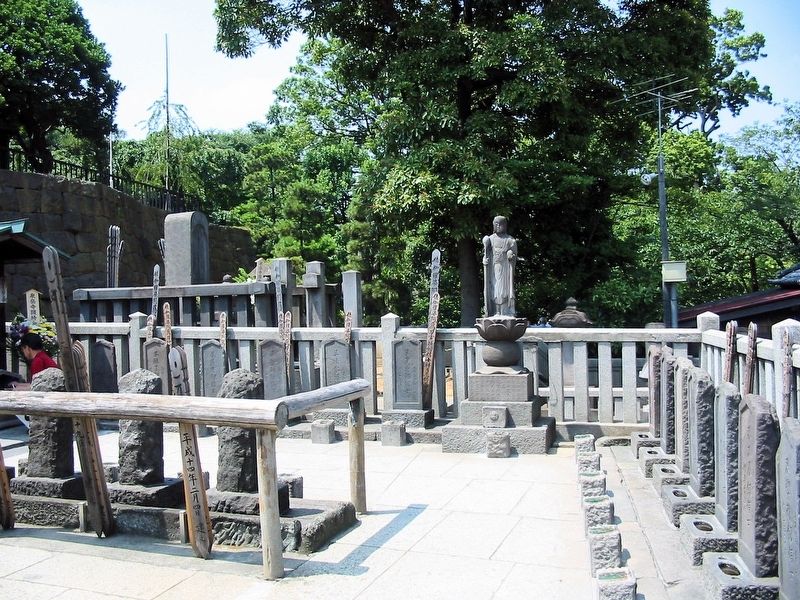
The revenge of the forty-seven rōnin (四十七士, Shijūshichishi), also known as the Akō incident (赤穂事件, Akō jiken) or Akō vendetta,(Submitted on March 24, 2026.)was a historical event in Japan in which a band of rōnin (lordless samurai) avenged the death of their former master on 31 January 1703. The incident has since become legendary. It is among the three major vengeance (adauchi 仇討ち) incidents in Japan, along with the Revenge of the Soga Brothers and the Igagoe vendetta.Photographed by Stéfan Le Dû (via Wikimedia Commons under CC 2.5 license), July 14, 20043. Graves of the 47 Ronin at Sengaku-ji temple, Tokyo.
The story tells of a group of samurai after their daimyō (feudal lord) Asano Naganori was compelled to perform seppuku (ritual suicide) for assaulting a powerful court official (kōke) named Kira Yoshinaka, after the court official insulted him. After waiting and planning for two years, the rōnin avenged their master's honor by killing Kira. Anticipating the authorities' intolerance of the vendetta's completion, they were prepared to face execution as a consequence. However, due to considerable public support in their favor, the authorities compromised by ordering the rōnin to commit seppuku as an honorable death for the crime of murder. Each of the 47 rōnin killed himself. This true story was popular in Japanese culture as emblematic of loyalty, sacrifice, persistence, and honor (qualities samurai follow called bushidō) that people should display in their daily lives.…
Credits. This page was last revised on March 24, 2026. It was originally submitted on March 22, 2026. This page has been viewed 39 times since then. Photos: 1, 2. submitted on March 22, 2026. 3. submitted on March 24, 2026. • Andrew Ruppenstein was the editor who published this page.
