Fürth, Bavaria, Germany — Central Europe
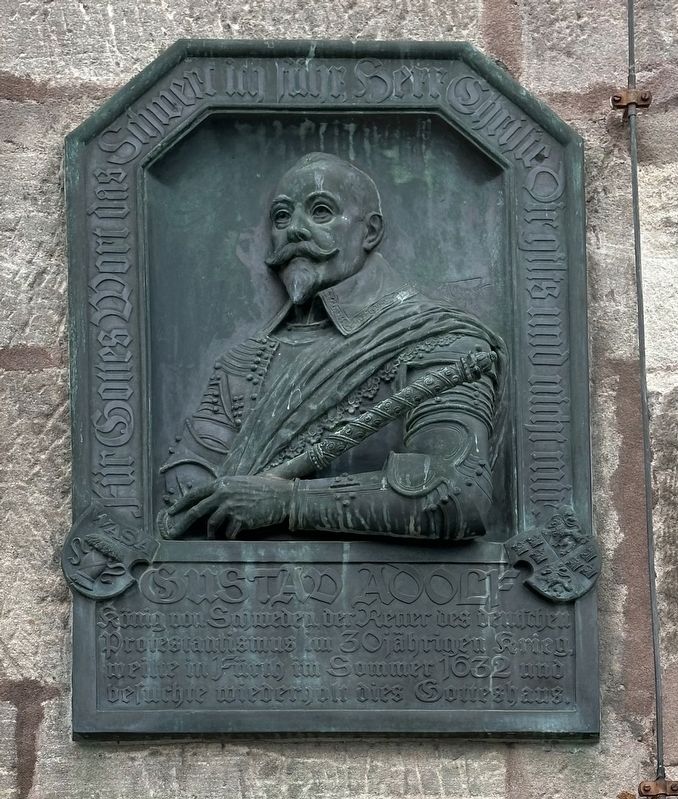
Gustav Adolf
Photographed by Andrew Ruppenstein, February 5, 2026
1. Gustav Adolf Marker

König von Schweden, der Retter des deutschen Protestantismus im 30jährigen Krieg, weilte in Fürth im Sommer 1632 und besuchte wiederholt dies Gotteshaus.
For God's word I bear the sword, Lord Christ, it is for you and not for me.
The King of Sweden, the savior of German Protestantism in the Thirty Years' War, stayed in Fürth in the summer of 1632 and visited this church several times.
Erected 1932.
Topics. This historical marker is listed in these topic lists: Religion & Religious Structures • Wars, Non-US. A significant historical month for this entry is September 1632.
Location. 49° 28.8′ N, 10° 59.31′ E. Marker is in Fürth, Bayern (Bavaria). It is on Kirchenplatz, on the right when traveling west. Touch for map. Marker is at or near this postal address: Kirchenplatz 4, Fürth BY 90762, Germany. Touch for directions.

Regionally, it is in Europe, the European Union, Atlantic Europe, Central Europe, the Schengen Area, Western Europe, and the Western World. Historically, it finds itself in what was
this page online
Other nearby markers. At least 8 other markers are within walking distance of this marker: St. Michael (a few steps from this marker); Die Kapelle zum heiligen Grab / The Chapel of the Holy Sepulchre (within shouting distance of this marker); Schlacht an der Alte Veste / Battle of the Alte Veste: Kirchenplatz (within shouting distance of this marker); Ehemaliges Amtshaus / Former Administrative Building (about 90 meters away, measured in a direct line); Malka and Marcus Mandel (about 90 meters away); Ehemaliger Eingang zum israelitischen Schulhof / Former Entrance to the Jewish Community Center (about 150 meters away); Ehemalige Gabrielschul / Former Gabriel Schul (about 150 meters away); Marktplatz / Market Square (about 180 meters away). Touch for a list and map of all markers in Fürth.
Also see . . .
1. Gustavus Adolphus (Wikipedia). Overview:
Gustavus Adolphus (9 December [N.S. 19 December] 1594 – 6 November [N.S. 16 November] 1632), also known in English as Gustav II Adolf or Gustav II Adolph, was King of Sweden from 1611 to 1632. He is credited with the rise of Sweden as a great European(Submitted on March 23, 2026.)power (Swedish: Stormaktstiden). During his reign, Sweden became one of the primary military forces in Europe during the Thirty Years' War, helping to determine the political and religious balance of power in Europe. He was formally and posthumously given the name Gustavus Adolphus the Great (Swedish: Gustav Adolf den store; Latin: Gustavus Adolphus Magnus) by the Riksdag of the Estates in 1634.Photographed by Andrew Ruppenstein, February 5, 20262. Gustav Adolf Marker - wide viewThe marker is visible here to the right of the side entrance.
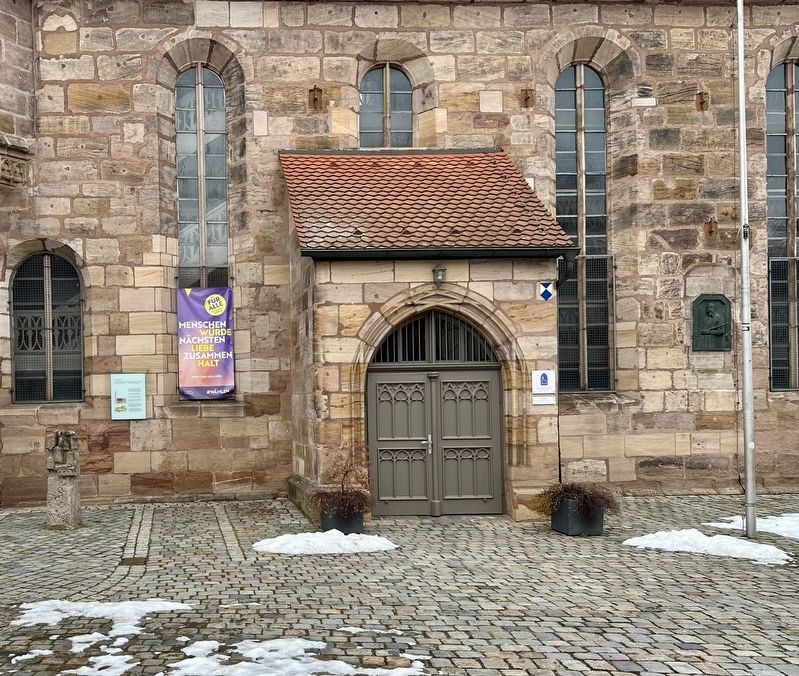
2. Kirche St. Michael (FürthWiki, in German). The plaque very nearly did not survive the Second World War, as the government requisitioned nearly all possible sources of metal for the war effort. This plaque was requisitioned and removed for melting, but survived, as told here (in translation):
…in May 1942, the Reich Minister of the Interior ordered the surrender of almost all municipal monuments. Municipalities were also instructed to ensure that as many bronze monuments as possible, including those in private ownership (i.e., church ownership), were surrendered.… The memorial plaque for Gustav Adolph was removed on July 13, 1942, stored in the municipal depot, and from there collected on March 4,(Submitted on March 23, 2026.)1944, by the company Hetzel & Co., Nuremberg, metal wholesalers, for melting down. The city subsequently received confirmation of receipt…However, the memorial plaque was rediscovered in a depot in 1949 and reinstalled in its original location, as further photographs also document.…Photographed by Andrew Ruppenstein, February 5, 20263. Gustav Adolf Marker - wider viewThe marker is visible here attached to the south side of the St. Michael Church.
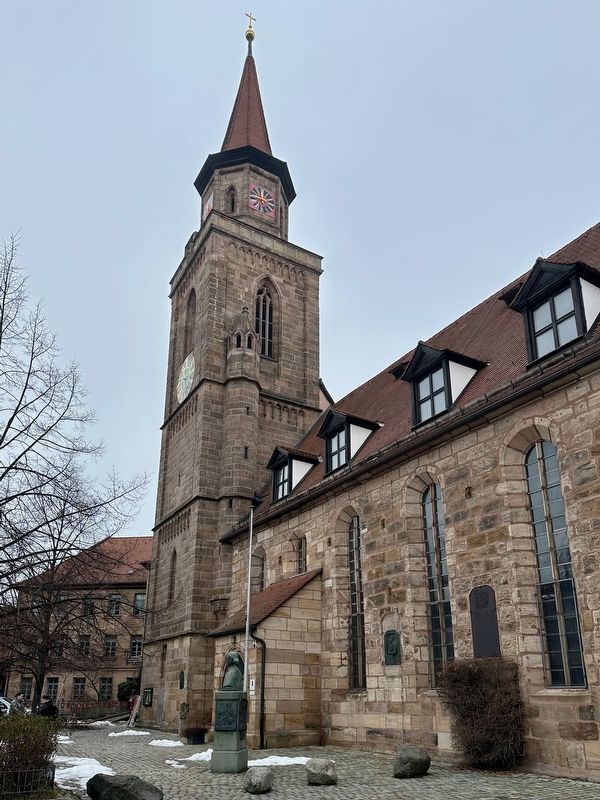
Additional keywords. Gedenktafel
Credits. This page was last revised on March 23, 2026. It was originally submitted on March 23, 2026, by Andrew Ruppenstein of Lamorinda, California. This page has been viewed 10 times since then. Photos: 1, 2, 3. submitted on March 23, 2026, by Andrew Ruppenstein of Lamorinda, California.
