Pioneer Square in Seattle in King County, Washington — The American West (Northwest)
What was Yesler’s Way?
⎯⎯⎯
How did a parking garage spark a preservation movement?
Photographed by Douglass Halvorsen, February 20, 2026
1. What was Yesler's Way? Marker
[Panel one]
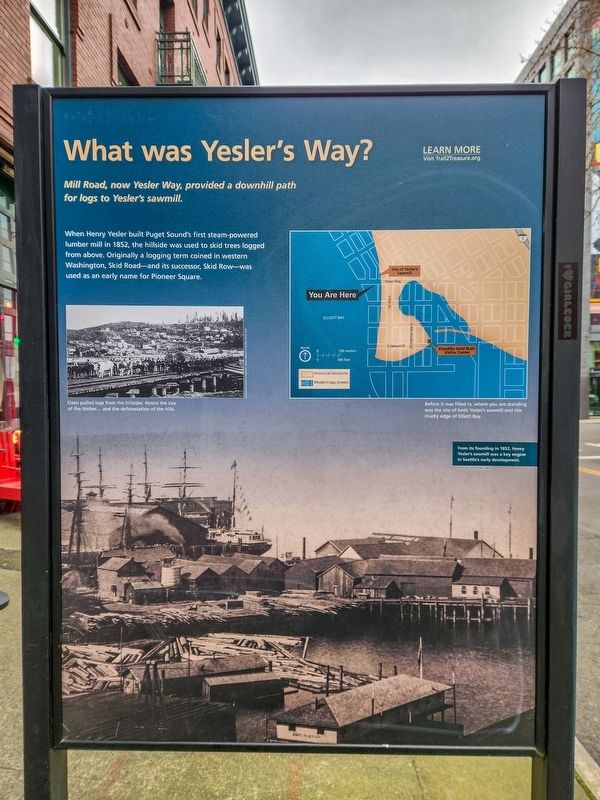
Mill Road, now Yesler’s Way, provided a downhill path for logs to Yesler’s sawmill.
When Henry Yesler built Puget Sound’s first steam-powered lumber mill in 1852, the hillside was used to skid trees logged from above. Originally a logging term coined in western Washington, Skid Road—and its successor, Skid Row—was used as an early name for Pioneer Square.
[Captions:]
Oxen pulled logs from the hillsides. Notice the size of the timber... and the deforestation of the hills.
Before it was filled in, where you are standing was the site of both Yesler’s sawmill and the mucky edge of Elliott Bay.
From its founding in 1852, Henry Yesler’s sawmill was a key engine in Seattle’s early development.
[Panel two]
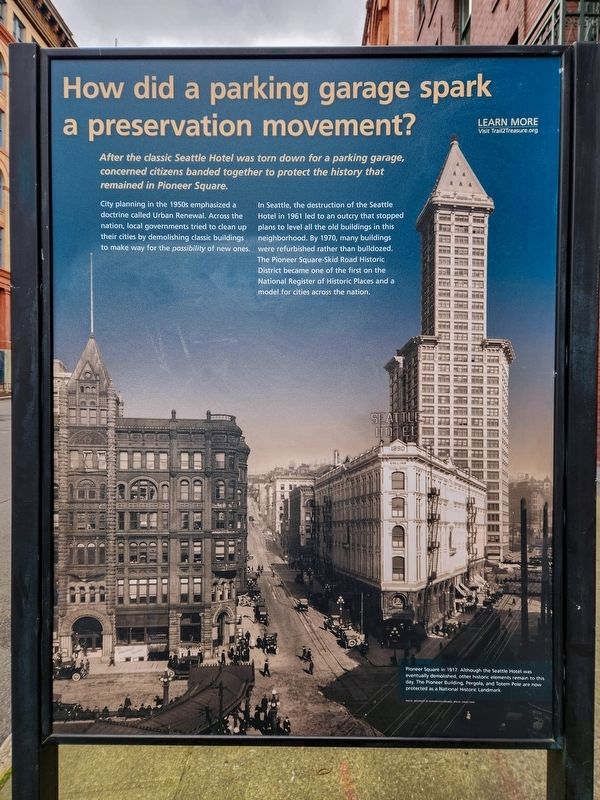
After the classic Seattle Hotel was torn down for a parking garage, concerned citizens banded together to protect the history that remained in Pioneer Square.
City planning in the 1950s emphasized a doctrine called the Urban Renewal. Across the nation, local governments tried to clean up their cities by demolishing classic buildings to make way for the possibility of new ones.
In Seattle,
this page online
[Caption:]
Pioneer Square in 1917. Although the Seattle Hotel was eventually demolished, other historic elements remain to this day. The Pioneer Building, Pergola, and Totem Pole are now protected as a National Historic Landmark.
Erected by Trails2Treasure.org.
Topics. This historical marker is listed in these topic lists: Industry & Commerce • Roads & Vehicles • Settlements & Settlers. A significant historical year for this entry is 1852.
Location. 47° 36.101′ N, 122° 20.113′ W. Marker is in Seattle, Washington, in King County. It is in Pioneer Square. It is on Yesler Way west of Firehouse Alley, on the right when traveling east. Touch for map. Marker is at or near this postal address: 79 Yesler Way, Seattle WA 98104, United States of America. Touch for directions.

Regionally,
Photographed by Douglass Halvorsen, February 20, 2026
2. What was Yesler’s Way? / How did a parking garage spark a preservation movement? Marker
Other nearby markers. At least 8 other markers are within walking distance of this marker: Pioneer Square Hotel (here, next to this marker); Schwabacher’s Store (within shouting distance of this marker); What do you need to rush for gold? (within shouting distance of this marker); Mutual Life Building (within shouting distance of this marker); Maynard Building (within shouting distance of this marker); Who landed here? (about 300 feet away, measured in a direct line); Habitat Beach (about 300 feet away); The Pioneer Square Pergola (about 300 feet away). Touch for a list and map of all markers in Seattle.
Also see . . .
1. Henry Yesler's Mill and Wharf (Seattle).
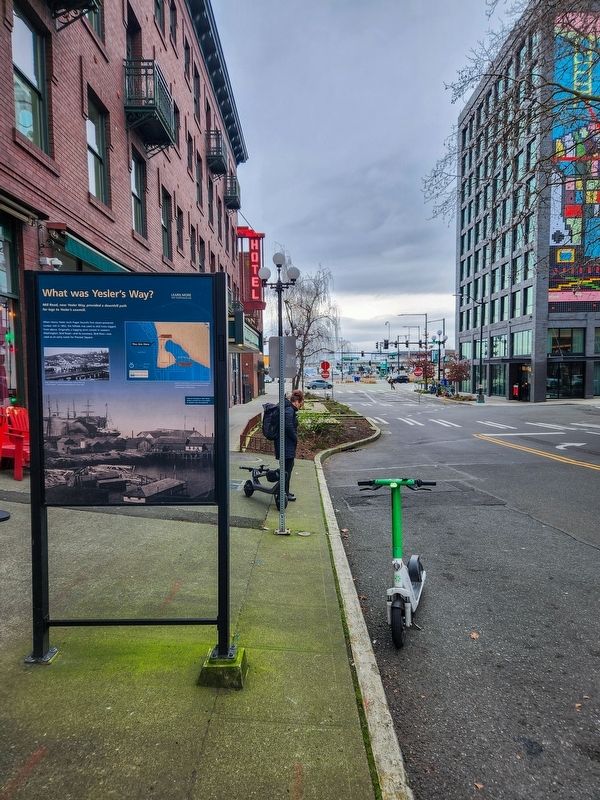
When Henry Yesler (1810?-1892) arrived in Seattle in October 1852, the tiny settlement had very little(Submitted on March 24, 2026, by Douglass Halvorsen of Klamath Falls, Oregon.)going for it other than the aspirations of the few men and women who had arrived about nine months earlier. Yesler would bring them all that was needed to forge a viable community – jobs, income, commerce, and hope. Starting in March 1853, his steam sawmill on the waterfront employed almost all of Seattle's white settlers and a number of Native Americans. Many settlers also sold Yesler logs, taken from their claims or from land yet unclaimed. The following year, Yesler brought commerce to Seattle by building its first wharf. He enlarged and strengthened it over the years, and the wharf remained a major hub of the town's maritime commerce into the late 1880s. It was destroyed in the Great Fire of 1889, but Yesler quickly rebuilt a large section of it. He sold the wharf in 1890, and in 1901 it was demolished and replaced by two large wharves with warehouses, later designated Piers 50 and 51, which for decades were used by the Alaska Steamship Company. Those endured until 1982, when they were removed for the convenience of the state's ferry system.Photographed by Douglass Halvorsen, February 20, 20263. What was Yesler’s Way? MarkerView of marker looking west towards Elliott Bay.
2. Now & Then — Seattle Hotel vs. the Sinking Ship.
Photographed by Douglass Halvorsen, February 20, 2026
4. How did a parking garage spark a preservation movement? Marker
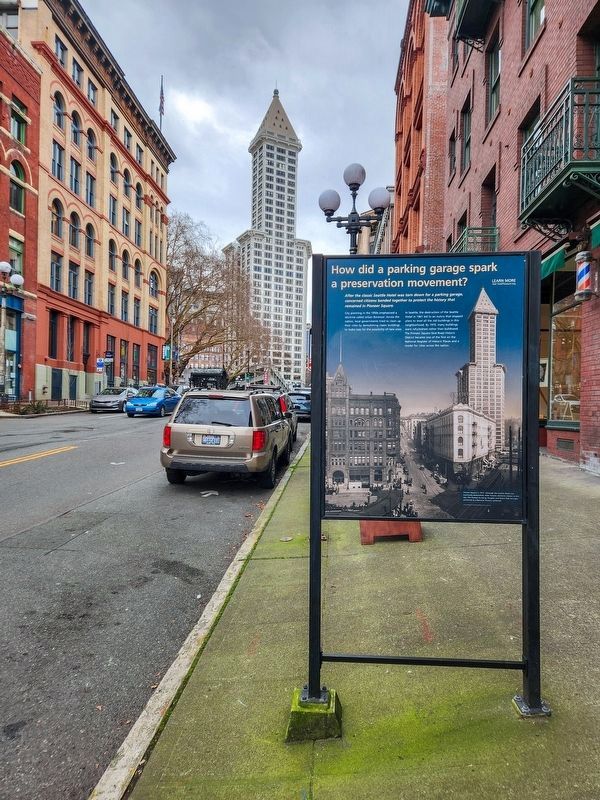
View of marker looking east. The parking garage, known as the 'Sinking Ship,' and former site of the historic Seattle Hotel, is small but visible in front of the prominent Smith Tower in the background.
Where the garage sinks, the Seattle Hotel once stood. This rare photograph of the hotel's mezzanine parlor suggests human life, the comforts of every human who ever enjoyed it.(Submitted on March 24, 2026, by Douglass Halvorsen of Klamath Falls, Oregon.)
The razing of the landmark hotel began on the forenoon of April 3, 1961. This downright sleazy work was pulled off in the name of "urban renewal."
Ultimately and happily, if too late for the Seattle Hotel, the city responded with -- not renewal -- but renovation. But it took a lot of pushing through to create a Pioneer Square Historic District.
Credits. This page was last revised on March 26, 2026. It was originally submitted on March 24, 2026, by Douglass Halvorsen of Klamath Falls, Oregon. This page has been viewed 30 times since then. Photos: 1, 2, 3, 4. submitted on March 24, 2026, by Douglass Halvorsen of Klamath Falls, Oregon. • James Hulse was the editor who published this page.
