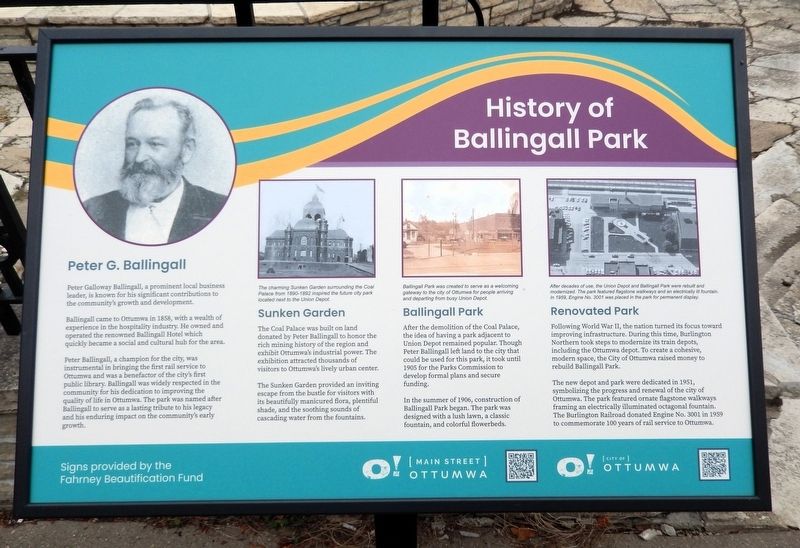
History of Ballingall Park
Peter G. Ballingall
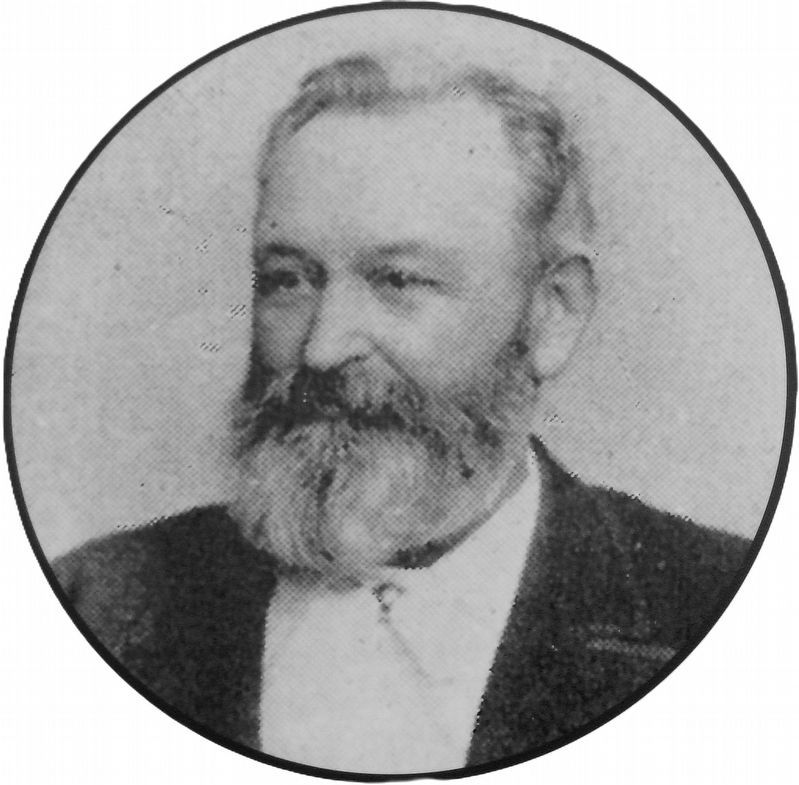
Peter Galloway Ballingall, a prominent local business leader. is known for his significant contributions to the community's growth and development.
Ballingall came to Ottumwa in 1858, with a wealth of experience in the hospitality industry. He owned and operated the renowned Ballingall Hotel which quickly became a social and cultural hub for the area.
Peter Ballingall, a champion for the city, was instrumental in bringing the first rail service to Ottumwa and was a benefactor of the city's first public library. Ballingall was widely respected in the community for his dedication to improving the quality of life in Ottumwa. The park was named after Ballingall to serve as a lasting tribute to his legacy and his enduring impact on the community's early growth.
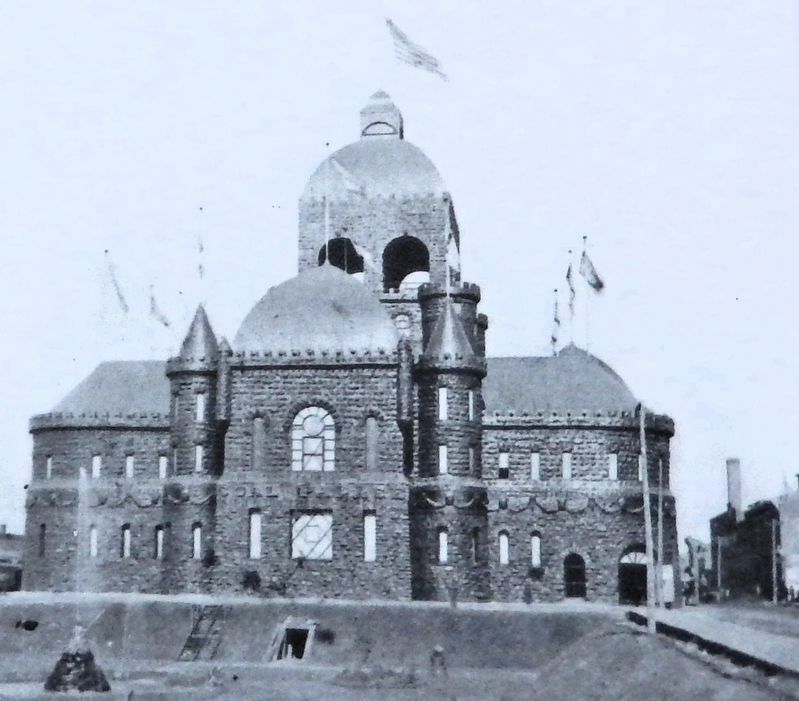
Sunken Garden
The Coal Palace was built on land donated by Peter Ballingall to honor the rich mining history of the region and exhibit Ottumwa's industrial power. The exhibition attracted thousands of visitors to Ottumwa's lively urban center.
The Sunken Garden provided an inviting escape from the bustle for visitors with its beautifully manicured flora,
this page online
Ballingall Park
After the demolition of the Coal Palace, the idea of having a park adjacent to Union Depot remained popular. Though Peter Ballingall left land to the city that could be used for this park, it took until 1905 for the Parks Commission to develop formal plans and secure funding.
In the summer of 1906, construction of Ballingall Park began. The park was designed with a lush lawn, a classic fountain, and colorful flowerbeds.
Renovated Park
Following World War II, the nation turned its focus toward improving infrastructure. During this time, Burlington Northern took steps to modernize its train depots, including the Ottumwa depot. To create a cohesive, modern space, the City of Ottumwa raised money to rebuild Ballingall Park.
The new depot and park were dedicated in 1951, symbolizing the progress and renewal of the city of Ottumwa. The park featured ornate flagstone walkways framing an electrically illuminated octagonal fountain. The Burlington Railroad donated Engine No. 3001 in 1959 to commemorate 100 years of rail service to Ottumwa.
[captions]
•
Erected by Main Street Ottumwa and City of Ottumwa.
Topics and series. This historical marker is listed in these topic lists: Charity & Public Work • Industry & Commerce • Parks & Recreational Areas • Railroads & Streetcars. In addition, it is included in the National Register of Historic Places (NRHP) series list. A significant historical year for this entry is 1906.
Location. 41° 1.123′ N, 92° 24.885′ W. Marker is in Ottumwa, Iowa, in Wapello County. It can be reached from South Washington Street (River Street) just south of West Main Street, on the right when traveling south. The marker is overlooking the fountain in Ballingall Park, directly in front of the historic Burlington Depot. Touch for map. Marker is at or near this postal address: 210 West Main Street, Ottumwa IA 52501, United States of America. Touch for directions.

Regionally, this marker is in Southern Iowa. It is also in the American Midwest and in the Corn Belt. Globally, it is in North America, the Western
Other nearby markers. At least 8 other markers are within walking distance of this marker: Depots of Ottumwa (a few steps from this marker); Burlington Depot (a few steps from this marker); Chicago, Burlington & Quincy Locomotive 3001 (a few steps from this marker); National Humane Alliance Fountain (within shouting distance of this marker); J. B. Sax Co. (approx. 0.2 miles away); Edna Ferber (approx. 0.2 miles away); Philip B. Hofmann (approx. 0.2 miles away); Ottumwa Public Library (approx. 0.2 miles away). Touch for a list and map of all markers in Ottumwa.
Regarding History of Ballingall Park. Contributing property, Historic Railroad District, National Register of Historic Places № 11000723.
From the National Register Nomination prepared by Molly Myers Naumann, 2/2011:
In March 1949 the city proposed to acquire land directly in front of the depot, right next to Ballingall Park, to expand the park. This would be in conjunction with the constructionof the new CB&Q depot and was seen as a "carrot" to encourage the railroad to follow through with their plans for the new building.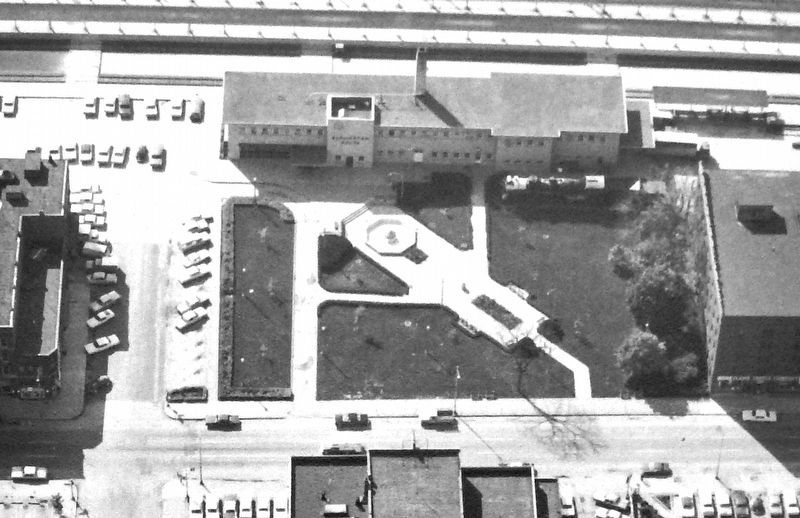 4. Marker detail: Renovated Park (aerial view)After decades of use, the Union Depot and Ballingall Park were rebuilt and modernized. The park featured flagstone walkways and an electrically lit fountain. In 1959, Engine No. 3001 was placed in the park for permanent display.
Ballingall Park had been a green space in downtown Ottumwa since the construction of the Coal Palace in 1890. The Coal Palace and park were built on land owned by Ottumwa philanthropist Peter Ballingall. The Coal Palace was an exhibition hall constructed to showcase the importance of coal mining in southern Iowa. Originally planned for only a single season, the palace was refurbished and opened for a second season in 1891. One of the major attractions of the Coal Palace was a working underground coal mine located in the basement of the building. A mule named Maude pulled a coal car out of the mine and into the sunlight of a sunken garden on the southeast end of the building.
When Peter Ballingall died at sea on the world tour in 1891, his will specified that two of the lots where the sunken garden was located should go to the Ottumwa Library Association with the plan that a public library be constructed on it. If the land was not used for library purposes, the two lots were to be added to those given the
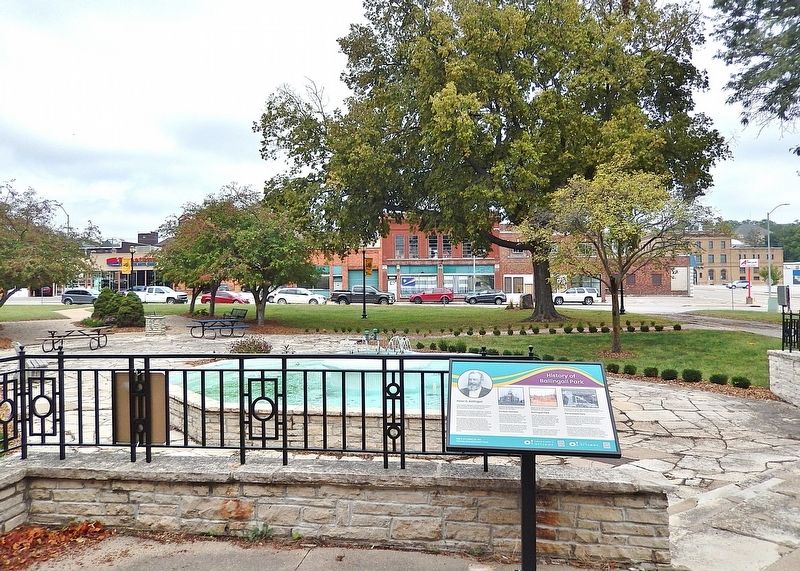
city of Ottumwa to be used as a park. The decision was made that the Ballingall land was too close to the railroad and would be too noisy for a library. Once another location was selected for the library, the land was turned over to the city and became part of Ballingall Park. At some point shortly after this, the sunken garden was filled in, and trees planted.Photographed by Cosmos Mariner, September 21, 20255. History of Ballingall Park MarkerLooking northeast across the fountain and Ballingall Park. West Main Street crosses in the background.Robinson and Parnham [park architects] used the same building material, limestone, for the park features that was used on the depot. A limestone wall with iron railing on top flanks broad limestone steps that lead down from the concrete depot sidewalk to the flagstone walkway connecting the various areas of the park. The major design feature of the park is a twenty-five-foot octagonal limestone fountain.
Related markers. Click here for a list of markers that are related to this marker.
Also see . . .
1. Peter G. Ballingall (Iowa Legislature).
Excerpt: A native of Scotland; born in Glasgow March 3, 1830; when about seven years old, he came to America and began his active, self-reliant career as an errand boy, in the Province of Ontario; before he was(Submitted on March 28, 2026, by Cosmos Mariner of Cape Canaveral, Florida.)11 years old he walked from Coburg, seventy-three miles below Toronto, to Chicago, by a roundabout way, a distance of seven or eight hundred miles; he served in various capacities in different hotels in Chicago… He came to Ottumwa in 1858; for nine years was proprietor of a stage-line from this place to Bloomfield, and in 1866 built the Ballingall House, which was the leading hotel in Ottumwa; he was also proprietor of the Depot Hotel; he was active in all public measures. For many years he was a member of the State Democratic Central committee and contributed liberally of his time and money to advance the interests of his party. He was a member of the general assembly of Iowa in 1883. Previous to this, however, he was elected alderman of the city of Ottumwa and re-elected several terms after. He originated many of the improvements of the city and urged them with a zeal that insured success.Photographed by Cosmos Mariner, September 21, 20256. Ballingall Park Marker(mounted on stone wall beside the historical marker)
Rebuilt 1951
Board of Park Commissioners
Clyde B. Hightshoe, Chairman
George M. Foster
Thomas H. Given
General Contractor Walter A. Zlogar, Inc.

2. Peter Galloway Ballingall (1830-1891) (Find A Grave).
(Ottumwa Cemetery, Ottumwa, Wapello County, Iowa, USA) Excerpt: In connection with his(Submitted on March 28, 2026, by Cosmos Mariner of Cape Canaveral, Florida.)hotel operations he had at one time seventeen Government licenses for separate and distinct branches of business, all of which he made successful. For nine years he was proprietor of the stage line from Ottumwa to Bloomfield, and during that long period, through sunshine and storm, never missed a trip. In 1870 the railroad crowded his stage line off the track and he withdrew his stock. Since that date he ran a line to Sigourney, a distance of thirty-two miles, until the completion of the Chicago, Milwaukee & St. Paul Railroad, when that, too, was withdrawn.Photographed by Cosmos Mariner, September 21, 20257. Ballingall Park & FountainLooking east from Ottumwa Station (former Burlington Depot). South Washington Street and West Main Street cross in the background.Ballingall died at sea, off the coast of China, while on a tour around the world, on March 07, 1891. His body was taken to Hong Kong and buried temporarily, but the remains were finally brought to Ottumwa and buried in the cemetery. The funeral service was largely attended by citizens of the county and by sympathizing friends from other parts of the state. Colonel Ballingall served four years in the State Senate from Wapello County and several terms as a member of the city council of Ottumwa.

Credits. This page was last revised on March 28, 2026. It was originally submitted on March 25, 2026, by Cosmos Mariner of Cape Canaveral, Florida. This page has been viewed 26 times since then. Photos: 1, 2, 3, 4, 5, 6, 7. submitted on March 28, 2026, by Cosmos Mariner of Cape Canaveral, Florida.
