Bethesda in Montgomery County, Maryland — The American Northeast (Mid-Atlantic)
Native American Veterans
Remarkable Montgomery: Untold Stories
⎯⎯⎯
Veteranos indígenas americanos
Montgomery Extraordinario: Historias Sin Contrar
Photographed by Devry Becker Jones (CC0), March 26, 2026
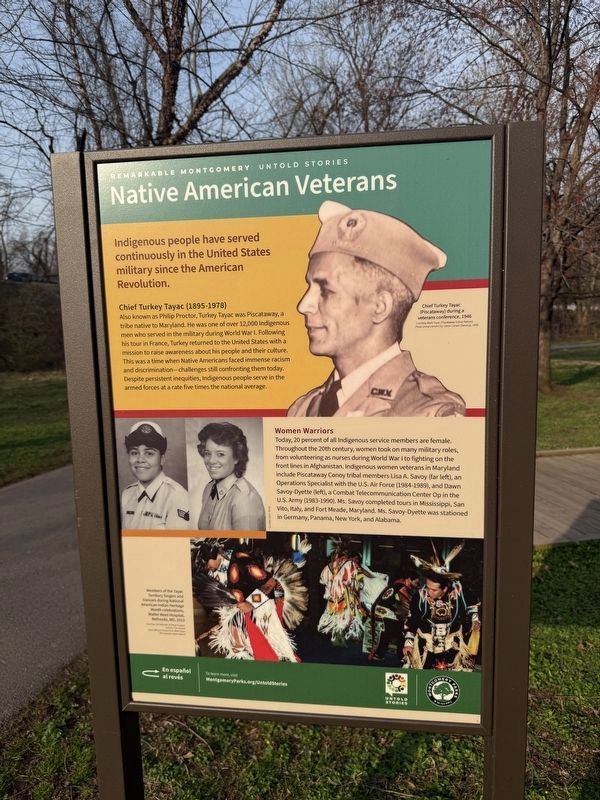
1. Native American Veterans side of the marker

Indigenous peoples have served in the United States military since the American Revolution.
Chief Turkey Tayac (1895-1978)
Also known as Philip Proctor, Turkey Tayac was Piscataway, a tribe native to Maryland. He was one of over 12,000 Indigenous men who served in the military during World War I. Following his tour in France, Turkey returned to the United States with a mission to raise awareness about his people and their culture. This was a time when Native Americans faced immense racism and discrimination—challenges still confronting them today. Despite persistent inequities, Indigenous people serve in the armed forces at a rate five times the national average.
Women Warriors
Today, 20 percent of all Indigenous service members are female. Throughout the 20th century, women took on many military roles, from volunteering as Nurses during World War I to fighting on the front lines in Afghanistan. Indigenous women veterans in Maryland include Piscataway Conoy tribal members Lisa A. Savoy (far left), and Operations Specialist with the U.S. Air Force (1984-1989), and Dawn Savy-Dyette (left), a Combat Telecommunication
this page online
[Captions:]
Chief Turkey Tayac (Piscataway) during a veterans conference, 1946
Members of the Tayac Territory Singers and Dancers during National Indian Heritage Month celebrations, Walter Reed Hospital, Bethesda, MD, 2013
Jefe Turkey Tayac (1895-1978)
También conocido como Philip Proctor, Turkey Tayac era piscataway, una tribu originaria de Maryland. Fue uno de los más de 12.000 hombres indígenas que sirvieron en el Ejército durante la Primera Guerra Mundial. Tras su paso por Francia, Turkey regresó a Estados Unidos con la misión de crear conciencia sobre su pueblo y su cultura. En aquella época, los indígenas americanos sufrían inmensos niveles de racismo y discriminación, cuestiones a las que aún se enfrentan hoy en día. A pesar de las constantes desigualdades, las personas indígenas sirven en las Fuerzas Armadas

Photographed by Devry Becker Jones (CC0), March 26, 2026
2. Veteranos indígenas americanos side of the marker
Guerreras
En la actualidad, el 20 % de las personas indígenas que sirven en las Feurzas Armadas son mujeres. A lo largo del siglo XX, las mujeres asumieron muchas funciones militares, desde el voluntariado como enfermeras durante la Primera Guerra Mundial hasta el combate en primera línea en Afganistán. Entre lasveteranas indígenas de Maryland figuran miembros de la Tribu Piscataway Conoy: Lisa A. Savoy (izquierda), especialista de operaciones de las Fuerzas Aéreas de Estados Unidos (1984-1989) y Dawn Savoy Dyette (derecha), operaria del Centro Telecomunicaciones de Combate del Ejército de Estados Unidos (1983-1990). Savoy cumplió misiones en Mississippi, San Vito, Italia y Fort Meade, Maryland. Savoy-Dyette estuvo radicada en Alemania, Panamá, Nueva York y Alabama.
[Notas al calce:]
Jefe Turkey Tayac (Piscataway) durante una conferencia de veteranos, 1946
Cantantes y bailarines miembros del Territorio Tayac durante las celebraciones del Mes Nacional de la Herencia Indígena Americana, Walter Reed Hospital, Bethesda, Maryland, 2013
Erected by Montgomery
Photographed by Devry Becker Jones (CC0), March 26, 2026
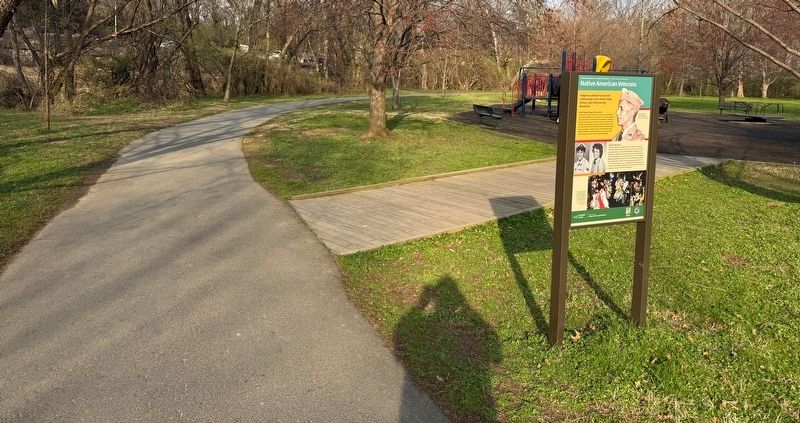
3. Native American Veterans / Veteranos indígenas americanos Marker
Topics and series. This historical marker is listed in these topic lists: Indigenous Peoples and Communities • Military. In addition, it is included in the Maryland, Montgomery Parks series list. A significant historical year for this entry is 1946.
Location. 39° 0.729′ N, 77° 5.505′ W. Marker is in Bethesda, Maryland, in Montgomery County. It is on Rock Creek Trail west of Cedar Lane, on the right when traveling west. Touch for map. Marker is at or near this postal address: 9598 Rock Creek Trail, Bethesda MD 20814, United States of America. Touch for directions.

Regionally, this marker is in the Washington Metropolitan Area. It is also in the American Mid-Atlantic. Globally, it is in North America, the Western Hemisphere, the Western World, and the Anglosphere. Historically, it finds itself in what was once one of the original Thirteen Colonies and also the Antebellum South.
Other nearby markers. At least 8 other markers are within walking distance of this marker: Cemetery of the Bethesda Presbyterian Church (approx. 0.3 miles away); The Church that Named a Community (approx. 0.4 miles away); Bethesda Meeting House
Photographed by Devry Becker Jones (CC0), March 26, 2026
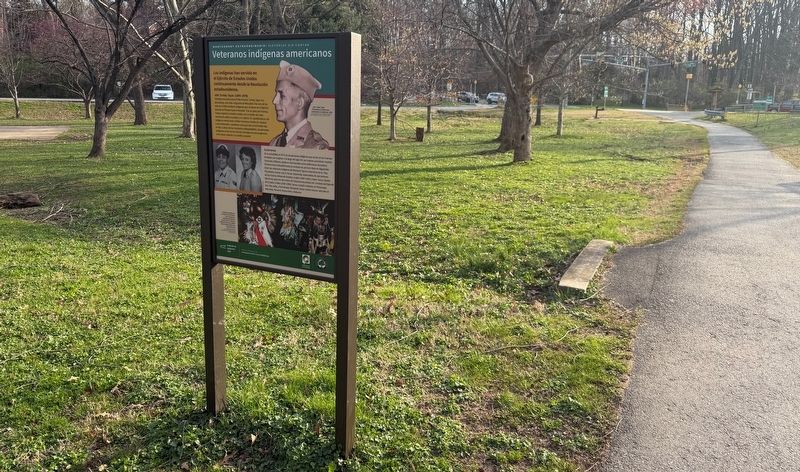
4. Native American Veterans / Veteranos indígenas americanos Marker
Credits. This page was last revised on March 26, 2026. It was originally submitted on March 26, 2026, by Devry Becker Jones of Washington, District of Columbia. This page has been viewed 30 times since then. Photos: 1, 2, 3, 4. submitted on March 26, 2026, by Devry Becker Jones of Washington, District of Columbia.
