Downtown Seattle in King County, Washington — The American West (Northwest)
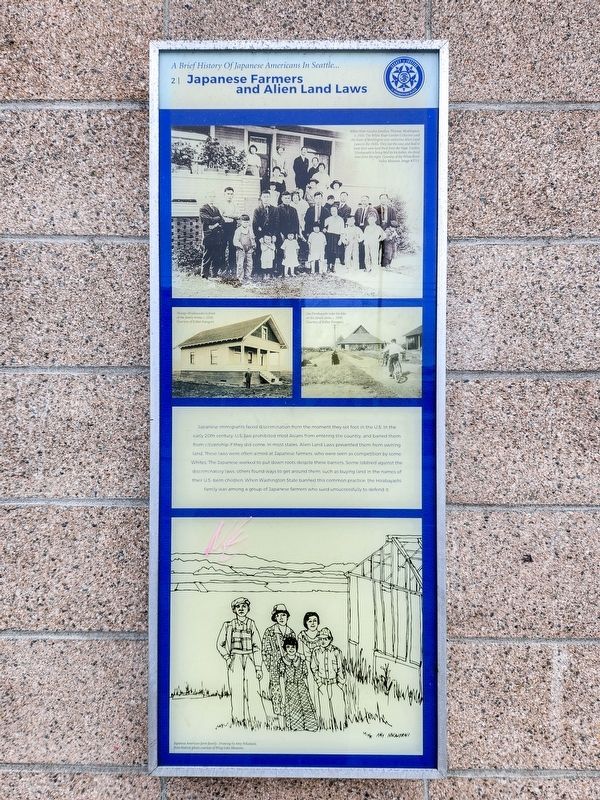
Japanese Farmers and Alien Land Laws
A Brief History of Japanese Americans In Seattle…
| — | Legacy of Justice at Hirabayashi Place | — |
Photographed by Douglass Halvorsen, February 20, 2026
1. Japanese Farmers and Alien Land Laws Marker
Japanese immigrants faced discrimination from the moment they set foot in the U.S. In the early 20th century, U.S. law prohibited most Asians from entering the country, and barred them from citizenship if they did come. In most states, Alien Land Laws prevented them from owning land. These laws were often aimed at Japanese farmers, who were seen as competition by some Whites. The Japanese worked to put down roots despite these barriers. Some lobbied against the discriminatory laws; others found ways to get around them, such as buying land in the names of their U.S.-born children. When Washington State banned this common practice, the Hirabayashi family was among a group of Japanese farmers who sued unsuccessfully to defend it.
[Captions:]
White River Garden families, Thomas, Washington, c. 1920. The White River Garden Collective sued the State of Washington over restrictive Alien Land Laws in the 1920s. They lost the case, and had to lease their own land back from the State. Gordon Hirabayashi is being held by his father, the third mand from the right. Courtesy of the White River Valley Museum, Image #3713.
Shungo Hirabayashi in front of the family home, c. 1920. Courtesy of Esther Furugori.
Jim Hirabayashi rides his bike on the family farm, c. 1930. Courtesy of Esther Furugori.
Japanese American farm family. Drawing by Amy Nikaitani, from historic photo courtesy of Wing Luke Museum.
this page online
Topics. This historical marker is listed in these topic lists: Asian Americans • Immigration • Settlements & Settlers. A significant historical year for this entry is 1920.
Location. 47° 36.016′ N, 122° 19.731′ W. Marker is in Seattle, Washington, in King County. It is in Downtown Seattle. It is on 4th Avenue South north of South Main Street, on the right when traveling north. Touch for map. Marker is at or near this postal address: 214 4th Ave S, Seattle WA 98104, United States of America. Touch for directions.

Regionally, this marker is in the Puget Sound Region. It is also on the American Pacific Coast, in the Pacific Northwest, and in the Lewis & Clark Corridor. Globally, it is in North America, in the Cascade Range, in the Inside Passage, on the Ring of Fire, on the Pacific Rim, in the Western Hemisphere, in the Western World, and in the Anglosphere.
Other nearby markers. At least 8 other markers are within walking distance of this marker: A Thriving Nihonmachi (here, next to this marker); A Community Takes Root (a few steps from this marker); Wartime Incarceration (a few steps from this
Photographed by Douglass Halvorsen, February 20, 2026
2. Japanese Farmers and Alien Land Laws Marker
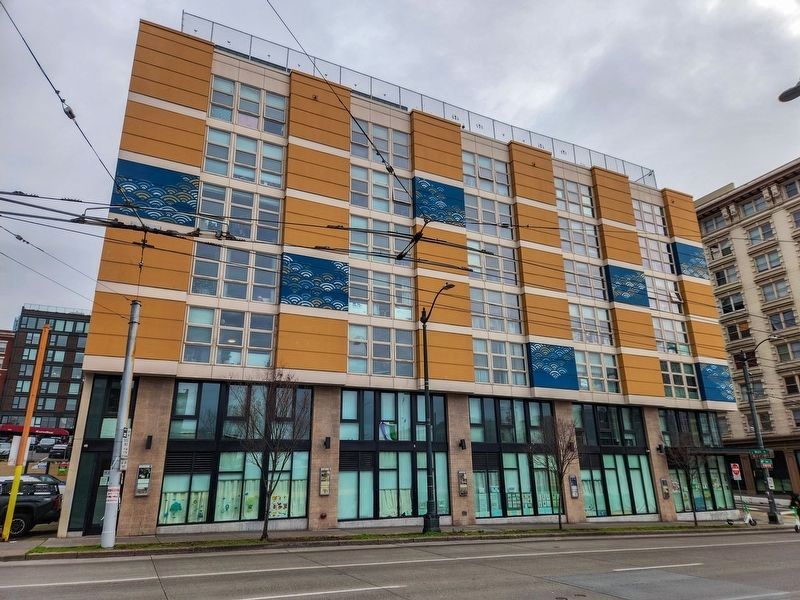
This marker is number two of five markers facing 4th Avenue in front of Hirabayashi Place.
Also see . . . Hirabayashi Place (#19).
Although completed in early 2016, Hirabayashi Place is a building that merges the past to the present with a call to the future. Built by InterIm CDA, this seven-story, 96-unit affordable housing project provides a new anchor for Nihonmachi along its western edge.(Submitted on March 26, 2026, by Douglass Halvorsen of Klamath Falls, Oregon.)
The building is named in honor of Gordon Hirabayashi. While many Japanese Americans during World War II demonstrated their loyalty to America by serving in the U.S. military, Hirabayashi fought to uphold American values rooted in the U.S. Constitution by defying the evacuation order and curfew. He was arrested and jailed for his actions and fought a long but successful court battle to overturn his convictions and clear his name.
Legacy of Justice installations of public art and interpretive elements interweave throughout the building, anchored by a 10′ tall by 8′ artwork by Roger Shimomura, depicting various icons pertaining to Hirabayashi’s life and influence. Start with this artwork located at the south entrance, then explore the building’s outside along Main Street and 4th Avenue for more.
Credits. This page was last revised on March 26, 2026. It was originally submitted on March 26, 2026, by Douglass Halvorsen of Klamath Falls, Oregon. This page has been viewed 23 times since then. Photos: 1, 2. submitted on March 26, 2026, by Douglass Halvorsen of Klamath Falls, Oregon. • Devry Becker Jones was the editor who published this page.
