Covent Garden in City of Westminster in Greater London, England, United Kingdom — Northwestern Europe (the British Isles)
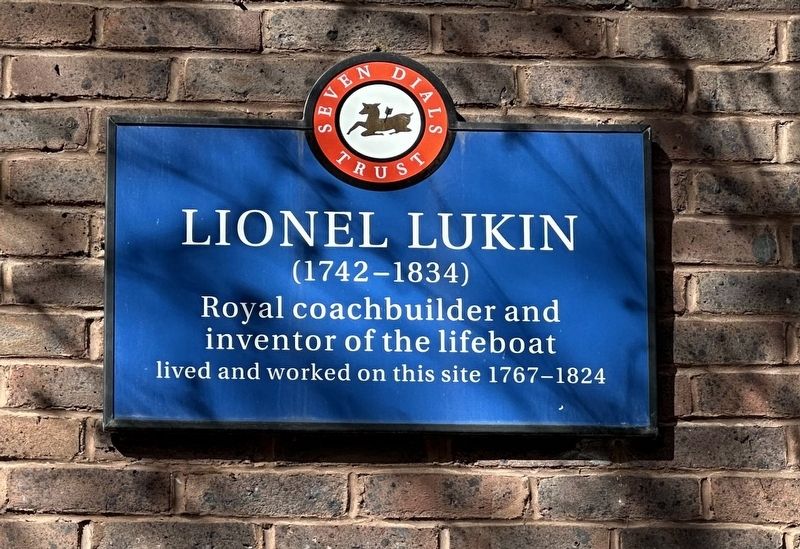
Lionel Lukin (1742-1834)
Photographed by Andrew Ruppenstein, March 26, 2026
1. Lionel Lukin (1742-1834) Marker
Royal coachbuilder and inventor of the lifeboat
lived and worked on this site 1767-1824
Erected by Seven Dials Trust.
Topics and series. This historical marker is listed in this topic list: Waterways & Vessels. In addition, it is included in the Seven Dials Trust series list. A significant historical date for this entry is November 2, 1785.
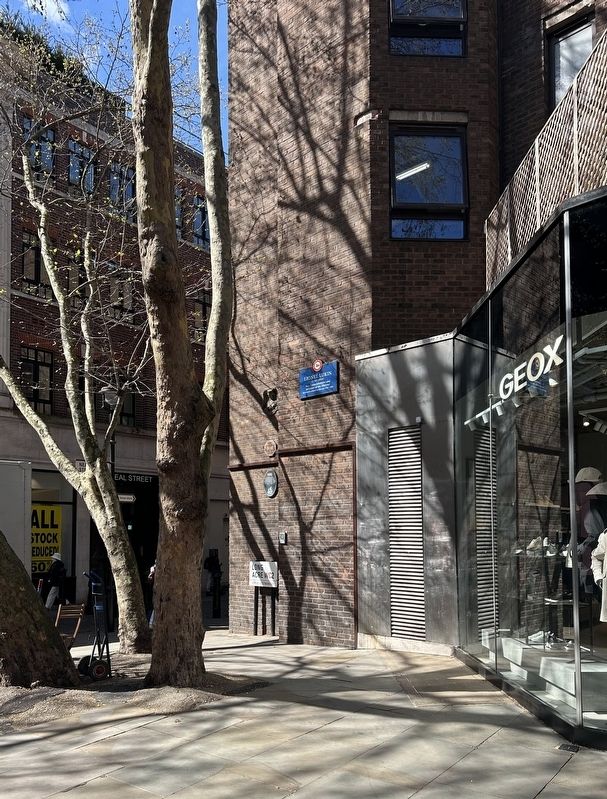
Location. 51° 30.804′ N, 0° 7.448′ W. Marker is in City of Westminster, England, in Greater London. It is in Covent Garden. It is at the intersection of Long Acre and Neal Street, on the left when traveling north on Long Acre. Touch for map. Marker is at or near this postal address: 48 Long Acre, City of Westminster, England WC2H 9QL, United Kingdom. Touch for directions.

Regionally, this marker is in London and in the Greater South East. Globally, it is on the Atlantic Ocean, in the North Atlantic Region, in Europe, in Atlantic Europe, on one of the British Isles, in the Western World, and in the Anglosphere. Historically, it finds itself in what was once the Roman Empire.
Other nearby markers. At least 8 other markers are within walking distance of this marker: Queen’s Theatre
this page online
Also see . . . Lionel Lukin (Wikipedia). Excerpt:
Lionel Lukin (18 May 1742 – 16 February 1834) was a British carriage builder and inventor, noted for the invention of the 'unimmergible' lifeboat.(Submitted on March 26, 2026.)
Lukin was granted a patent on 2 November 1785 for an 'unimmergible' boat. The design had increased buoyancy because of sealed air spaces along the side of the boat and in the bow and stern. This enabled it to stay afloat if swamped with water, or when carrying people rescued from the water. A heavy iron keel gave stability. These principles were used in most lifeboats built until the 1960s.
Rather than use the patent to make a profit, he published the designso that everyone could benefit from his ideas. The Royal Humane Society commended him for his "very praiseworthy liberality".Photographed by Andrew Ruppenstein, March 26, 20262. Lionel Lukin (1742-1834) Marker - wide view
Credits. This page was last revised on March 26, 2026. It was originally submitted on March 26, 2026, by Andrew Ruppenstein of Lamorinda, California. This page has been viewed 9 times since then. Photos: 1, 2. submitted on March 26, 2026, by Andrew Ruppenstein of Lamorinda, California.
