Downtown Seattle in King County, Washington — The American West (Northwest)
Vindication, Healing, and the Legacy of Justice
A Brief History of Japanese Americans In Seattle…
| — | Legacy of Justice at Hirabayashi Place | — |

Photographed by Douglass Halvorsen, February 20, 2026
1. Vindication, Healing, and the Legacy of Justice Marker
The 1980s saw a growing movement to secure justice for Japanese Americans who had been incarcerated during WWII. Along with the campaign for redress came efforts to overturn the wartime cases of Gordon Hirabayashi, Fred Korematsu, and Minoru Yasui. Armed with newly discovered evidence that the government had lied about the security risk posed by Japanese Americans, legal teams filed coram nobis petitions requesting that the three wartime cases be re-opened. In 1987, Gordon Hirabayashi’s convictions were vacated, giving further momentum to the redress movement. In 1990 the government issued a formal apology to the Japanese American community and began to distribute financial reperations to those who had been incarcerated.
These vindications have helped Japanese Americans begin to heal from the traumatic events of WWII. As part of that healing, the community has committed to making sure the story of the incarceration is not forgotten. These efforts include education programs, artistic works, public events, and advocacy on behalf of others whose civil liberties are threatened. Gordon Hirabayashi’s legacy of justice runs
this page online
[Captions:]
Gordon Hirabayashi with his legal team, June 1985. Photo by Stan Shikuma, courtesy of University of Washington.
Actor Ryun Yu performs “Hold These Truths,” Jeanne Sakata’s one-man play about Gordon Hirabayashi, at ACT Theater, 2015. The play has been performed across the U.S. since 2007. Photo courtesy of Chris Bennion.
Minidoka Pilgrimage 2015 group photo including 3 generations of Japanese Americans, plus families, friends, and advocates. The annual Minidoka Pilgrimage includes tours of the Minidoka National Historic Site, intergenerational programs, and a commemorative ceremony. Courtesy of the Minidoka Pilgrimage Planning Committee.
Gordon Hirabayashi at a conference in Japan, 1988. Courtesy of University of Washington.
Youth learning about the mass incarceration of Japanese Americans from a Nisei elder who experienced it. Kirie (Japanese paper cut) image by Aki Sogabe.
(Marker Number 7.)
Topics. This historical marker is listed in these topic lists: Asian Americans • Civil Rights • War, World II. A significant historical year for this entry is 1987.
Location. 47° 36.009′ N, 122° 19.723′ W.
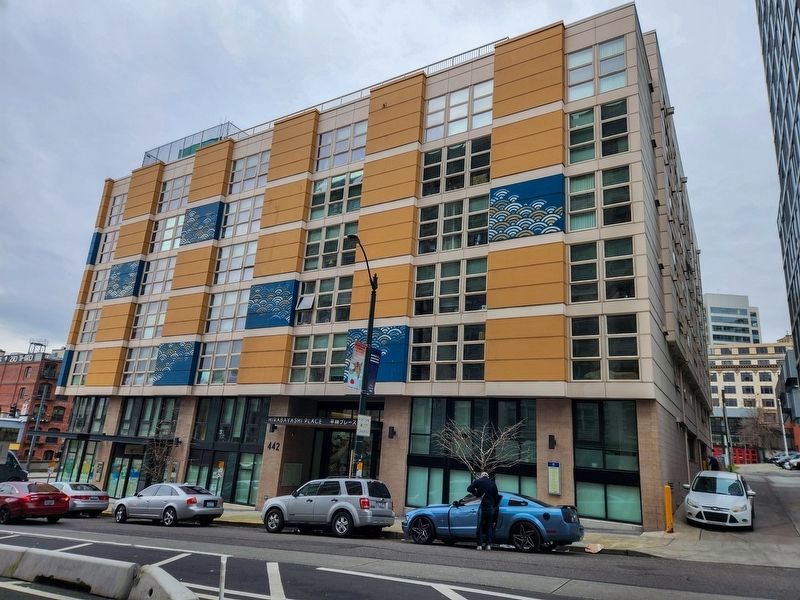
Photographed by Douglass Halvorsen, February 20, 2026
2. Vindication, Healing, and the Legacy of Justice Marker
This marker is number seven of seven markers and this marker faces Souoth Main Street at Hirabayashi Place.

Regionally, this marker is in the Puget Sound Region. It is also on the American Pacific Coast, in the Pacific Northwest, and in the Lewis & Clark Corridor. Globally, it is in North America, in the Cascade Range, in the Inside Passage, on the Ring of Fire, on the Pacific Rim, in the Western Hemisphere, in the Western World, and in the Anglosphere.
Other nearby markers. At least 8 other markers are within walking distance of this marker: Reclaiming our Roots (here, next to this marker); Gordon Hirabayashi (a few steps from this marker); A Community Takes Root (a few steps from this marker); Japanese Farmers and Alien Land Laws (a few steps from this marker); A Thriving Nihonmachi (a few steps from this marker); Wartime Incarceration (within shouting distance of this marker); Starting Over After the War (within shouting distance of this marker); Great Northern Tunnel (within shouting distance of this marker). Touch for a list and map of all markers in Seattle.
Also see . . . Hirabayashi Place (#19).
Although completed in early 2016, Hirabayashi Place is a building that merges the past to the present with a call to the future. Built by InterIm CDA, this seven-story, 96-unit affordable housing project provides a new anchor for Nihonmachi along its western edge.(Submitted on March 27, 2026, by Douglass Halvorsen of Klamath Falls, Oregon.)
The building is named in honor of Gordon Hirabayashi. While many Japanese Americans during World War II demonstrated their loyalty to America by serving in the U.S. military, Hirabayashi fought to uphold American values rooted in the U.S. Constitution by defying the evacuation order and curfew. He was arrested and jailed for his actions and fought a long but successful court battle to overturn his convictions and clear his name.
Legacy of Justice installations of public art and interpretive elements interweave throughout the building, anchored by a 10′ tall by 8′ artwork by Roger Shimomura, depicting various icons pertaining to Hirabayashi’s life and influence. Start with this artwork located at the south entrance, then explore the building’s outside along Main Street and 4th Avenue for more.
Credits. This page was last revised on March 31, 2026. It was originally submitted on March 26, 2026, by Douglass Halvorsen of Klamath Falls, Oregon. This page has been viewed 13 times since then. Photos: 1. submitted on March 26, 2026, by Douglass Halvorsen of Klamath Falls, Oregon. 2. submitted on March 27, 2026, by Douglass Halvorsen of Klamath Falls, Oregon. • Devry Becker Jones was the editor who published this page.
