Salisbury in Wicomico County, Maryland — The American Northeast (Mid-Atlantic)
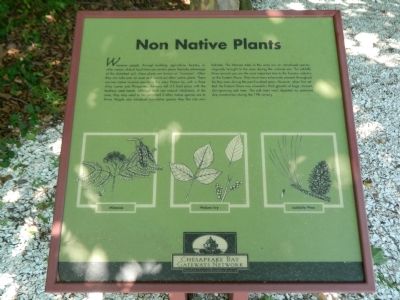
Non Native Plants
Photographed by Nate Davidson, July 25, 2014
1. Non Native Plants Marker
Whenever people, through building, agriculture forestry, or other means, disturb land there are certain plants that take advantage of the disturbed soil. These plants are known as "invasives." Often they can take over an area and crowd out other native plants. There are two native invasive species in this area: Poison Ivy, with its three shiny leaves and Phramites, the very tall (12 foot) grass with the feathery seed heads. Although both are natural inhabitants of the area, they may need to be controlled if other native species are to thrive. People also introduce non-native species they like into new habitats. The Mimosa trees in this area are an introduced species originally brought to the area during the colonial era. The Loblolly Pines around you are the most important tree to the forestry industry on the Eastern Shore. They have been extensively planted throughout the Bay area during the past hundred years. However, when first settled, the Eastern Shore was covered in thick growths of huge, ancient, slow-growing oak trees. The oak trees were depleted via extensive ship construction during the 19th century.
Erected by Chesapeake
this page online
Topics. This historical marker is listed in these topic lists: Environment • Horticulture & Forestry.
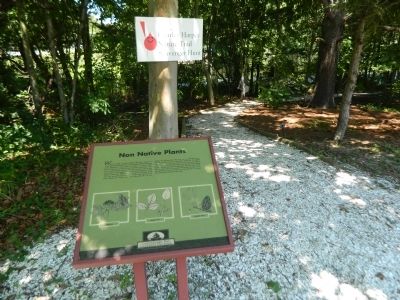
Location. 38° 21.133′ N, 75° 34.367′ W. Marker is in Salisbury, Maryland, in Wicomico County. It can be reached from the intersection of Beaglin Park Drive and South Park Drive, on the right when traveling north. The marker stands along the nature trail near the Ward Museum. Touch for map. Marker is at or near this postal address: 1100 Beaglin Park Dr, Salisbury MD 21804, United States of America. Touch for directions.

Regionally, this marker is on the Eastern Shore. It is also in the American Mid-Atlantic, on the Delmarva Peninsula, in the Tidewater, and on the Eastern Seaboard. Globally, it is in the North Atlantic Region, North America, the Western Hemisphere, the Western World, and the Anglosphere. Historically, it finds itself in what was once one of the original Thirteen Colonies and also the Antebellum South.
Other nearby markers. At least 8 other markers are within walking distance of this marker: Wetland Marsh (within shouting distance
Photographed by Nate Davidson, July 25, 2014
2. Non Native Plants Marker
Photographed by Nate Davidson, July 25, 2014
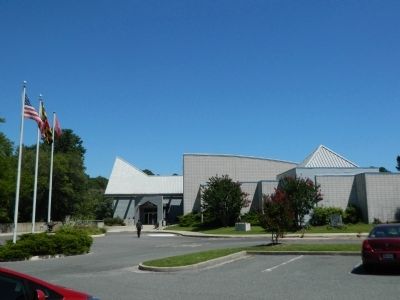
3. Ward Museum of Waterfowl Art
Credits. This page was last revised on March 31, 2026. It was originally submitted on November 27, 2014, by Nathan Davidson of Salisbury, Maryland. This page has been viewed 438 times since then and 25 times this year. Last updated on March 27, 2026, by Carl Gordon Moore Jr. of North East, Maryland. Photos: 1, 2, 3. submitted on November 27, 2014, by Nathan Davidson of Salisbury, Maryland. • Devry Becker Jones was the editor who published this page.
