Penn Yan in Yates County, New York — The American Northeast (Mid-Atlantic)
129 Clinton Street
Samuel Fosdick Curtis House
| — | Penn Yan Historic Preservation District | — |
Photographed by Cosmos Mariner, May 22, 2022
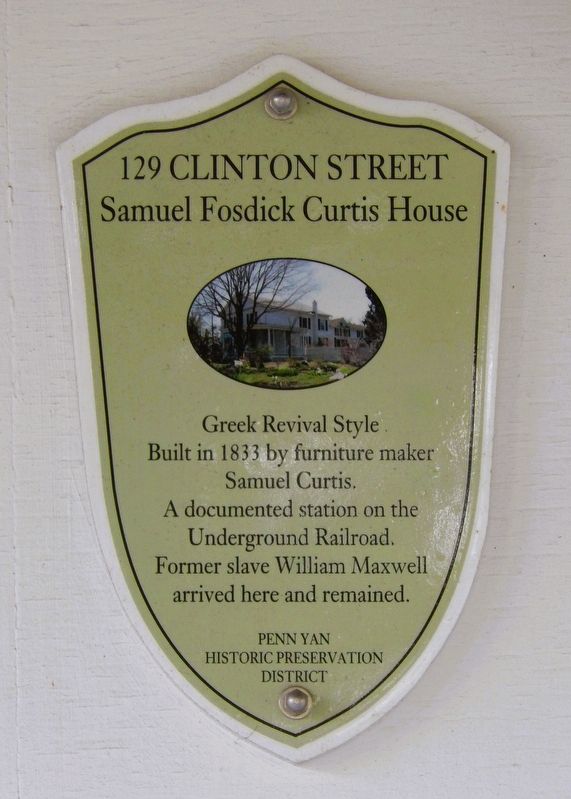
1. 129 Clinton Street Marker
Greek Revival Style. Built in 1833 by furniture maker Samuel Curtis. A documented station on the Underground Railroad. Former slave William Maxwell arrived here and remained.
Erected by Penn Yan Historic Preservation Committee.
Topics and series. This historical marker is listed in these topic lists: Abolition & Underground RR • African Americans • Architecture • Settlements & Settlers. In addition, it is included in the National Register of Historic Places (NRHP) series list. A significant historical year for this entry is 1833.
Location. 42° 39.876′ N, 77° 3.177′ W. Marker is in Penn Yan, New York, in Yates County. It is at the intersection of Clinton Street (State Highway 54) and Benham Street, on the right when traveling east on Clinton Street. The marker is mounted on the northwest corner of the subject house, facing Clinton Street. Touch for map. Marker is at or near this postal address: 129 Clinton Street, Penn Yan NY 14527, United States of America. Touch for directions.

Regionally, this marker is in Upstate New York, specifically in Western New York, and in the Finger Lakes. It is also in
this page online
Other nearby markers. At least 8 other markers are within walking distance of this marker: 224 Clinton Street (approx. 0.2 miles away); Vietnam Conflict Memorial (approx. 0.2 miles away); 158 Main Street (approx. 0.2 miles away); Korean Conflict Memorial (approx. 0.2 miles away); World War I Heroic Dead (approx. 0.2 miles away); World War Memorial (approx. 0.2 miles away); World War II Memorial (approx. 0.2 miles away); 131 Main Street (approx. 0.2 miles away). Touch for a list and map of all markers in Penn Yan.
Regarding 129 Clinton Street. Contributing property Penn Yan Historic District, National Register of Historic Places № 85000591.
From the National Register Nomination prepared by Larry E. Gobrecht, 9/1984:
The Penn Yan Historic District is significant both architecturally and historically as a chronicle of the village’sdevelopment. The community remains surprisingly intact with few non-contributing elements. The nominated historic district is historically significant as a reflection of the growth of the village from its early beginnings as a trading community for the Finger Lakes region, through its emergence in the late nineteenth and early twentieth centuries as the regional center for agricultural production. The architecture of Penn Yan spans a period of almost 200 years. There are excellent examples of the major styles as well as vernacular interpretations. The Penn Yan Historic District encompasses the historic core of the village on an area of 65 acres. The residential areas of the historic district reflect the village’s history with representative examples of major nineteenth and early twentieth century architectural styles. Each of the streets in the residential section of the historic district is lined with tall stately trees, the residences recessed on spacious lots.Photographed by Cosmos Mariner, May 22, 20222. 129 Clinton Street MarkerThe marker is on the right side of the front entrance, which is at the northwest corner of the house. The entrance, surrounded by a northwest corner porch, faces Clinton Street.129 Clinton Street, c.1830; Three-bay, two-story frame residence; Greek Revival; porch added early 20th century.

Also see . . .
1. Samuel Fosdick Curtis (Yates County History Center).
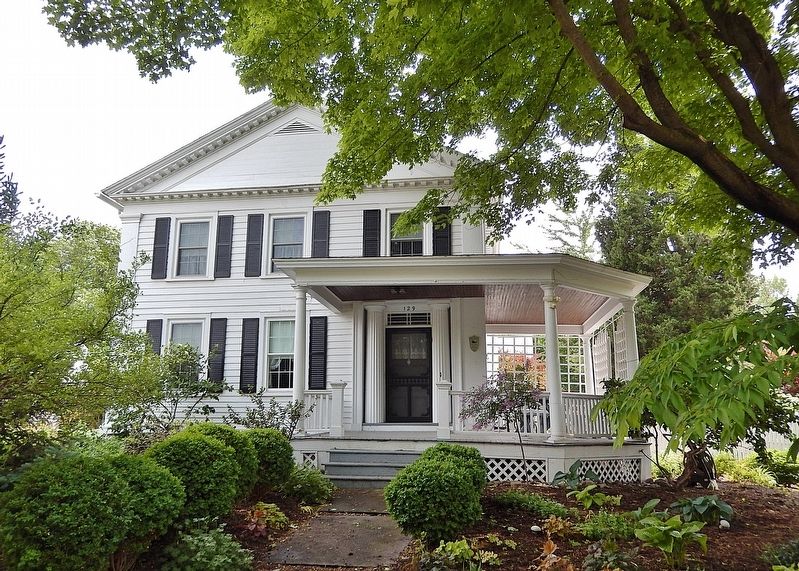
Photographed by Cosmos Mariner, May 22, 2022
3. Samuel Fosdick Curtis House (north elevation)
The entrance, surrounded by a northwest corner porch, faces Clinton Street.
Excerpt: Samuel Fosdick Curtis was born in Wethersfield, Connecticut in 1799. He left home at 17 to undertake a chair making apprenticeship with his older brother, Roswell Curtis, in Auburn. In 1824, he arrived in Penn Yan with a wagonload of stock goods and applied to Sheldon & Babcock to rent a room in the second story of their store to begin his business career. Mr. Babcock was pleased with the young man’s spirit of independence and self-reliance and leased him shop room in a building at the southwest corner of Main and Head Streets. Young Samuel Curtis set up shop and began manufacturing and selling chairs. Thus began the business he worked in for nearly 46 years.(Submitted on April 1, 2026, by Cosmos Mariner of Cape Canaveral, Florida.)Throughout his adult life, Samuel Fosdick Curtis was a strong supporter of the anti-slavery movement and was equally faithful to the cause of temperance. Active in local organizations and government, Curtis’ name was associated with much of the growth and advancement of the village of Penn Yan.
2. Penn Yan Historic District (Wikipedia).
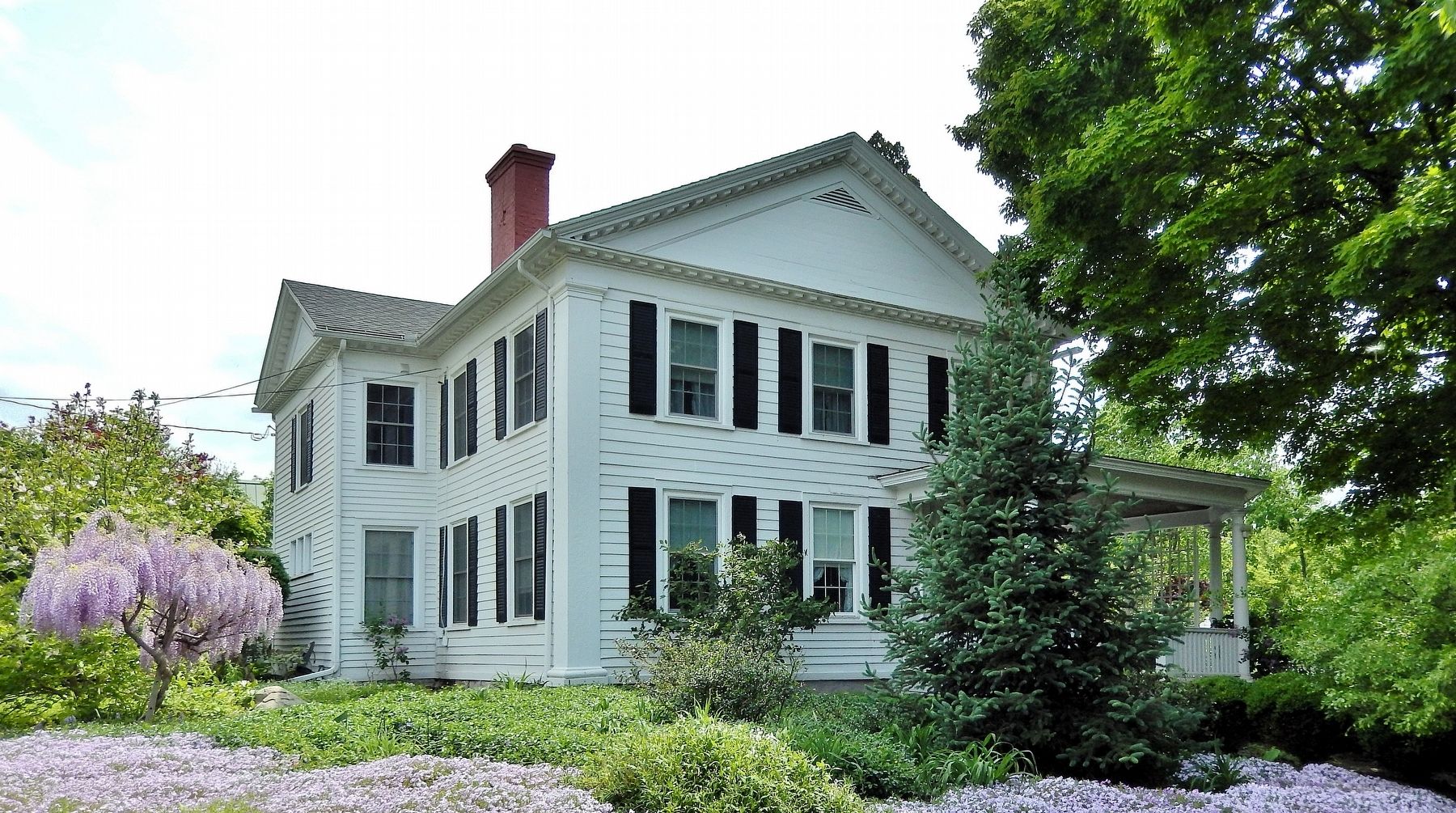
Excerpt: Penn Yan Historic District includes(Submitted on April 1, 2026, by Cosmos Mariner of Cape Canaveral, Florida.)a broad range of architecturally significant resources that document the village's development from the 1820s to 1929. It includes representative examples of residential, commercial, industrial, civic, and ecclesiastical structures. It was listed on the National Register of Historic Places in 1985.Photographed by Cosmos Mariner, May 22, 20224. Samuel Fosdick Curtis House (northeast elevation)
Credits. This page was last revised on April 1, 2026. It was originally submitted on March 28, 2026, by Cosmos Mariner of Cape Canaveral, Florida. This page has been viewed 28 times since then. Photos: 1, 2, 3, 4. submitted on April 1, 2026, by Cosmos Mariner of Cape Canaveral, Florida.
