Pullman in Chicago in Cook County, Illinois — The American Midwest (Great Lakes)
Pullman 1894 Strike Memorial Rose & Herb Garden

Photographed by Daniel Barriball, March 21, 2026
1. Pullman 1894 Strike Memorial Rose & Herb Garden Marker
The town of Pullman was one of the first and most important planned industrial communities in America. George Mortimer Pullman believed that beautiful surroundings would have "a refining influence" on workers. He directed architect Solon Spencer Beman, and landscape architect Nathan Franklin Barrett to design everything in the town with an eye toward efficiency and beauty. Pullman believed, "With such surroundings and such regard for the needs of the body as well as the soul...the disturbing conditions of strikes and other troubles that periodically convulse the world of labor would not need to be feared here."
The town of Pullman was widely acclaimed and generally thrived until the nation-wide depression of 1893. Although the Pullman Palace Car Company accepted contracts at a loss in order to keep as many workers employed as possible, one third of the workforce was laid off. Of those workers who remained, their wages were slashed by an average of thirty percent. However, the rents charged by the company for housing remained the same. Consequently, many workers quickly fell in debt to the company. In a meeting with company
this page online
With Pullman refusing to negotiate with the strikers and the majority of Pullman families in dire straits, another delegation was sent to the national convention of the American Railway Union. In particular, Rev. William Carwardine of the Pullman Methodist Church and 19-year old Jenny Curtis, a company seamstress, convinced delegates to the convention to support a boycott of all Pullman cars, in spite of the reservations of union president Eugene Debs. The American Railway Union boycott began on June 26, and quickly spread nation-wide. On July 2, Attorney General Richard Olney, a former railroad attorney, obtained a restraining order on all actions that would impede the movement of the mail. This restraining order effectively made the boycott illegal, as nearly all trains of
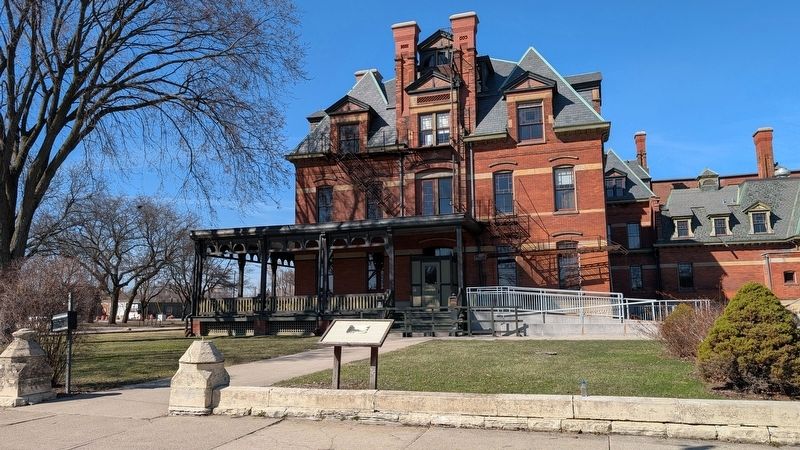
Photographed by Daniel Barriball, March 21, 2026
2. Pullman 1894 Strike Memorial Rose & Herb Garden Marker in context
The building behind the marker is the Hotel Florence.
To stave off potential backlash against the restraining order, President Grover Cleveland sent federal troops to Chicago. Illinois governor John Peter Altgeld, at the request of Chicago mayor John Patrick Hopkins, sent Illinois militia troops to Pullman. The militia bivouacked on the southeast lawn of the Hotel Florence, now the site of the rose and herb garden. Although no violence occurred in Pullman, much did occur throughout the country, eventually turning the press and public opinion against the American Railway Union.
spent six months in prison. The boycott never officially ended, but died out within a few months. Most strikers quit the union. Many were re-hired after signing affidavits that they would remain non-union. Leaders of the strike and boycott were blacklisted. The company never attempted to collect unpaid rents.
George Pullman saved his company from ruin, but received widely conflicting reviews for his hard-line stance against the strikers. He died on October 19, 1897, and was buried in Chicago's Graceland Cemetery. In 1898, the Illinois Supreme Court ordered the Pullman Palace Car Company to divest itself of all non-industrial property, including the housing stock. This ruling, along with subsequent shifts in company policy, effectively brought to an end Pullman's vision for a model industrial community.
Pullman residents planted the Rose garden in the early 1980's. Having fallen into decline, the garden was restored beginning in 1998. The roses planted in the interior beds are varieties developed during the life span of George Pullman, 1831-1897. On June 28, 2000, the garden was dedicated to commemorate the strike of 1894, one of the watershed events in Pullman and the history of labor in America.
Restoration Contributors: The Keebler Company•Art Smith•Arnie Anderson•Arcade Park Garden Club•Jan & Larry Bailey•Elizabeth Baird•Edward Beyer•Kate Chappell•Billie & George Chiagouris•Denise L. Cowan•Arlene Echols & Roderick Lewis•Lisa A. Everett•Dee Dee Fabris•Fred Fallin•Mackenzie M. Flynn•Suzanne J. Flynn•Linda & John Feutz•Gay and Lesbian Association of Pullman•Bruna & Jack Gaggini•William C. Helberg•Historic Pullman Foundation•Carol E. Kees•Judith Kubida & Benjamin Kocolowski & Julia Melnyk•Irene Hertle•Barbara & Al Hudson•Beverly & Earl Johnson•Mary L. Knapp•Bruce Lange•Kenneth A. Lesak•Carol & Jim Lett•Joan D. Mahon•Jane & James McDonough•Ruth E. Miller•Melinda Moore•Julia Nichele•Frank O Block•Arthur Pearson•Deborah J. Pearson•Hannah B. Pearson•Lauretta M. Pearson•Mary & Art Pearson, Sr.•Emma Pigato•Marge & George Ryan•Lynn A. Smith•Mary Staunton•The Swinea Family•Kris Thomsen•Tina, Jaimie & Myles Trinidad-Bulla•P.K. Vander Beke•Carol Vining•Patricia Vogt•Josephene Wesolowski•Nancy L. Zalane•Norma & Tom Zarris•Constance Zarris-Booz
In Memoriam: Ralph Antoniazzi•Opal Cummings•John E. Chappell•Bruno DeNardi•Shirley Hastings•John D. Johnson•(unreadable) Larson•Carl Emil Pearson•Eddie Silagyi•Reno P. Zenere
Design and Layout by Tina Trinidad-Bulla
Sign Construction by Gordon Hirsig and Arthur Pearson
Topics. This historical marker is listed in these topic lists: Charity & Public Work • Industry & Commerce • Labor Unions • Railroads & Streetcars. A significant historical date for this entry is May 11, 1894.
Location. 41° 41.519′ N, 87° 36.53′ W. Marker is in Chicago, Illinois, in Cook County. It is in Pullman. It is on South Forrestville Avenue west of South St. Lawrence Avenue, on the right when traveling west. This marker stands along the sidewalk on the south lawn of the Hotel Florence. Touch for map. Marker is at or near this postal address: 11114 S Forrestville Ave, Chicago IL 60628, United States of America. Touch for directions.

Regionally, this marker is in the American Midwest. Globally, it is in North America, on the Great Lakes, in the Western Hemisphere, in the Western World, and in the Anglosphere. Historically, it finds itself in what was once the Viceroyalty of New France, the territory of the Mississippian Culture, and the Northwest Territory.
Other nearby markers. At least 8 other markers are within walking distance of this marker: The Arcade (within shouting distance of this marker); Lake Vista & Illinois Central Railroad Depot (within shouting distance of this marker); Arcade Park & The Pullman Stables (within shouting distance of this marker); The Workers' Main Gate (about 400 feet away, measured in a direct line); Welcome to Pullman (about 400 feet away); a different marker also named Welcome to Pullman (about 400 feet away); The Town of Pullman (about 500 feet away); From Wood to Steel (about 500 feet away). Touch for a list and map of all markers in Chicago.
Credits. This page was last revised on March 31, 2026. It was originally submitted on March 29, 2026, by Daniel Barriball of Chesterton, Indiana. This page has been viewed 28 times since then. Photos: 1. submitted on March 29, 2026, by Daniel Barriball of Chesterton, Indiana. 2. submitted on March 30, 2026, by Daniel Barriball of Chesterton, Indiana. • Devry Becker Jones was the editor who published this page.
