Downtown in Columbus in Franklin County, Ohio — The American Midwest (Great Lakes)
The Main Street Bridge
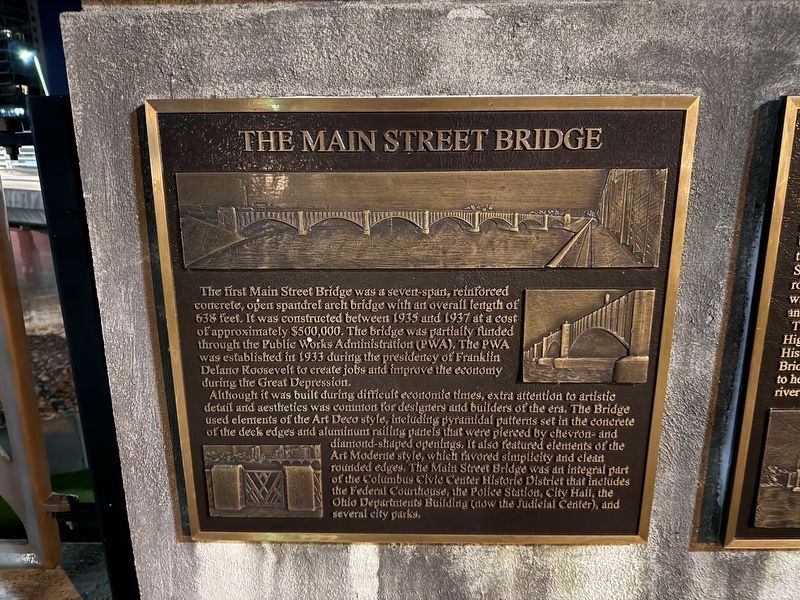
The first Main Street Bridge was a seven-span, reinforced concrete, open spandrel arched bridge with an overall length of 638 feet. It was constructed between 1935 and 1937 at a cost of approximately $500,000. The bridge was partially funded through the Public Works Administration (PWA). The PWA was established in 1933 during the presidency of Franklin Delano Roosevelt to create jobs and improve the economy during the Great Depression.
Although it was built during difficult economic times, extra attention to artistic detail and aesthetics was common for designers and builders of the era. The Bridge used elements of the Art Deco style, including pyramidal patterns set in the concrete of the deck edges and aluminum railing panels that were pierced by chevron- and diamond-shaped openings. It also featured elements of the Art Moderne style, which favored simplicity and clean rounded edges. The Main Street Bridge was an integral part of the Columbus Civic Center Historic District that includes the Federal Courthouse, the Police Station, City Hall, the Ohio Departments Building (now the Judicial Center), and several city
this page online
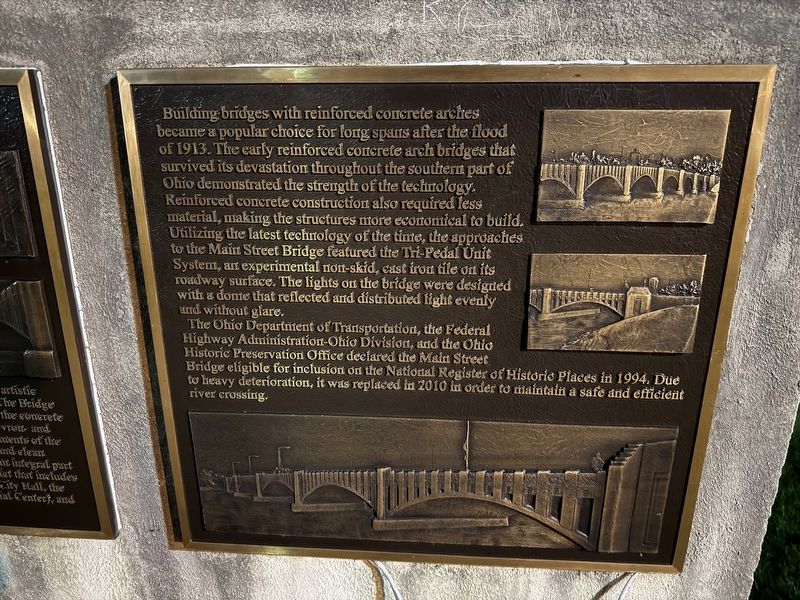
Building bridges with reinforced concrete arches became a popular choice for long spans after the flood of 1913. The early reinforced concrete arch bridges that survived its devastation throughout the southern part of Ohio demonstrated the strength of the technology. Reinforced concrete construction also required less material, making the structures more economical to build. Utilizing the latest technology of the time, the approaches to the Main Street Bridge featured the Tri-Pedal Unit System, an experimental non-skit, cast iron tile on its roadway surface. The lights on the bridge were designed with a dome that reflected and distributed light evenly and without glare.
The Ohio Department of Transportation, the Federal Highway Administration-Ohio Division, and the Ohio Historic Preservation Office declared the Main Street Bridge eligible for inclusion on the National Register of Historic Places in 1994. Due to heavy deterioration, it was replaced in 2010 in order to maintain a safe and efficient river crossing.
Topics and series. This historical marker is listed in these topic lists: Architecture • Bridges & Viaducts
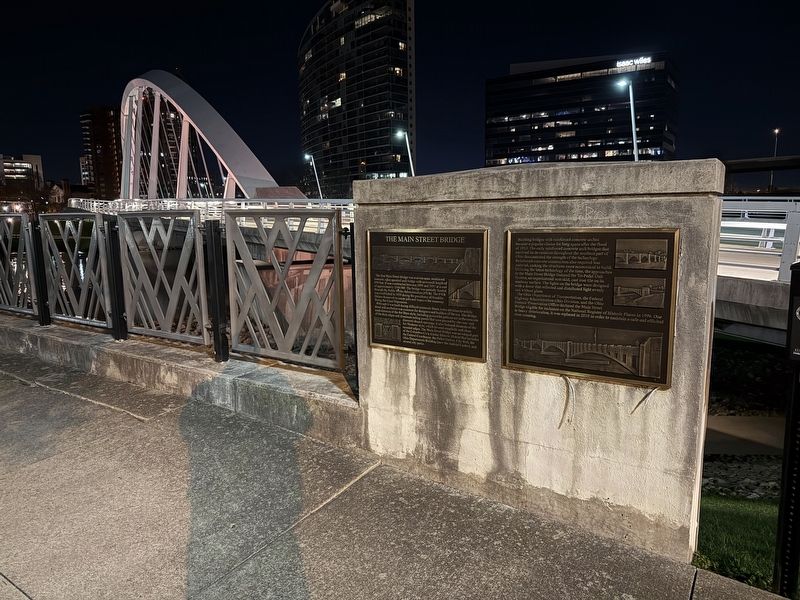
Location. 39° 57.389′ N, 83° 0.45′ W. Marker is in Columbus, Ohio, in Franklin County. It is in Downtown. It is on Washington Boulevard east of Belle Street, on the right when traveling east. Touch for map. Marker is at or near this postal address: 222 Washington Blvd, Columbus OH 43215, United States of America. Touch for directions.

Regionally, this marker is in Ohio’s Scioto Valley. It is also in the American Midwest and in the Corn Belt. Globally, it is in North America, the Western Hemisphere, the Western World, and the Anglosphere. Historically, it finds itself in what was once the Haudenosaunee (Iroquois) Confederacy, the territory of the Mississippian Culture, and the Northwest Territory.
Other nearby markers. At least 8 other markers are within walking distance of this marker: A different marker also named The Main Street Bridge (a few steps from this marker); Columbus Civic Center Historic District (within shouting

Photographed by Craig Doda, April 11, 2026
4. The Main Street Bridge Marker
Credits. This page was last revised on April 20, 2026. It was originally submitted on March 30, 2026, by Devry Becker Jones of Washington, District of Columbia. This page has been viewed 11 times since then. Photos: 1, 2, 3. submitted on March 30, 2026, by Devry Becker Jones of Washington, District of Columbia. 4. submitted on April 16, 2026, by Craig Doda of Napoleon, Ohio.
Editor’s want-list for this marker. Clear, daylight photos of the marker, its context and the bridge. • Can you help?
