Ithaca in Tompkins County, New York — The American Northeast (Mid-Atlantic)
The Cascadilla Boathouse
Photographed by Susan A. Dalaba, September 2, 2025
1. The Cascadilla Boathouse Marker
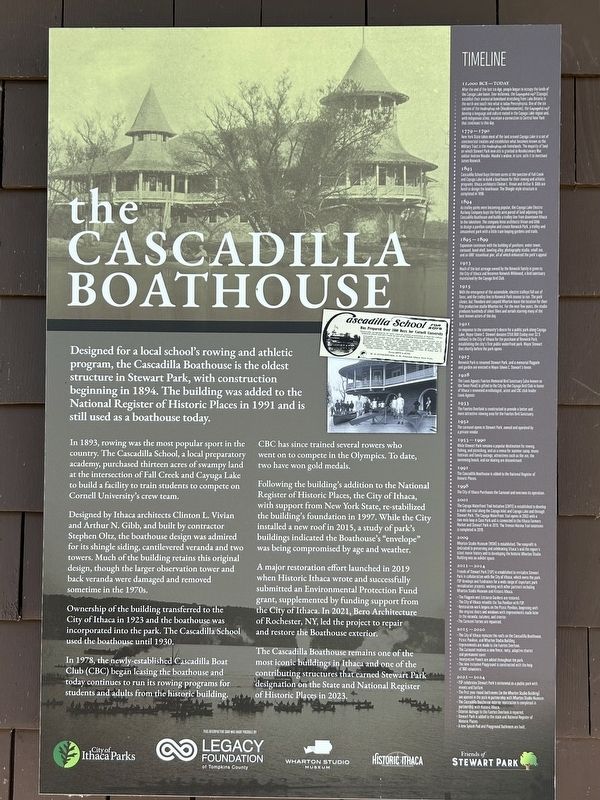
Designed for a local school’s rowing my and athletic program, the Cascadilla Boathouse is the oldest structure in Stewart Park, with construction beginning in 1894. The building was added to the National Register of Historic Places in 1991 and is still used as a boathouse today.
In 1893, rowing was the most popular sport in the country. The Cascadilla School, a local preparatory academy, purchased thirteen acres of swampy land at the intersection of Fall Creek and Cayuga Lake to build a facility to train students to compete on Cornell University’s crew team.
Designed by Ithaca architects Clinton L. Vivian and Arthur N. Gibb, and built by contractor Stephen Oltz, the boathouse design was admired for its shingle siding, cantilevered veranda and two towers. Much of the building retains this original design, though the larger observation to er and back veranda were damaged and removed sometime in the 1970s.
Ownership of the building transferred to the City of Ithaca in 1923 and the boathouse was incorporated into the park. The Cascadilla School used the boathouse until 1930.
In 1978, the newly-established Cascadilla
this page online
CBC has since trained several rowers who went on to compete in the Olympics. To date, two have won gold medals.
Following the building’s addition to the National Register of Historic Places, the City of Ithaca, with support from New York State, re-established the building’s foundation in 1997. While the City installed a new roof in 2015, a study of the park’s buildings indicated the Boathouse’s “envelope” was being compromised by age weather.
A major restoration effort launched in 2019 when Historic Ithaca wrote and successfully submitted an Environmental Protection Fund grant, supplemented by funding support from the City of Ithaca. In 2021, Bero Architecture of Rochester, NY, led the project to repair and restore the Boathouse exterior.
The Cascadilla Boathouse remains one of the most iconic buildings in Ithaca and one of the contributing structures that earned Stewart Park designation on the State and National Register of Historic Places in 2023.
Timeline
11,000 BCE - Today
After

Photographed by Susan A. Dalaba, September 2, 2025
2. The Cascadilla Boathouse
1779 – 1790
New York State takes most of the land around Cayuga Lake in a set of controversial treaties and establishes what becomes known as the Military Tract in the Hodinohso:nh homelands. The majority of land on which Stewart Park now sits is granted to Revolutionary War soldier Andrew Moodie. Moodie’s widow, in turn, sells it to merchant James Renwick.
1893
Cascadilla School buys thirteen acres at the junction of Fall Creek and Cayuga Lake to build a bathhouse for their rowing and athletic programs. Ithaca architects Clinton L. Vivian and Arthur N. Gibbs are hired to design the boathouse. The Shingle-style structure is completed in 1896.
1894 As

Photographed by Susan A. Dalaba, September 2, 2025
3. The Cascadilla Boathouse
1895 – 1899
Expansion continues with the building of pavilions, water tower, carousel, bandshell, bowling alley, photography studio, small zoo, and an 880’ steamboat pier, all of which enhanced the park’s appeal.
1913
Much of the last acreage owned by the Renwick family is given to the City of Ithaca and becomes Renwick Wildwood, a bird sanctuary maintained by the Cayuga Bird Club.
1915
With the emergence of the automobile, electric trolleys fallout of favor, and the trolley line to Renwick Park ceases to run. The park closes, but Theodore and Leopold Wharton lease the location for their film production studio Wharton, Inc. For the next few years, the studio produces hundreds of silent films and serials starring many of the best-known actors of the day.
1921
In response to the community’s desire for a public park along Cayuga Lake, Mayor Edwin C. Stewart donates $150,000 (today over $2.5 million) to the City of Ithaca for the purchase of Renwick Park, establishing the city’s first public waterfront park. Mayor Stewart dies shortly before the park opens.
1927
Renwick Park is renamed Stewart Park, and a memorial flagpole, and garden are erected in Mayor Edwin C. Stewart’s honor.
1933
The Fuertes Overlook is constructed to provide a better and more attractive viewing area for the Fuertes Bird Sanctuary.
1952
The carousel in Stewart Park, owned and operated by a private vendor.
1953 - 1990
While Stewart Park remains a popular

Photographed by Susan A. Dalaba, September 2, 2025
4. The Cascadilla Boathouse
The marker is in the shadow, near the left edge of the building.
1991
The Cascadilla Board house is added to the National Register of Historic Places.
1998
The City of Ithaca purchases the carousel and oversees operation.
2001
The Cayuga Waterfront Trail Initiative (CWTI) is established to develop a multi-use trail along the Cayuga Inlet and Cayuga Lake and through Stewart Park. The Cayuga two-mile loop in Cass Park and is connected to the Ithaca Farmers Market and Stewart Park in 2015. The Treman Marina Trail extension is completed in 2019.
2009
Wharton Studio Museum (WSM) is established. The nonprofit is dedicated to preserving and celebrating Ithaca’s and the region’s silent movie history and to developing the historic Wharton Studio Building into an exhibit space.
2011 - 2014
Friends of Stewart Park (FSP) is established to revitalize Stewart Park in collaboration with the City of Ithaca, which owns the park. FSP develops and fundraises for a wide range of important park revitalization projects,

Photographed by Susan A. Dalaba, September 2, 2025
5. Stewart Park
- The flagpole and Entrance Gardens are rejuvenated.
-The City of Ithaca rebuilds the Tea Pavilion with FSP.
-Restoration work begins on the Picnic Pavilion, beginning with the original doors and windows with improvements made later to the veranda, columns, and interior.
-The Carousel horses are repainted.
2015 - 2020
-The City of Ithaca replaces the roof on the Cascadilla Boathouse, Picnic Pavilion, and Wharton Studio Building.
-Improvements are made to the Fuertes Overlook. -The Carousel receives a new fence, ramp, adaptive chariot and permanent cover.
2021 - 2024
-FSP celebrates Stewart Park’s centennial as a public park with events and fanfare.
-The first year-round bathrooms [in Wharton Studio Building] are opened in the park in partnership with Wharton Studio Museum.
-The Cascadilla Boathouse exterior restoration is completed in partnership with Historic Ithaca.
-Exterior damage to the Fuertes Overlook is repaired.
-Stewart Park is added to the State and National Register of Historic Places.
-A new Splash Pad and Playground Bathroom

Photographed by Susan A. Dalaba, March 31, 2026
6. The Cascadilla Boathouse
Topics. This historical marker is listed in these topic lists: Architecture • Education • Parks & Recreational Areas • Sports. A significant historical year for this entry is 1894.
Location. 42° 27.612′ N, 76° 30.509′ W. Marker is in Ithaca, New York, in Tompkins County. It is on Stewart Park west of Stewart Park Lane, on the right when traveling west. Located in Stewart Park. The road is a one way loop around the park. Touch for map. Marker is at or near this postal address: 71 Stewart Park, Ithaca NY 14850, United States of America. Touch for directions.

Regionally, this marker is in Upstate New York and in the Southern Tier. It is also in the American Northeast and in the Mid-Atlantic. Globally, it is in North America, the Western Hemisphere, the Western World, and the Anglosphere. Historically, it finds itself in what was once the Haudenosaunee (Iroquois) Confederacy, New Netherland, and one of the original Thirteen Colonies.
Other nearby markers. At least 8 other markers are within walking distance of this marker: Louis Agassiz Fuertes Memorial Bird Sanctuary & Overlook (within shouting distance of this marker); The Movie Studio (approx. ¼ mile away); Wharton Studio (approx. ¼ mile away); Edwin Crowell Stewart (approx. 0.3 miles away); The Picnic Pavilion (approx. 0.3 miles away); Cayuga Lake And The Erie Canal: (approx. 0.3 miles away); Welcome to Stewart Park! (approx. 0.3 miles away); Stewart Park (approx. 0.3 miles away). Touch for a list and map of all markers in Ithaca.
Also see . . . Cascadilla Boat Club. (Submitted on April 11, 2026, by Michael Herrick of Southbury, Connecticut.)
Credits. This page was last revised on April 11, 2026. It was originally submitted on March 30, 2026, by Susan A. Dalaba of Cortland, New York. This page has been viewed 54 times since then. Photos: 1, 2, 3, 4. submitted on March 30, 2026, by Susan A. Dalaba of Cortland, New York. 5, 6. submitted on March 31, 2026, by Susan A. Dalaba of Cortland, New York. • Michael Herrick was the editor who published this page.
