Melbourne Arts Precinct , Victoria, Australia — Oceania
Observatory House
| — | Melbourne Observatory | — |
Photographed by Dean Barton-Ancliffe, March 30, 2026
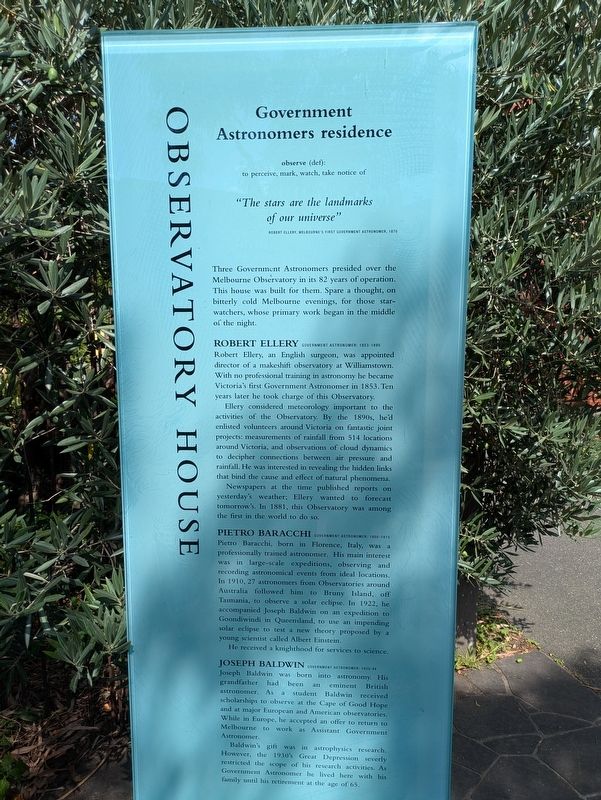
1. Observatory House Marker
Government Astronomers residence
observe (def): to perceive, mark, watch, take notice of
“The stars are the landmarks of our universe”
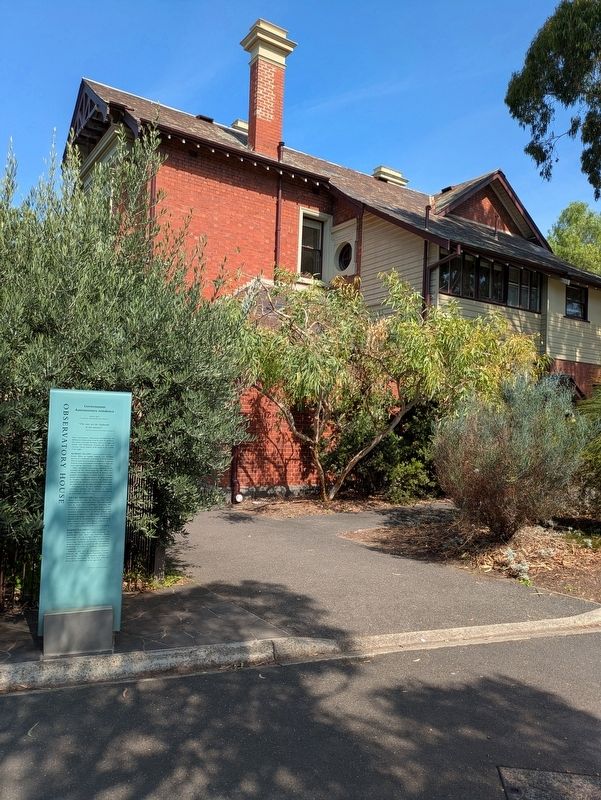
Three Government Astronomers presided over the Melbourne Observatory in its 82 years of operation. This house was built for them. Spare a thought, on bitterly cold Melbourne evenings, for those star-watchers, whose primary work began in the middle of the night.
Robert Ellery Government Astronomer: 1853-1895
Robert Ellery, an English surgeon, was appointed director of a makeshift observatory at Williamstown. With no professional training in astronomy be became Victoria's first Government Astronomer in 1853. Ten years later he took charge of this Observatory.
Ellery considered meteorology important to the activities of the Observatory. By the 1890s, he'd enlisted volunteers around Victoria on fantastic joint projects: measurements of rainfall from 514 locations around Victoria, and observations of cloud dynamics to decipher connections between air pressure and rainfall. He was interested in revealing the hidden links that bind the cause and effect of natural phenomena.
Newspapers
this page online
Pietro Baracchi Government Astronomer: 1900-1915
Pietro Baracchi, born in Florence, Italy, was a professionally trained astronomser. His main interest was in large-scale expeditions, observing and recording astronomical events from ideal locations. In 1910, 27 astronomers from Observatories around Australia followed him to Bruny Island, off Tasmania, to observe a solar eclipse. In 1922, he accompanied Joseph Baldwin on an expedition to Goondiwindi in Queensland, to use an impending solar eclipse to test a new theory proposed by a young scientist called Albert Einstein.
He received a knighthood for services to science.
Joseph Baldwin Government Astronomer: 1920-44
Joseph Baldwin was born into astronomy His grandfather had been an eminent British astronomer. As a student Baldwin received scholarships to observe at the Cape of Good Hope and at major European and American observatories. While in Europe, he accepted an offer to return to Melbourne to work as Assistant
Photographed by Dean Barton-Ancliffe, March 30, 2026
2. Observatory House at the Marker
Baldwin's gift was in astrophysics research, However, the 1930s Great Depression severely restricted the scope of his research activities. As Government Astronomer he lived here with his family until his retirement at the age of 65.
Topics. This historical marker is listed in this topic list: Science & Medicine. A significant historical year for this entry is 1853.
Location. 37° 49.796′ S, 144° 58.555′ E. Marker is in Melbourne, Victoria. It is in Melbourne Arts Precinct. It can be reached from Birdwood Avenue 0.1 kilometers west of Dallas Brooks Drive. Touch for map. Marker is in this post office area: Melbourne VIC 3004, Australia. Touch for directions.

Regionally, it is in Oceania, Australasia, the Pacific Ocean, South Pacific, the Pacific Rim, the Western World, and the Anglosphere. Historically, it finds itself in what was once a British colony.
Other nearby markers. At least 8 other markers are within walking distance of this marker: Magnet House (within shouting distance of this marker); Astrograph House (within shouting distance of this marker); Observatory Building (within shouting distance of this marker); Photoheliograph House 8" South Equatorial House (within shouting distance of this marker); King's Domain - La Trobe's Cottage (within shouting distance of this marker); Observatory Gate (about 90 meters away, measured in a direct line); Gate Lodge (about 90 meters away); Edward George Honey (about 120 meters away). Touch for a list and map of all markers in Melbourne.
Also see . . . Melbourne Observatory. (Submitted on March 30, 2026, by Dean Barton-Ancliffe of Rowville, Victoria.)
Credits. This page was last revised on April 1, 2026. It was originally submitted on March 30, 2026, by Dean Barton-Ancliffe of Rowville, Victoria. This page has been viewed 20 times since then. Photos: 1, 2. submitted on March 30, 2026, by Dean Barton-Ancliffe of Rowville, Victoria. • Andrew Ruppenstein was the editor who published this page.
