Melbourne , Victoria, Australia — Oceania
Magnet House
| — | Melbourne Observatory | — |
Photographed by Dean Barton-Ancliffe, March 30, 2026
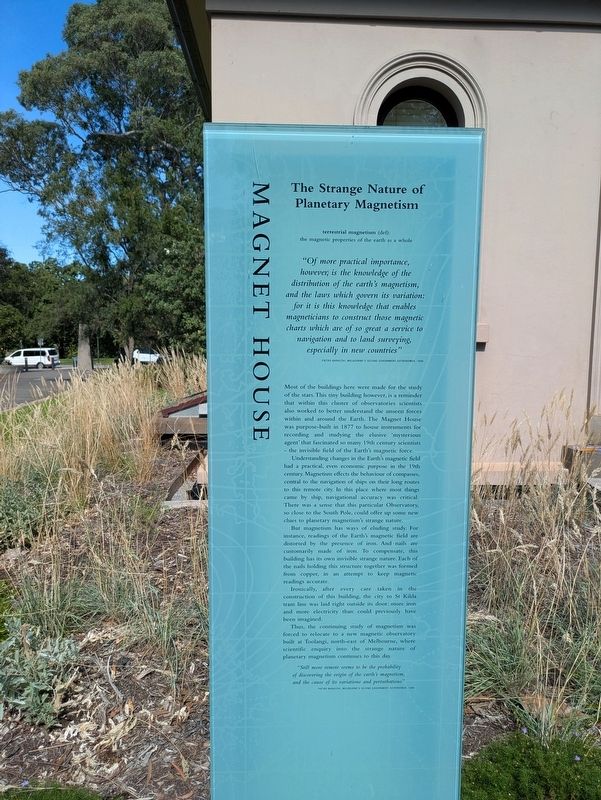
1. Magnet House Marker
The Strange Nature of Planetary Magnetism
terrestrial magnetism (def): the magnetic properties of the earth as a whole
"Of more practical importance, however, is the knowledge of the distribution of the earth's magnetism, and the laws which govern its variation: for it is this knowledge that enables magneticians to construct those magnetic charts which are of so great a service to navigation and to land surveying especially in new countries"
Pietro Barracchi, Melbourne's Second Government Astronomer
Most of the building here were made for the study of the stars. This tiny building however, is a reminder that within this cluster of observatories scientists also worked to better understand the unseen forces within and around the Earth. The Magnet House was purpose-built in 1877 to house instruments for recording and studying the elusive 'mysterious agent' that fascinated so many 19th century scientists - the invisible field of the Earth's magnetic force.
Understanding changes in the Earth's magnetic field had a practical, even economic purpose in the 19th century. Magnetism effects the behaviour of compasses,
this page online
But magnetism has ways of eluding study. For instance, readings of the Earth magnetic field are distorted by the presence of iron. And nails are customarily made of iron. To compensate, this building has its own invisible strange nature. Each of the nails holding this structure together was formed from copper, in an attempt to keep magnetic readings accurate.
Ironically, after every care taken in the construction of this building, the city to St Kilda tram line was laid right outside its door: more iron and more electricity than could previously have been imagined.
Thus the continuing study of magnetism was forced to locate to new magnetic observatory built at Toolangi, north-east of Melbourne, where scientific enquiry into the strange nature of planetary magnetism continues to this day.
"Still more remote seems to be

Photographed by Dean Barton-Ancliffe, March 30, 2026
2. Magnet House behind the Marker
Pietro Baracchi, Melbourne's Second Government Astronomer, 1898
Topics. This historical marker is listed in these topic lists: Architecture • Science & Medicine. A significant historical year for this entry is 1877.
Location. 37° 49.803′ S, 144° 58.529′ E. Marker is in Melbourne, Victoria. It is on Birdwood Avenue west of Dallas Brooks Drive, on the right when traveling north. Touch for map. Marker is in this post office area: Melbourne VIC 3004, Australia. Touch for directions.

Regionally, it is in Oceania, Australasia, the Pacific Ocean, South Pacific, the Pacific Rim, the Western World, and the Anglosphere. Historically, it finds itself in what was once a British colony.
Other nearby markers. At least 8 other markers are within walking distance of this marker: Photoheliograph House 8" South Equatorial House (within shouting distance of this marker); Observatory Building (within shouting distance of this marker); Observatory House (within shouting distance of this marker); Astrograph House (within shouting distance of this marker); King's Domain - La Trobe's Cottage (within shouting distance of this marker); Observatory Gate (within shouting distance of this marker); Gate Lodge (within shouting distance of this marker); Edward George Honey (about 90 meters away, measured in a direct line). Touch for a list and map of all markers in Melbourne.
Also see . . . Melbourne Observatory. (Submitted on March 31, 2026, by Dean Barton-Ancliffe of Rowville, Victoria.)
Credits. This page was last revised on April 1, 2026. It was originally submitted on March 30, 2026, by Dean Barton-Ancliffe of Rowville, Victoria. This page has been viewed 17 times since then. Photos: 1. submitted on March 30, 2026, by Dean Barton-Ancliffe of Rowville, Victoria. 2. submitted on March 31, 2026, by Dean Barton-Ancliffe of Rowville, Victoria. • Andrew Ruppenstein was the editor who published this page.
