Ohio City in Cleveland in Cuyahoga County, Ohio — The American Midwest (Great Lakes)
Ohio City
⎯⎯⎯
Monroe Street Cemetery
Photographed by J. J. Prats, June 21, 2019
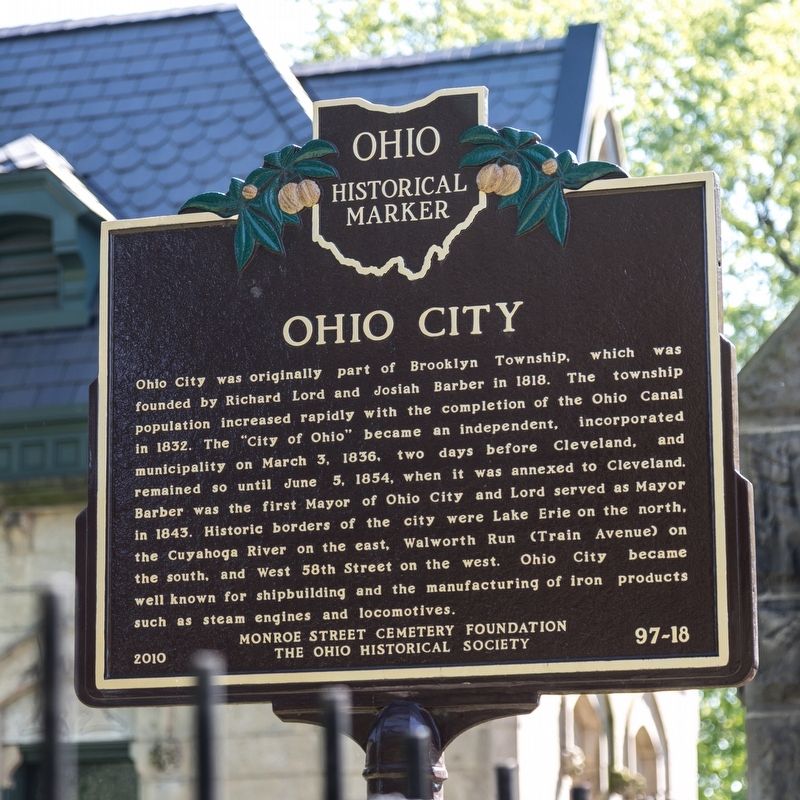
1. Ohio City side of marker
Ohio City. Ohio City was originally part of Brooklyn Township, which was founded by Richard Lord and Josiah Barber in 1818. The township population increased rapidly with the completion of the Ohio Canal in 1832. The “City of Ohio” became an independent, incorporated and municipality on March 3, 1836, two days before Cleveland, and remained so until June 5, 1854, when it was annexed to Cleveland. Barber was the first Mayor of Ohio City and Lord served as Mayor in 1843. Historic borders of the city were Lake Erie on the north, the Cuyahoga River on the east, Walworth Run (Train Avenue) on the south, and West 58th Street on the west. Ohio City became well known for shipbuilding and the manufacturing of iron products such as steam engines and locomotives.
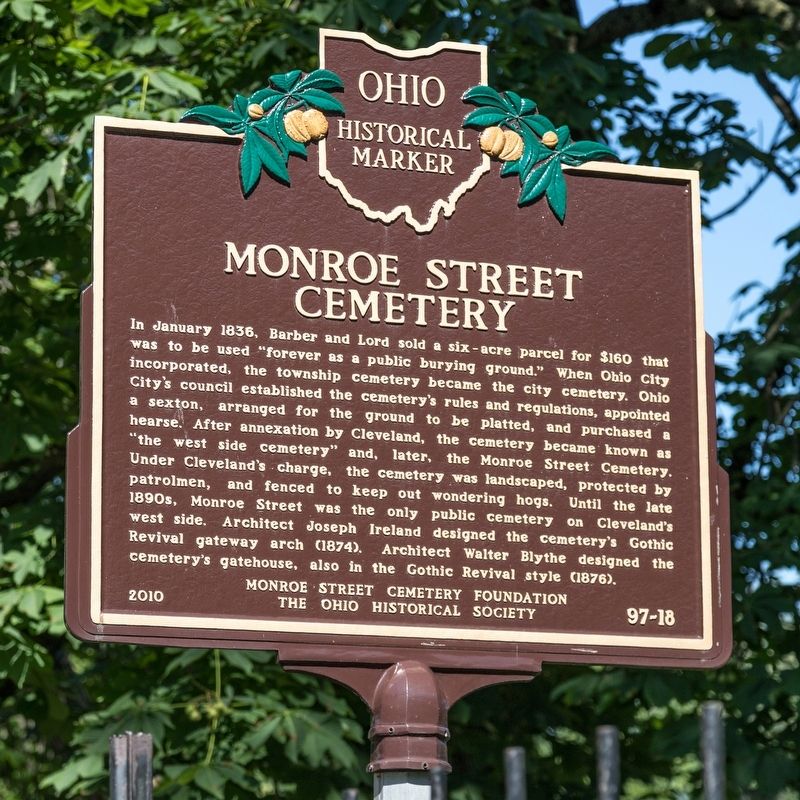
Monroe Street Cemetery. In January 1836, Barber and Lord sold a six-acre parcel for $160 that was to be used “forever as a public burying ground.” When Ohio City incorporated, the township cemetery became the city cemetery. Ohio City’s council established the cemetery’s rules and regulations, appointed a sexton, arranged for the ground to be platted, and purchased a
this page online
Erected 2010 by Monroe Street Cemetery Foundation and The Ohio Historical Society. (Marker Number 97-18.)
Topics and series. This historical marker is listed in these topic lists: Cemeteries & Burial Sites • Political Subdivisions • Settlements & Settlers. In addition, it is included in the Ohio Historical Society / The Ohio History Connection series list. A significant historical month for this entry is January 1836.
Location. Marker is missing. It was located near 41° 28.731′ N, 81° 42.39′ W. Marker was in Cleveland, Ohio, in Cuyahoga County. It was in Ohio City. It was at the intersection of Monroe Avenue and
Photographed by J. J. Prats, June 21, 2019
2. Monroe Street Cemetery side of marker

Regionally, this marker was on the Lake Erie Shore and in the Western Reserve. It was also in the American Midwest. Globally, it was in North America, on the Great Lakes, in the Western Hemisphere, in the Western World, and in the Anglosphere. Historically, it found itself in what was once the Haudenosaunee (Iroquois) Confederacy, the territory of the Mississippian Culture, and the Northwest Territory.
Other nearby markers. At least 8 other markers are within walking distance of this location: Henry Lord Whitman (a few steps from this marker); Welcome to Monroe Street Cemetery (a few steps from this marker); Jacob Baehr 1824 – 1873/Magdalena Baehr 1834 - 1909 (within shouting distance of this marker); Elias Sims (within shouting distance of this marker); Rev. James A. Thome (within shouting distance of this marker); Gustav Schaefer (within shouting distance of this marker); In memoriam (within shouting distance

Photographed by J. J. Prats, June 21, 2019
3. Monroe Street Cemetery Entrance Arch
Architect Joseph Ireland designed the cemetery’s Gothic Revival gateway arch (1874). The gatehouse is behind it on the right. The historical marker is just our of frame on the left, inside the fence line.

Photographed by J. J. Prats, June 21, 2019
4. Monroe Street Cemetery Gatehouse
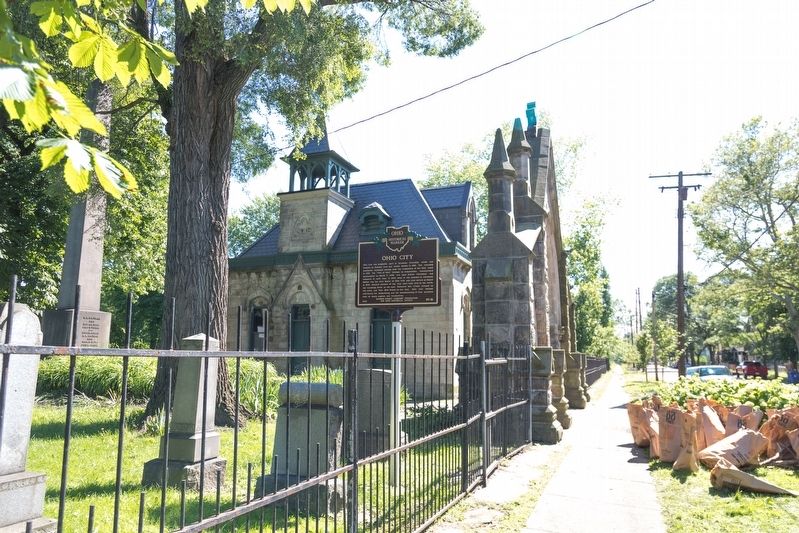
Architect Walter Blythe designed the cemetery’s gatehouse, also in the Gothic Revival style. This view is from the marker.
Photographed by J. J. Prats, June 21, 2019
5. Ohio City / Monroe Street Cemetery Marker

Photographed by Craig Doda, March 7, 2026
6. Monroe Street Cemetery entrance
Credits. This page was last revised on March 31, 2026. It was originally submitted on July 20, 2019, by J. J. Prats of Powell, Ohio. This page has been viewed 471 times since then and 39 times this year. Last updated on March 31, 2026, by Craig Doda of Napoleon, Ohio. Photos: 1, 2, 3, 4, 5. submitted on July 20, 2019, by J. J. Prats of Powell, Ohio. 6. submitted on March 22, 2026, by Craig Doda of Napoleon, Ohio. • Devry Becker Jones was the editor who published this page.
