Cleveland in White County, Georgia — The American South (South Atlantic)
Smithgall Woods is Helping to Bring Back America Chestnut Tree
Photographed by Darren Jefferson Clay, March 28, 2026
1. Smithgall Woods is Helping to Bring Back America Chestnut Tree Marker
A Valuable Tree
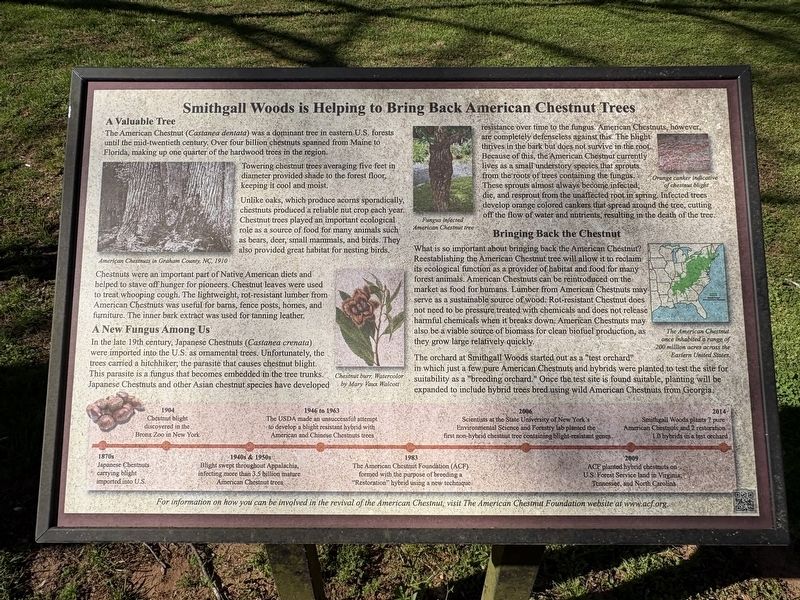
The American Chestnut (Castanea dentata) was a dominant tree in eastern U.S. forests until the mid-twentieth century. Over four billion chestnuts spanned from Maine to Florida, making up one quarter of the hardwood trees in the region.
Towering chestnut trees averaging five feet in diameter provided shade to the forest floor, keeping it cool and moist.
Unlike oaks, which produce acorns sporadically, chestnuts produced a reliable nut crop each year. Chestnut trees played an important ecological role as a source of food for many animals such as bears, deer, small mammals, and birds. They also provided great habitat for nesting birds.
Chestnuts were an important part of Native American diets and helped to stave off hunger for pioneers. Chestnut leaves were used to treat whooping cough. The lightweight, rot-resistant lumber from American Chestnuts was useful for barns, fence posts, homes, and furniture. The inner bark extract was used for tanning leather.
A New Fungus Among Us
In the late 19th century, Japanese Chestnuts (Castanea crenata) were imported into the U.S. as ornamental trees.
this page online
Bringing Back the Chestnut
What is so important about bringing back the American Chestnut? Reestablishing the American Chestnut tree will allow it to reclaim its ecological function as a provider of habitat and food for many forest animals. American Chestnuts can be reintroduced on the market as food for humans. Lumber from American Chestnuts
Photographed by Darren Jefferson Clay, March 28, 2026
2. Smithgall Woods is Helping to Bring Back America Chestnut Tree Marker
The orchard at Smithgall Woods started out as a "test orchard" in which just a few pure American Chestnuts and hybrids were planted to test the site for suitability as a "breeding orchard." Once the test site is found suitable, planting will be expanded to include hybrid trees bred using wild American Chestnuts from Georgia
Timeline
1870s- Japanese Chestnuts carrying blight imported into U.S.
1904 - Chestnut blight discovered in the Bronx Zoo in New York
1940s & 1950s - Blight swept throughout Appalachia, infecting more than 3.5 billion mature American Chestnut trees
1946 to 1963 - The USDA made an unsuccessful attempt to develop a blight resistant hybrid with American and Chinese Chestnuts trees
1983 - The American Chestnut Foundation (ACF) formed with the purpose of breeding a "Restoration" hybrid using a new technique
2006 - Scientists at the State University of New York's Environmental Science and Forestry lab planted the first non-hybrid chestnut tree containing blight-resistant genes
2009 - ACF planted hybrid chestnuts on U.S. Forest Service land in Virginia, Tennessee, and North Carolina. 2014 - Smithgall Woods plants 7 pure American Chestnuts and 2 restoration 1.0 hybrids in a test orchard
For information on how you can be involved in the revival of the American Chestnut, visit The American Chestnut Foundation website at www.acf.org.
Topics. This historical marker is listed in these topic lists: Environment • Horticulture & Forestry. A significant historical year for this entry is 1904.
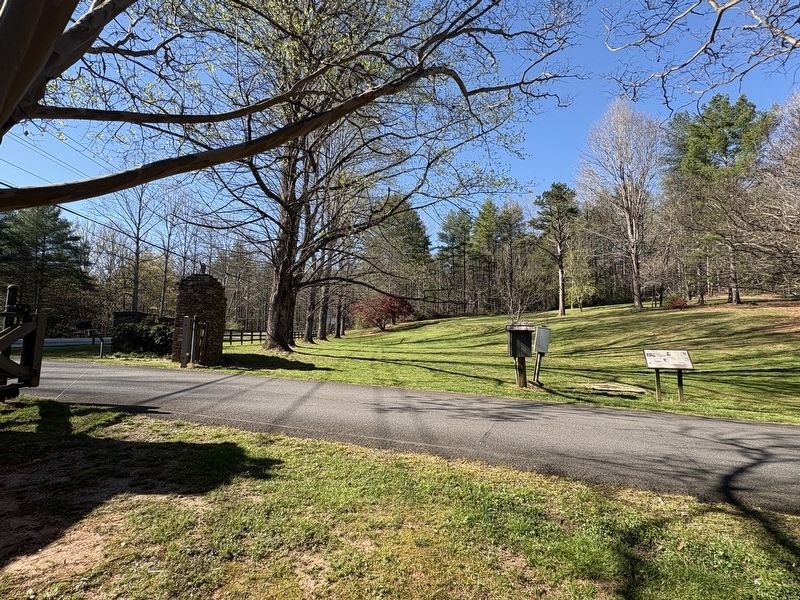
Location. 34° 41.509′ N, 83° 46.166′ W. Marker is in Cleveland, Georgia, in White County. It is on Dukes Creek Drive east of Georgia Route 75A, on the left when traveling east. Touch for map. Marker is at or near this postal address: 124 Prospect Trl, Helen GA 30545, United States of America. Touch for directions.

Regionally, this marker is in the Mountains. It is also in the American South, specifically in the Deep South, in Appalachia, and specifically in Southern Appalachia. Globally, it is in North America, the Western Hemisphere, the Western World, and the Anglosphere. Historically, it finds itself in what was once the original Cherokee Nation, the territory of the Mississippian Culture, one of the original Thirteen Colonies, one of the Confederate States of America, and the Antebellum South.
Other nearby markers. At least 8 other markers are within 4 miles of this marker, measured as the crow flies: Ronald H. Glaze - The Distinguished Service Cross (approx. 2.9 miles away); Gold, Lumber and Tourism in the North GA Hills (approx. 3.3 miles away); The Gainesville & Northwestern Railroad (approx. 3.3 miles away); The Unicoi Turnpike (approx. 3.4 miles away); The Hardman Farm Estate (approx. 3.4 miles away); Three Families at the Farm (approx. 3.4 miles away); a different marker also named Three Families at the Farm (approx. 3.4 miles away); Welcome to Hardman Farm State Historic Site (approx. 3.4 miles away).
Credits. This page was last revised on April 15, 2026. It was originally submitted on March 31, 2026, by Darren Jefferson Clay of Duluth, Georgia. This page has been viewed 22 times since then. Photos: 1, 2. submitted on March 31, 2026, by Darren Jefferson Clay of Duluth, Georgia. • Devry Becker Jones was the editor who published this page.
