East End in Melbourne, Victoria, Australia — Oceania
St Pauls Cathedral Precinct
Photographed by Dean Barton-Ancliffe, March 30, 2026
1. St Pauls Cathedral Precinct Marker
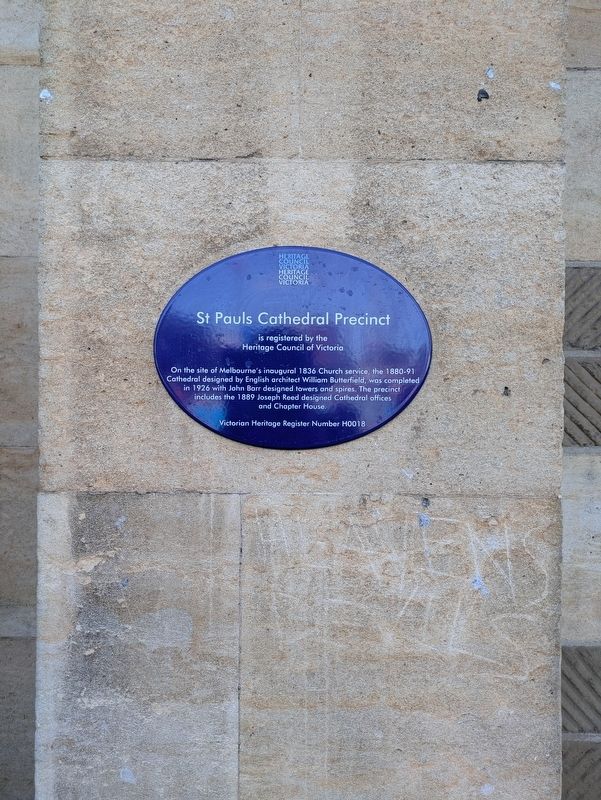
St Pauls Cathedral Precinct
is registered by the Heritage Council of Victoria
On the site of Melbourne's inaugural 1836 Church service, the 1880-91 Cathedral designed by English architect William Butterfield, was completed in 1926 with John Barr designed towers and spires. The precinct includes the 1889 Joseph Reed designed Cathedral offices and Chapter House.
Victorian Heritage Register Number H0018
Erected by Heritage Council of Victoria. (Marker Number H0018.)
Topics. This historical marker is listed in these topic lists: Architecture • Colonial Era • Religion & Religious Structures. A significant historical year for this entry is 1880.
Location. 37° 49.028′ S, 144° 58.068′ E. Marker is in Melbourne, Victoria. It is in East End. It is at the intersection of Flinders Street and Swanston Street, on the left when traveling east on Flinders Street. The marker is to the right of the main door facing Flinders Street. Touch for map. Marker is at or near this postal address: 198 Flinders Street, Melbourne VIC 3000, Australia. Touch for directions.

Regionally, it is in Oceania, in Australasia, in the Pacific
this page online
Other nearby markers. At least 8 other markers are within walking distance of this marker: The First Melbourne Land Auction (within shouting distance of this marker); Princes Bridge Hotel (within shouting distance of this marker); St Paul's Cathedral c1860 (about 120 meters away, measured in a direct line); You Should Have Seen It (about 180 meters away); Duke of Wellington Hotel (about 210 meters away); Town Hall Foundation Stone (about 210 meters away); The Athenaeum Building (about 210 meters away); The Melbourne Athenaeum (about 210 meters away). Touch for a list and map of all markers in Melbourne.
Also see . . . St Pauls Cathedral.
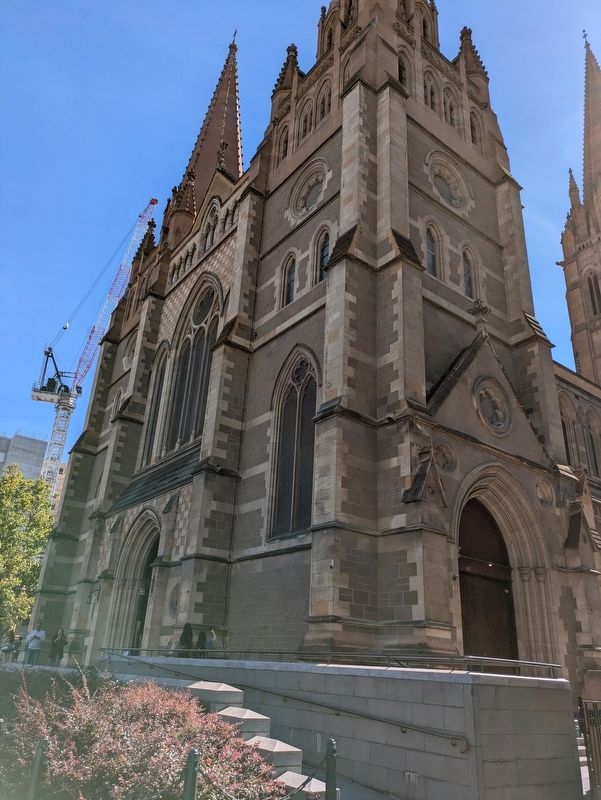
St Paul’s Cathedral has been an integral part of Christian Melbourne since the city’s foundation: it stands on the site where the first public Christian services in Melbourne were led by Dr Alexander Thomson in 1836. From 1836 to 1848 the site on which the Cathedral stands served as a corn market for the growing city. In 1848,(Submitted on April 6, 2026, by Dean Barton-Ancliffe of Rowville, Victoria.)it was granted to the Anglican Church to build the bluestone St Paul’s Parish Church. Consecrated in 1852, St Paul’s Church was used until 1885 when it was demolished to make way for the liturgical West-end of the present Cathedral.Photographed by Dean Barton-Ancliffe, March 30, 20262. St Pauls Cathedral
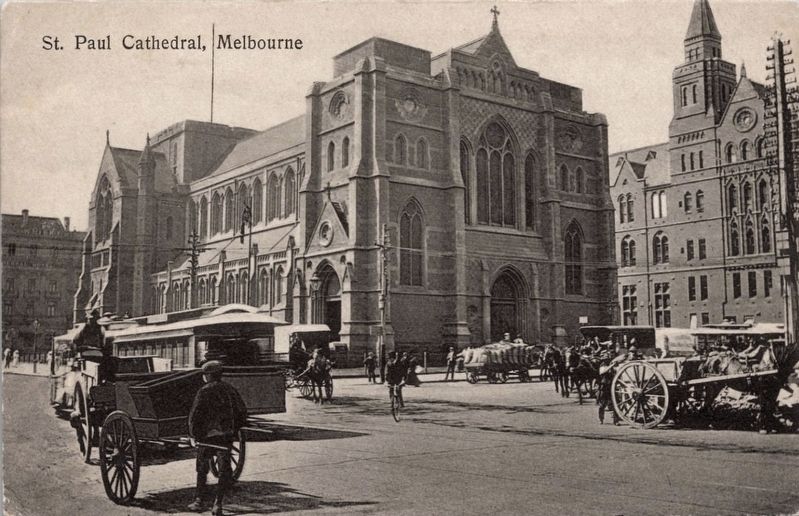
The Cathedral’s foundation stone was laid in 1880, and work continued for eleven years, leading to the consecration of St Paul’s Cathedral on 22 January 1891. The construction of the three spires did not begin until 1926, to a revised design of John Barr of Sydney rather than the original design of an octagonal central tower and gable west end towers of Butterfield. The central spire is the second highest in the Anglican Communion, after Salisbury Cathedral.
Like European Cathedrals, St Paul’s also relies on the services of traditional craftspeople to maintain the historic building. In the 1960s a first restoration of the exterior of the Cathedral took place, in 1989 the Cathedral’s magnificent organ was restored. In 2009, extensive restoration works were carried out to the exterior and interior of the Cathedral. More recently, the historic office buildings at St Paul’s House, immediately adjacentto the Cathedral were extensively restored to provide new ministry and administrative facilities for the Cathedral and Diocese of Melbourne.circa 19103. St Paul Cathedral, Melbourne (pre-spires)
Credits. This page was last revised on April 6, 2026. It was originally submitted on April 6, 2026, by Dean Barton-Ancliffe of Rowville, Victoria. This page has been viewed 16 times since then. Photos: 1, 2. submitted on April 6, 2026, by Dean Barton-Ancliffe of Rowville, Victoria. 3. submitted on April 6, 2026. • Andrew Ruppenstein was the editor who published this page.
