Memphis in Shelby County, Tennessee — The American South (East South Central)
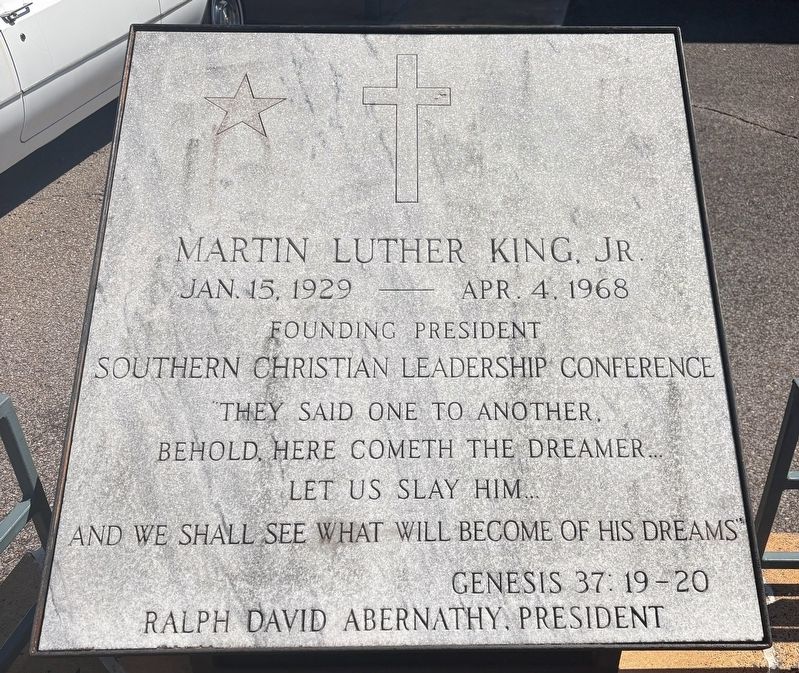
Martin Luther King, Jr.
Jan. 15, 1929 — Apr. 4, 1968
Photographed by Sean P. Flynn, March 29, 2026
1. Martin Luther King, Jr. Marker
Southern Christian Leadership Conference
”They said one to another.Ralph David Abernathy, President
Behold, here cometh the dreamer...
Let us slay him...
And we shall see what will become of his dreams”
Genesis 37:19-20
Erected 1968 by Southern Christian Leadership Conference.
Topics and series. This historical marker is listed in these topic lists: African Americans • Civil Rights • Religion & Religious Structures. In addition, it is included in the Martin Luther King, Jr. series list. A significant historical date for this entry is April 4, 1968.
Location. 35° 8.073′ N, 90° 3.465′ W. Marker is in Memphis, Tennessee, in Shelby County. It is on Mulberry Street north of Butler Avenue, on the right when traveling north. The square marker is near the entrance to the National Civil Rights Museum, just below the Lorraine Motel balcony where Martin Luther King was assassinated. Touch for map. Marker is at or near this postal address: 450 Mulberry Street, Memphis TN 38103, United States of America. Touch for directions.

Regionally, this marker is in West Tennessee. It is also in the American South,
this page online
Other nearby markers. At least 8 other markers are within walking distance of this marker: Lorraine Motel Vintage Cars (here, next to this marker); Here, on April 4, 1968 … / … Today, a Place of Remembrance (here, next to this marker); The Lorraine Motel (here, next to this marker); Founders Park Banners (within shouting distance of this marker); Founders Park (within shouting distance of this marker); Welcome To The National Civil Rights Museum (within shouting distance of this marker); The Blues Foundation (about 300 feet away, measured in a direct line); WLOK Radio Station (about 600 feet away). Touch for a list and map of all markers in Memphis.
More about this marker. Based on contemporary photographs, it is believed that this memorial was unveiled

Photographed by Sean P. Flynn, March 29, 2026
2. Martin Luther King, Jr. Marker at the Lorraine Motel
The wreath on the balcony is a replica of the one posted there after Martin Luther King was assassinated at that spot on April 4, 1968.
Later photographs indicate that the memorial was displayed next to the door to Room 306 for several years before being moved to its current location. One 1971 photo shows this memorial plaque in the window next to the door, and above that the words "I have been to the mountain top," a reference to King's final speech, which he gave in Memphis on April 3, the day before he died.
The Lorraine
Photographed by Sean P. Flynn, March 29, 2026
3. Martin Luther King, Jr.'s assassination site
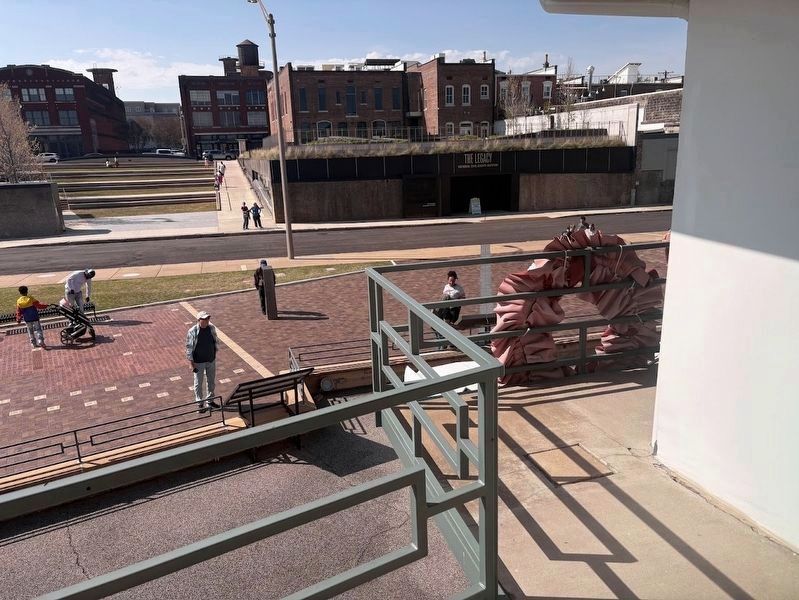
The memorial is visible on the street in this photo taken from the site of the Lorraine Motel's Rome 306. The square in the balcony's pavement is where Martin Luther King was standing when he was shot on April 4, 1968. James Earl Ray, who was convicted for King's murder, is believed to have fired the shot from the building across the street (below the word "Legacy"), where he had been staying in a boarding house.
Regarding Martin Luther King, Jr.. Ralph Abernathy was Martin Luther King's close confidante and his lieutenant on the Southern Christian Leadership Conference (SCLC), the prominent civil rights organization for which Dr. King was the first president. In fact, Abernathy was originally going to be the main speaker on the evening of April 3, 1968, at Mason Temple in Memphis, but he saw the crowd and convinced Dr. King to come and give the address. Instead, Abernathy was the introductory speaker for Dr. King, who went on to give the "Mountaintop" speech that ended up as the last before his death. At the beginning of that speech, Dr. King thanked Abernathy for the kind words and said, "Ralph Abernathy is the best friend I have in the world." The next evening, Abernathy was among the civil rights leaders standing on the balcony of the Lorraine Motel outside Room 306 when Dr. King was shot and killed by an assassin.
Abernathy was immediately named the successor as leader of SCLC. On the morning of April

Photographed by Sean P. Flynn, March 29, 2026
4. National Civil Rights Museum
The museum is located at the site of the Lorraine Motel, where Martin Luther King was assassinated on April 4, 1968.
Also see . . .
1. Crowd outside Lorraine Motel after the assassination of Dr. Martin Luther King, Jr. This image, held by the Smithsonian Institution, shows a large crowd outside the Lorraine Motel, where Ralph Abernathy and King family members are unveiling this plaque in honor of Dr. King. According to the Smithsonian, this photo was taken on May 2, 1968.
Description: "A black-and-white photograph of a large crowd gathered outside the Lorraine Motel after the assassination of Martin Luther King, Jr. Microphones and speakers are set up on the crowded second story balcony. A few members of CBS News have set up on the roof."(Submitted on April 10, 2026, by Sean P. Flynn of Oak Park, Illinois.)
2. National Civil Rights Museum official site. (Submitted on April 8, 2026, by Sean P. Flynn of Oak Park, Illinois.)
3. Southern Christian Leadership Conference. From the New Georgia Encyclopedia.
Excerpt: "The assassination of Martin Luther King Jr. on April 4, 1968, thrust Abernathy into the organization’s presidency. Abernathy could not match King’s leadership talents, however, and schisms in the leadership and difficulty with fund-raising led to the SCLC’s marked decline in influence. In 1977 when Abernathy resigned to run for Congress, [Joseph] Lowery succeeded him as president."(Submitted on April 9, 2026, by Sean P. Flynn of Oak Park, Illinois.)
Credits. This page was last revised on April 15, 2026. It was originally submitted on April 8, 2026, by Sean P. Flynn of Oak Park, Illinois. This page has been viewed 48 times since then. Photos: 1, 2, 3, 4. submitted on April 8, 2026, by Sean P. Flynn of Oak Park, Illinois.
