Mound Township near Luverne in Rock County, Minnesota — The American Midwest (Upper Plains)
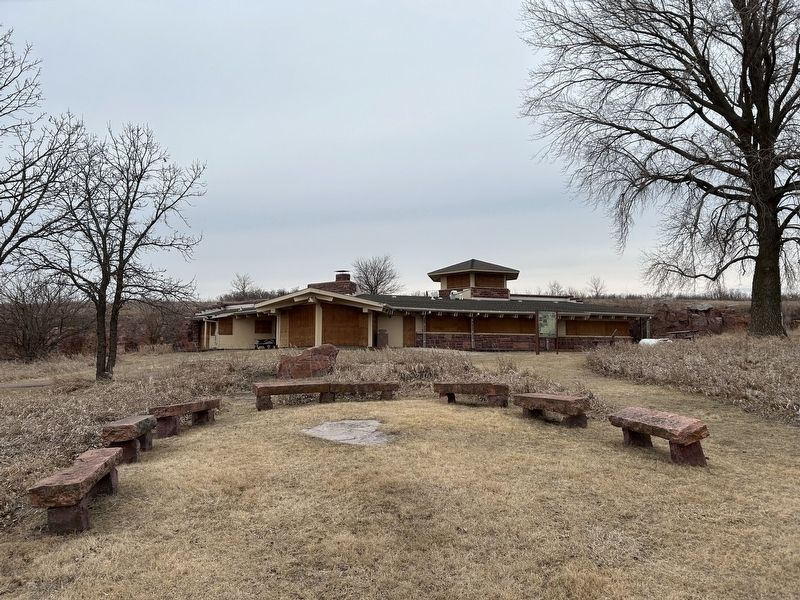
Blue Mounds State Park Interpretive Center
Telling Stories of Yesterday and Today
March 14, 2026
1. Blue Mounds State Park Interpretive Center Marker
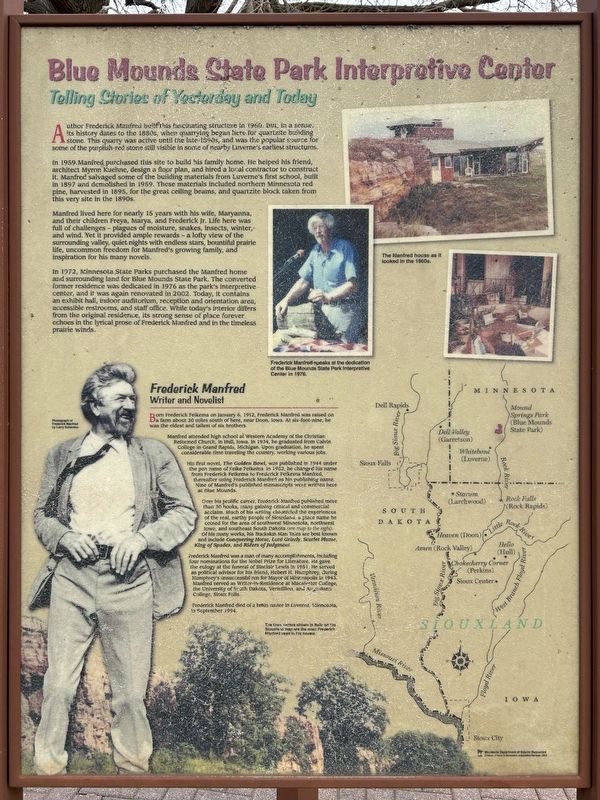
In 1959 Manfred purchased this site to build his family home. He helped his friend, architect Myron Kuehne, design a floor plan, and hired a local contractor to construct it. Manfred salvaged some of the building materials from Luverne's first school, built in 1897 and demolished in 1959. These materials included northern Minnesota red pine, harvested in 1895, for the great ceiling beams, and quartzite block taken from this very site in the 1890s.
Manfred lived here for nearly 15 years with his wife, Maryanna, and their children Freya, Marya, and Frederick Jr. Life here was full of challenges – plagues of moisture, snakes, insects, winter, and wind. Yet it provided ample rewards – a lofty view of the surrounding valley, quiet nights with endless stars, bountiful prairie life,
this page online
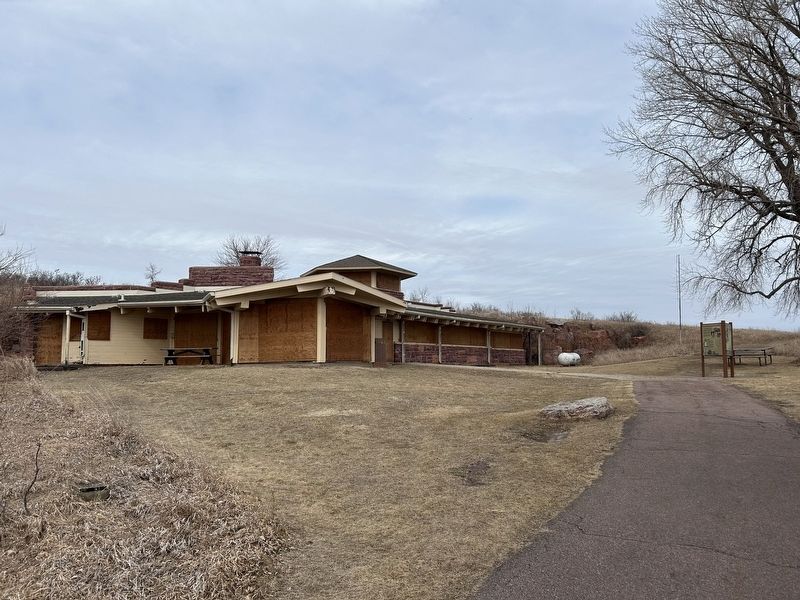
In 1972, Minnesota State Parks purchased the Manfred home and surrounding land for Blue Mounds State Park. The converted former residence was dedicated in 1976 as the park's interpretive center, and it was again renovated in 2002. Today, it contains an exhibit hall, indoor auditorium, reception and orientation area, accessible restrooms, and staff office. While today's interior differs from the original residence, its strong sense of place forever echoes in the lyrical prose of Frederick Manfred and in the timeless prairie winds.
Frederick Manfred speaks at the dedication of the Blue Mounds State Park Interpretive Center in 1976.
The Manfred house as it looked in the 1960s.
Frederick Manfred
Writer and Novelist
Born Frederick Feikema on January 6, 1912, Frederick Manfred was raised on a farm about 20 miles south of here, near Doon, Iowa. At six-foot-nine, he was the eldest and tallest of six brothers.
Manfred attended high school at Western Academy of the Christian Reformed Church, in Hull, Iowa. In 1934, he graduated from Calvin College
March 14, 2026
2. Blue Mounds State Park Interpretive Center & Marker
His first novel, The Golden Bowl, was published in 1944 under the pen name of Feike Feikema. In 1952, he changed his name from Frederick Feikema to Frederick Feikema Manfred, thereafter using Frederick Manfred as his publishing name. Nine of Manfred's published manuscripts were written here at Blue Mounds.
Over his prolific career, Frederick Manfred published more than 30 books, many gaining critical and commercial acclaim. Much of his writing chronicled the experiences of the real, earthy people of Siouxland, a place name he coined for the area of southwest Minnesota, northwest Iowa, and southeast South Dakota (see map to the right). Of his many works, his Buckskin Man Tales are best known and include Conquering Horse, Lord Grizzly, Scarlet Plume, King of Spades, and Riders of Judgment.
Frederick Manfred was a man of many accomplishments, including four nominations for the Nobel Prize for Literature. He gave the eulogy at the funeral of Sinclair Lewis in 1951. He served as political advisor for his friend, Hubert
March 14, 2026
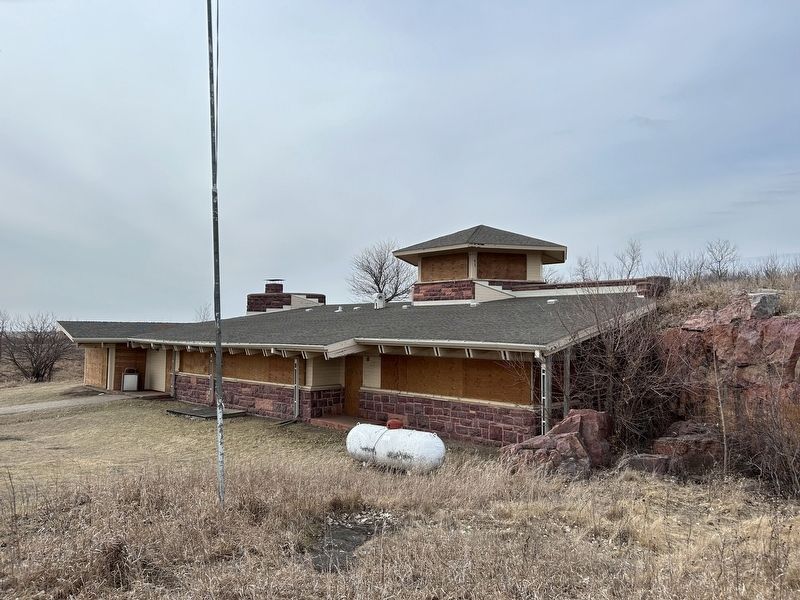
3. Blue Mounds State Park Interpretive Center
Frederick Manfred died of a brain tumor in Luverne, Minnesota, in September 1994.
Photograph of Frederick Manfred by Larry Schermer
The town names shown in italic on the Siouxland map are the ones Frederick Manfred used in his novels.
Dell Rapids · Sioux Falls · Dell Valley (Garretson) · Whitebone (Luverne) · Mound Springs Park (Blue Mounds State Park) · Starum (Larchwood) · Rock Falls (Rock Rapids) · Heaven (Doon) · Amen (Rock Valley) · Chokecherry Corner (Perkins) · Hello (Hull) · Sioux Center · Sioux City
Erected 2004 by Minnesota Department of Natural Resources Division of Parks & Recreation, Interpretive Services.
Topics. This historical marker is listed in these topic lists: Arts, Letters, Music • Parks & Recreational Areas. A significant historical date for this entry is January 6, 1912.
Location. 43° 41.497′ N, 96° 11.75′ W. Marker is near Luverne, Minnesota, in Rock County.
March 14, 2026
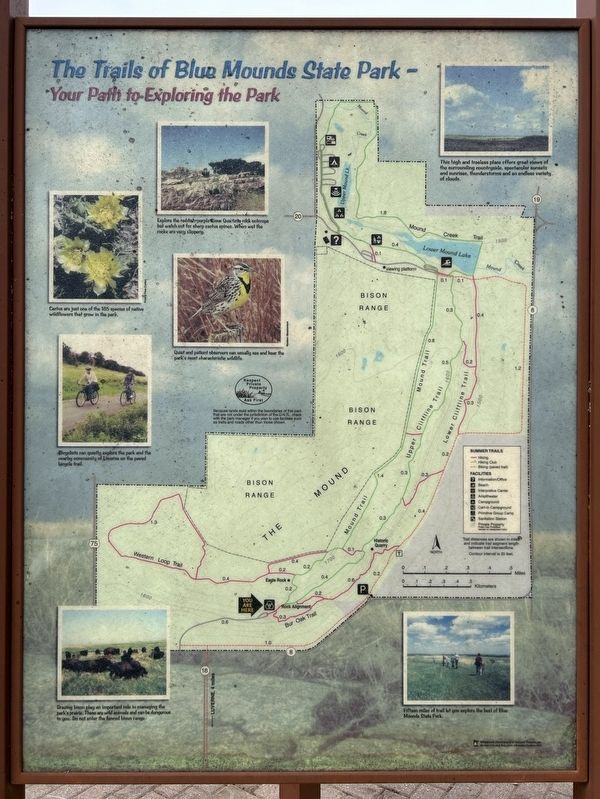
4. The Trails of Blue Mounds State Park, Adjacent Marker

Regionally, this marker is in Southwest Minnesota. It is also in the American Midwest, in the Corn Belt, and on the Great Plains. Globally, it is in North America, the Western Hemisphere, the Western World, and the Anglosphere. Historically, it finds itself in what was once Rupert’s Land, the territory of the Mississippian Culture, and the Louisiana Purchase.
Other nearby markers. At least 7 other markers are within 15 miles of this marker, measured as the crow flies: Prairie Passage / Tallgrass Prairie / Prairie Passage Route (approx. 0.9 miles away); a different marker also named Prairie Passage / Tallgrass Prairie / Prairie Passage Route (approx. 1.6 miles away); Rock County Veterans Memorial (approx. 2½ miles away); Home of the Blue Goose (approx. 5.2 miles away); Preserving the Prairie
March 14, 2026
5. Blue Mounds State Park Interpretive Center Area
Stones' inscriptions:
Native Prairie Wildflower Garden
Dedicated to the memory Carrie Nelson who died on May 20, 2001 while working at Blue Mounds State Park
"Beside a withering flower is a bud about to bloom. Many seeds remain after a flower dies. How similar to a flower is life."
Hoshino Tomihiro
Native Prairie Wildflower Garden
Dedicated to the memory Carrie Nelson who died on May 20, 2001 while working at Blue Mounds State Park
"Beside a withering flower is a bud about to bloom. Many seeds remain after a flower dies. How similar to a flower is life."
Hoshino Tomihiro
Also see . . .
1. Preservation group hopes to reignite conversations with DNR about fate of Manfred House | MPR News. July 21, 2022 article by Hannah Yang for Minnesota Public Radio News. (Submitted on April 9, 2026.)
2. Photos from the Frederick F. Manfred Papers | Save the Manfred House. Historical photos of the Manfred House (Blue Mounds State Park Interpretive Center). (Submitted on April 9, 2026.)
Credits. This page was last revised on April 11, 2026. It was originally submitted on April 9, 2026. This page has been viewed 52 times since then. Photos: 1, 2, 3, 4, 5. submitted on April 9, 2026.
