Spotsylvania Courthouse in Spotsylvania County, Virginia — The American South (Mid-Atlantic)
U. S. Colored Troops in Spotsylvania
Photographed by Bernard Fisher, June 21, 2015
1. U. S. Colored Troops in Spotsylvania Marker
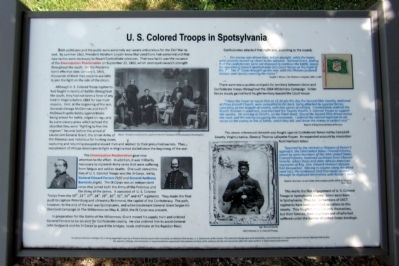
Both politicians and the public were extremely war-weary and anxious for the Civil War to end. By summer 1862, President Abraham Lincoln knew that conditions had worsened and that new tactics were necessary to thwart Confederate advances. That new tactic was the issuance of the Emancipation Proclamation on September 22, 1862, which destroyed slavery’s strength throughout the south. On the Proclamation's effective date, January 1, 1863, thousands of black men became available to join the fight on the side of the Union.
Although U. S. Colored Troop regiments had fought in nearly all battles throughout the south, they had not been a force of any kind in Virginia before 1864 for two main reasons. First, at the beginning of the war, Generals George McClennan and lrvin McDowell spoke boldly against blacks being armed for battle, edged on regularly by a pro-slavery press which echoed the idea that they were "fighting to free the negroes.” Second, before the arrival of Lieutenant General Grant, the Union Army of the Potomac was notorious for hunting down, capturing and returning escaped enslaved men and women to their
this page online
The Emancipation Proclamation gave new attention to the effort. In addition, it was militarily necessary to replenish Army ranks that were suffering from fatigue and soldier deaths. One such concentration of U.S. Colored Troops was the IX Corps, led by General Edward Ferrero (left) and General Ambrose Burnside (right). The IX Corps was an independent corps that joined both the Army of the Potomac and the Army of the James. It consisted of U.S. Colored Troops from the 19th, 23rd, 27th, 28th, 29th, 30th, 31st, 39th and 43rd regiments. They made the final push to capture Petersburg and ultimately Richmond, the capitol of the Confederacy. The path, however, to the end of the war was Spotsylvania, and when Lieutenant General Grant began his Overland Campaign at The Wilderness on May 4, 1864, the IX Corps was present.
In preparation for the Battle of the Wilderness, Grant moved his supply train and ordered General Ferrero to be on alert for Confederate cavalry. He also ordered him to assist General John Sedgwick and
Photographed by Bernard Fisher, June 21, 2015
2. U. S. Colored Troops in Spotsylvania Marker
Confederates attacked that night and, according to the record,
“…the enemy was driven back before daylight, while the trains were securely moved up closer to the advance. General Grant, finding that the confederates were not disposed to continue the battle, begun the movement toward Spottsylvania (sic) Court House on the night of the 7th. The 9th Corps brought up the rear, with the Phalanx [colored] division and cavalry covering the trains.”
Joseph T. Wilson, The Phalanx in Virginia, 1897, p 387.
There were many pushes and pulls for territory between Union and Confederate troops throughout the 1864 Wilderness Campaign. Union forces slowly gained hard-fought territory toward the Court House.
"I have the honor to report that at 12:30 pm this day the Second Ohio Cavalry, stationed at Piney Branch Church, were compelled to fall back, being attacked by superior forces, consisting of one brigade of cavalry, with two pieces of artillery. I immediately ordered the Fourth Division in readiness, and marched the Twenty-third U.S. Colored Troops to support the cavalry. On arriving at AIrich's, on the Plank Road, I found the Second Ohio driven across the road, and the enemy occupying the crossroads. I ordered the colored regiment to advance on the enemy in line of battle, which they did, and drove the enemy in perfect rout."
Report
Photographed by Bernard Fisher
3. Wilderness Elementary School Markers
The above referenced skirmish was fought against Confederate forces led by Campbell County, Virginia native, General Thomas Lafayette Rosser. An expanded account by researcher Noel Harrison notes:
"Apprised by the retreating Ohioans of Rosser’s approach, the 23rd United States Colored Infantry, joined by some members of the 30th United States Colored Infantry, hastened southeast from Chancellorsville, where those and other African American regiments of Brig. Gen. Edward Ferrero’s division had bivouacked. Moving in column along the plank road (sic), the reinforced 23rd first made contort through its deployed skirmishers with Rosser’s men.”
Noel G. Harrison, In our midst: first combat of the USCTs in Virginia, June 2010
This marks the first engagement of U.S. Colored Troops in Spotsylvania County. Some were born in Spotsylvania. Thus far, 16 members of USCT regiments have been identified as natives to this county. They fought to free not only themselves, but their families, their neighbors and all who had suffered under the banner of United States bondage.
(captions)
Above: President Lincoln and his cabinet at the first reading of the Emancipation Proclamation.
Sgt. Nimrod Burke, 23rd Infantry, U.S. Colored Troops
Topics and series. This historical marker is listed in these topic lists: African Americans • War, US Civil. In addition, it is included in the Former U.S. Presidents: #16 Abraham Lincoln, and the Former U.S. Presidents: #18 Ulysses S. Grant series lists. A significant historical month for this entry is January 1987.
Location. This marker has been replaced by another marker nearby. It was located near 38° 16.524′ N, 77° 37.512′ W. Marker was in Spotsylvania Courthouse, Virginia, in Spotsylvania County. It could be reached from Catharpin Road (County Route 612) 0.9 miles south of Old Plank Road (County Route 610), on the right when traveling south. The marker stands at the entrance to Wilderness Elementary School. Touch for map. Marker was at or near this postal address: 11600 Catharpin Rd, Spotsylvania VA 22553, United States of America. Touch for directions.

Regionally, this marker was in the Washington Metropolitan Area, in Northern Virginia, and in the Piedmont. It was also in the American South, specifically in the Upper South, in the Mid-Atlantic, and on the Eastern Seaboard. Globally, it was in the North Atlantic Region, North America, the Western Hemisphere, the Western World, and the Anglosphere. Historically, it found itself in what was once the territory of the Mississippian Culture, one of the original Thirteen Colonies, one of the Confederate States of America, and the Antebellum South.
Other nearby markers. At least 8 other markers are within 2 miles of this location, measured as the crow flies: First Shots of Freedom (here, next to this marker); U.S. Colored Troops (here, next to this marker); Heroics of Sgt. Benjamin Brown (here, next to this marker); 23rd USCT At the Alrich Farm (approx. half a mile away); Jackson on the Move (approx. 1.1 miles away); Matthew Fontaine Maury (approx. 1.1 miles away); Maury House Trail (approx. 1.1 miles away); Ordeal of the Wellfords (approx. 1.2 miles away). Touch for a list and map of all markers in Spotsylvania Courthouse.
Other markers no longer nearby. Sergeant Benjamin Brown (was here, next to this marker but has been replaced with another marker now near it); The Wilderness and the Overland Campaign (was here, next to this marker but has been permanently removed).
Also see . . . Spotsylvania African American Heritage Trail. (Submitted on June 22, 2015.)
Additional keywords. USCT
Credits. This page was last revised on April 13, 2026. It was originally submitted on June 22, 2015, by Bernard Fisher of Richmond, Virginia. This page has been viewed 847 times since then and 40 times this year. Last updated on April 12, 2026, by Mike McKeown of Baltimore, Maryland. Photos: 1, 2, 3. submitted on June 22, 2015, by Bernard Fisher of Richmond, Virginia. • Devry Becker Jones was the editor who published this page.
