
Spotsylvania Courthouse in Spotsylvania County, Virginia — The American South (Mid-Atlantic)
The Wilderness and the Overland Campaign
Photographed by Bernard Fisher, June 21, 2015
1. The Wilderness and the Overland Campaign Marker
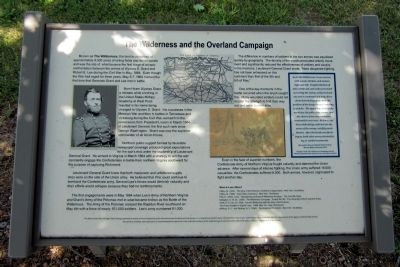
Known as The Wilderness, the land is comprised of approximately 9,000 acres of rolling fields and dense woods and was the site of what became the first stage of an epic a confrontation between the armies of Ulysses S. Grant and Robert E. Lee during the Civil War in May, 1864. Even though the War had raged for three years, May 5-7, 1864 marked the first time that Generals Grant and Lee met in battle.
Born Hiram Ulysses Grant, a mistake while enrolling in the United States Military Academy at West Point resulted in his name being changed to Ulysses S. Grant. His successes in the Mexican War and then in battles in Tennessee and Vicksburg during the Civil War, earned him the commission from President Lincoln in March 1864 of Lieutenant General, the first such rank since George Washington. Grant was now the supreme commander of all Union forces.
Northern public support fanned by favorable newspaper coverage produced great expectations for the war‘s end under the leadership of Lieutenant General Grant. He arrived in Virginia in March 1864 with a strategy to win the war: constantly engage the Confederates
this page online
Lieutenant General Grant knew that both manpower and unfettered supply lines were on the side of the Union army. He believed that if he could continue to bombard the Confederate army, General Lee's forces would diminish naturally and their efforts would collapse because they had no reinforcements.
The first engagements were in May 1864 when Lee's Army of Northern Virginia and Grant's Army of the Potomac met in what became known as the Battle of the Wilderness. The Army of the Potomac crossed the Rapidan River southward on May 4th with a force of nearly 101,000 soldiers. Lee’s army numbered 61,000.
The difference in numbers of soldiers in the two armies was equalized quickly by geography. The density of the woods precluded orderly movement and significantly reduced the effectiveness of artillery and cavalry. In his memoirs, Lieutenant General Grant wrote, “More desperate fighting has not been witnessed on this continent than that of the 5th and 6th of May."
One of the key moments in the' battle occurred when the brush caught
Photographed by Bernard Fisher, June 21, 2015
2. The Wilderness and the Overland Campaign Marker
Even in the face of superior numbers, the Confederate Army of Northern Virginia fought valiantly and deterred the Union advance. After several days of intense fighting, the Union army suffered 18,000 casualties; the Confederates suffered 6,000. Both armies, however, regrouped to fight another day.
Want to Learn More?
Catton, B. (1953) The Army of the Potomac: A stillness at Appomattox. New York: Doubleday.
Catton, B. (1968) Grant Takes Command New York: Doubleday
Fitts, D. (2002, June) "Spectacular purchase of Wilderness Acreage" The War News
Gallagher, G.W. ed. (1997) The Wilderness Campaign Chapel Hill, NC: The University of North Carolina Press
Scott, R.G. (rev. ed. 1992) Into the Wilderness with the Army of the Potomac
“The Field of Battle in Virginia" map. (1864, May 14) New York Herald
Whitney, D.C. and Whitney, R.V. (1985) The American Presidents. New York: Doubleday
(sidebar)
As for the Wilderness, it was uneven, with woods, thickets, and ravines right and left. Tangled thickets of pine,
Photographed by Bernard Fisher, June 21, 2015
3. The Wilderness and the Overland Campaign Marker
Alexander Stewart Webb (1835-1911), Brevet Major-General, USA
Fought in both The Wilderness Campaign and the Battle of Spotsylvania where he was seriously wounded.
The African American Heritage Trail is supported in part by a Preserve America grant administered by the National Park Service, United States Department of the Interior. This product is based upon work assisted by a grant from the U.S. Department of the Interior, National Park Service. Any opinions, findings, conclusions or recommendations expressed in this material are those of the author and do not necessarily reflect the views of the U.S. Department of the Interior.
Erected 2015 by Spotsylvania African American Heritage Trail.
Topics and series. This historical marker is listed in these topic lists: African Americans • War, US Civil. In addition, it is included in the Former U.S. Presidents: #16 Abraham Lincoln, and the Former U.S. Presidents: #18 Ulysses S. Grant series lists. A significant historical month for this entry is March 1864.
Location. Marker has been permanently removed. It was located near 38° 16.524′ N, 77° 37.51′ W. Marker was in Spotsylvania Courthouse, Virginia, in Spotsylvania County. It could be reached from Catharpin Road (County Route 612) 0.9 miles Old Plank Road (County Route 610), on the right when traveling south. Located at the entrance to Wilderness Elementary School. Touch for map. Marker was at or near this postal address: 11600 Catharpin Rd, Spotsylvania VA 22553, United States of America.
We have been informed that this marker is no longer there and will not be replaced. This page is an archival view of what was.
Regionally, this marker was in the Washington Metropolitan Area, in Northern Virginia, and in the Piedmont. It was also in the American South, specifically in the Upper South, in the Mid-Atlantic, and on the Eastern Seaboard. Globally, it was in the North Atlantic Region, North America, the Western Hemisphere, the Western World, and the Anglosphere. Historically, it found itself in what was once the territory of the Mississippian Culture, one of the original Thirteen Colonies, one of the Confederate States of America, and the Antebellum South.

Other nearby markers. At least 8 other markers are within 2 miles of this location, measured as the crow flies: First Shots of Freedom (here, next to this marker); U.S. Colored Troops (here, next to this marker); Heroics of Sgt. Benjamin Brown (a few steps from this marker); 23rd USCT At the Alrich Farm (approx. half a mile away); Jackson on the Move (approx. 1.1 miles away); Matthew Fontaine Maury (approx. 1.1 miles away); Maury House Trail (approx. 1.1 miles away); Ordeal of the Wellfords (approx. 1.2 miles away). Touch for a list and map of all markers in Spotsylvania Courthouse.
Other markers no longer nearby. U. S. Colored Troops in Spotsylvania (was here, next to this marker but has been replaced with another marker now near it); Sergeant Benjamin Brown (was here, next to this marker but has been replaced with another marker now near it).
Also see . . . Spotsylvania African American Heritage Trail. (Submitted on June 22, 2015.)
Credits. This page was last revised on April 13, 2026. It was originally submitted on June 22, 2015, by Bernard Fisher of Richmond, Virginia. This page has been viewed 686 times since then and 37 times this year. Last updated on April 12, 2026, by Mike McKeown of Baltimore, Maryland. Photos: 1, 2, 3. submitted on June 22, 2015, by Bernard Fisher of Richmond, Virginia. • Devry Becker Jones was the editor who published this page.
