Bloomingdale in Northwest Washington in Washington, District of Columbia — The American Northeast (Mid-Atlantic)
Iconic Landmark
⎯⎯⎯
Fitting Tribute
McMillan Sand Filtration Plant
| — | 1905-1986 | — |
Photographed by Shirley A Stirling, April 8, 2026
1. Iconic Landmark
Iconic Landmark
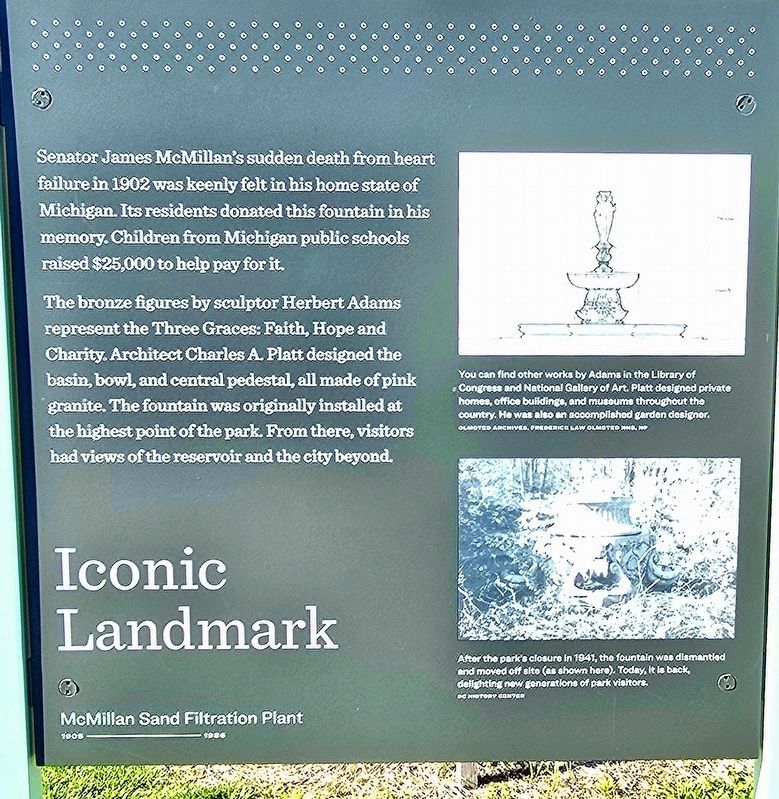
Senator James McMillan's sudden death from heart failure in 1902 was keenly felt in his home state of Michigan. Its residents donated this fountain in his memory. Children from Michigan public schools raised $25,000 to help pay for it. The bronze figures by sculptor Herbert Adams represent the Three Graces: Faith, Hope and Charity. Architect Charles A. Platt designed the basin, bowl, and central pedestal, all made of pink granite. The fountain was originally installed at the highest point of the park. From there, visitors had views of the reservoir and the city beyond.
[Captions:]
You can find other works by Adams in the Library of Congress and National Gallery of Art. Platt designed private homes, office buildings, and museums throughout the country. He was also an accomplished garden designer.
After the park's closure in 1941, the fountain was dismantled and moved off-site (as shown here). Today, it is back, delighting new generations of park visitors.
Fitting Tribute
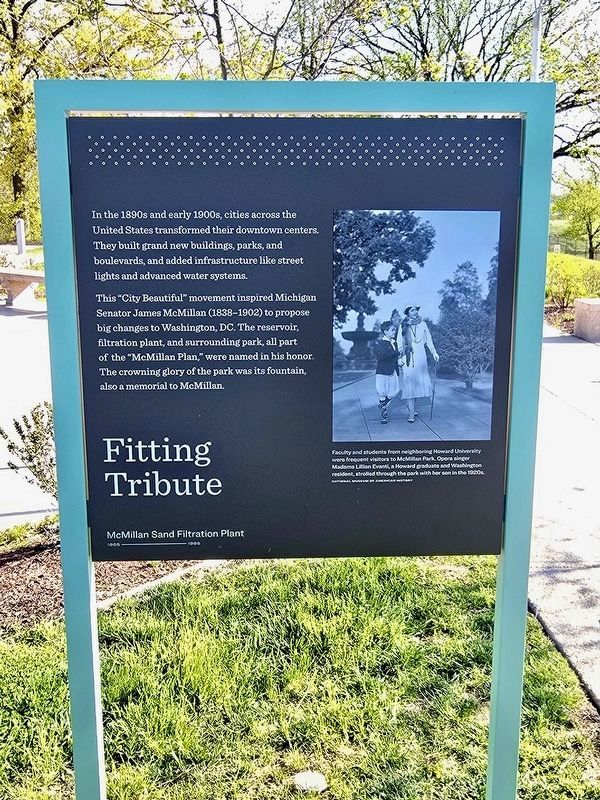
In the 1890s and early 1900s, cities across the United States transformed their downtown centers. They built grand new buildings,
this page online
This "City Beautiful” movement inspired Michigan Senator James McMillan (1838-1902) to propose big changes to Washington, DC. The reservoir, filtration plant, and surrounding park, all partof the "McMillan Plan,” were named in his honor. The crowning glory of the park was its fountain, also a memorial to McMillan.
[Captions:]
Faculty and students from neighboring Howard University were frequent visitors to McMillan Park Opera singer Madame Lan Evant a Howard graduate and Washington resident, strolled through the park with her son in the 1920s. (Marker Number 338.)
Topics. This historical marker is listed in these topic lists: African Americans • Government & Politics • Parks & Recreational Areas. A significant historical year for this entry is 1902.
Location. 38° 55.369′ N, 77° 0.712′ W. Marker is in Northwest Washington in Washington, District of Columbia. It is in Bloomingdale. It is on 1st Street Northwest south of Lower Service Court Northwest, on the right when traveling north. Touch for map. Marker is at or near this
Photographed by Shirley A Stirling, April 8, 2026
2. Fitting Tribute

Regionally, this marker is in the Washington Metropolitan Area. It is also in the American Northeast, in the Upper South, in the Mid-Atlantic, in the Tidewater, and in the Chesapeake Bay Region. Globally, it is in North America, the Western Hemisphere, the Western World, and the Anglosphere.
Other nearby markers. At least 8 other markers are within walking distance of this marker: Green Space / Sustaining the City (a few steps from this marker); Sand Bin (within shouting distance of this marker); Sand Washer (about 300 feet away, measured in a direct line); Regulator House (about 300 feet away); Central to the System / How It Worked (about 500 feet away); Filter Bed (about 500 feet away); Court Nullifies Racial Covenants (about 700 feet away); Water for the City (approx. ¼ mile away). Touch for a list and map of all markers in Northwest Washington.

Photographed by Shirley A Stirling, April 8, 2026
3. Iconic Landmark / Fitting Tribute Marker

Photographed by Shirley A Stirling, April 8, 2026
4. Iconic Landmark / Fitting Tribute Marker
Credits. This page was last revised on April 14, 2026. It was originally submitted on April 13, 2026, by Shirley A Stirling of Lacey, Washington. This page has been viewed 27 times since then. Photos: 1, 2, 3, 4. submitted on April 13, 2026, by Shirley A Stirling of Lacey, Washington. • Devry Becker Jones was the editor who published this page.
