Bloomingdale in Northwest Washington in Washington, District of Columbia — The American Northeast (Mid-Atlantic)
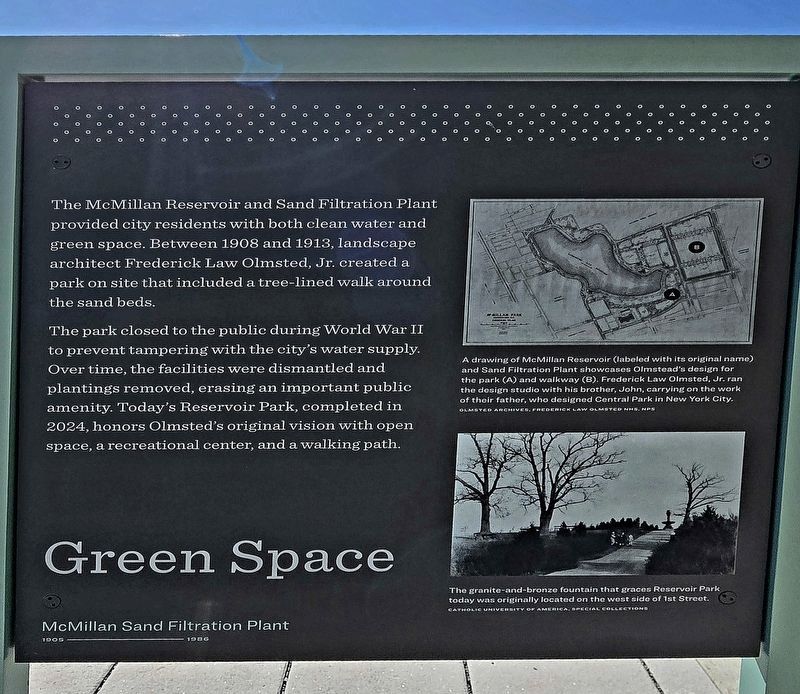
Green Space
⎯⎯⎯
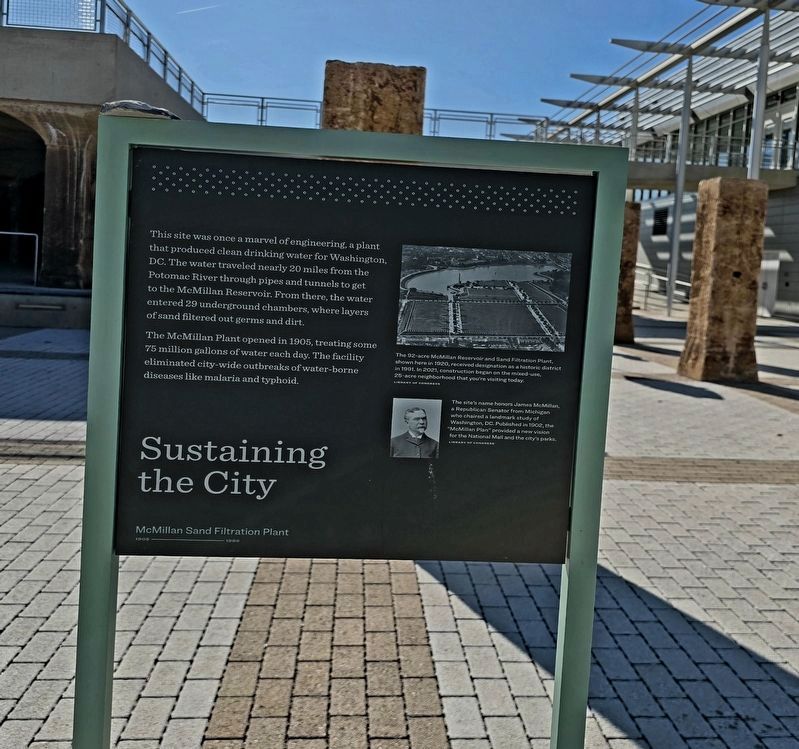
Sustaining the City
McMillan Sand Filtration Plant
| — | 1905-1986 | — |
Photographed by Shirley A Stirling, April 8, 2026
1. Green Space side of the marker
Green Space
The McMillan Reservoir and Sand Filtration Plant provided city residents with both clean water and green space. Between 1908 and 1913, landscape architect Frederick Law Olmsted, Jr. created a park on site that included a tree-lined walk around the sand beds.
The park closed to the public during World War II to prevent tampering with the city's water supply. Over time, the facilities were dismantled and plantings removed, erasing an important public amenity. Today's Reservoir Park, completed in 2024, honors Olmsted's original vision with open space, a recreational center, and a walking path.
[Caption:]
A drawing of McMillan Reservoir (labeled with its original name) and Sand Filtration Plant showcases Olmstead's design for the park (A) and walkway (B). Frederick Law Olmsted, Jr. ran the design studio with his brother, John, carrying on the work of their father, who designed Central Park in New York City.
The granite-and-bronze fountain that graces Reservoir Park today was originally located on the west side of 1st Street.
Sustaining the City
This site was once a marvel of engineering, a plant
this page online
The McMillan Plant opened in 1905, treating some 75 million gallons of water each day. The facility eliminated city-wide outbreaks of water-borne diseases like malaria and typhoid.
[Captions:]
The 92-acre McMillan Reservoir and Sand Filtration Plant shown here in 1920, received designation as a historic district in 1991. In 2021, construction began on the mix 25-acre neighborhood that you're visiting today.
The site's name honors James McMillan Republican Senator from Michigan who chaired a landmark study of Washington, DC. Published in 1902, the "McMillan Plan” provided a new vision for the National Mall and the city's parks.
Erected 2024.
Topics. This historical marker is listed in these topic lists: Architecture • Natural Resources • Parks & Recreational Areas. A significant historical year for this entry is 1902.
Location. 38° 55.36′ N, 77° 0.704′ W.
Photographed by Shirley A Stirling, April 8, 2026
2. Sustaining the City side of the marker

Regionally, this marker is in the Washington Metropolitan Area. It is also in the American Northeast, in the Upper South, in the Mid-Atlantic, in the Tidewater, and in the Chesapeake Bay Region. Globally, it is in North America, the Western Hemisphere, the Western World, and the Anglosphere.
Other nearby markers. At least 8 other markers are within walking distance of this marker: Iconic Landmark / Fitting Tribute (a few steps from this marker); Sand Bin (about 300 feet away, measured in a direct line); Sand Washer (about 300 feet away); Regulator House (about 300 feet away); Central to the System / How It Worked (about 500 feet away); Filter Bed (about 500 feet away); Court Nullifies Racial Covenants (about 600 feet away); Water for the City (approx. ¼ mile away). Touch for a list and map
Photographed by Shirley A Stirling, April 8, 2026
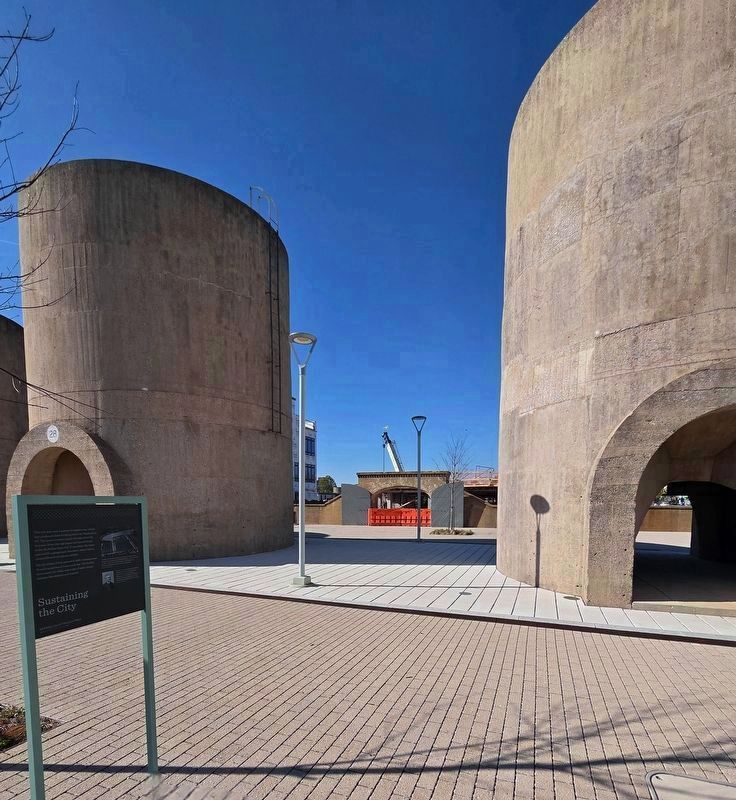
3. Green Space / Sustaining the City Marker
Additional keywords. landscape architecture
Credits. This page was last revised on April 21, 2026. It was originally submitted on April 13, 2026, by Shirley A Stirling of Lacey, Washington. This page has been viewed 17 times since then. Photos: 1, 2, 3. submitted on April 13, 2026, by Shirley A Stirling of Lacey, Washington. • Devry Becker Jones was the editor who published this page.
