Scotland in St. Mary's County, Maryland — The American Northeast (Mid-Atlantic)
The Armaments of Point Lookout
Point Lookout State Park
| — | Maryland Park Service | — |
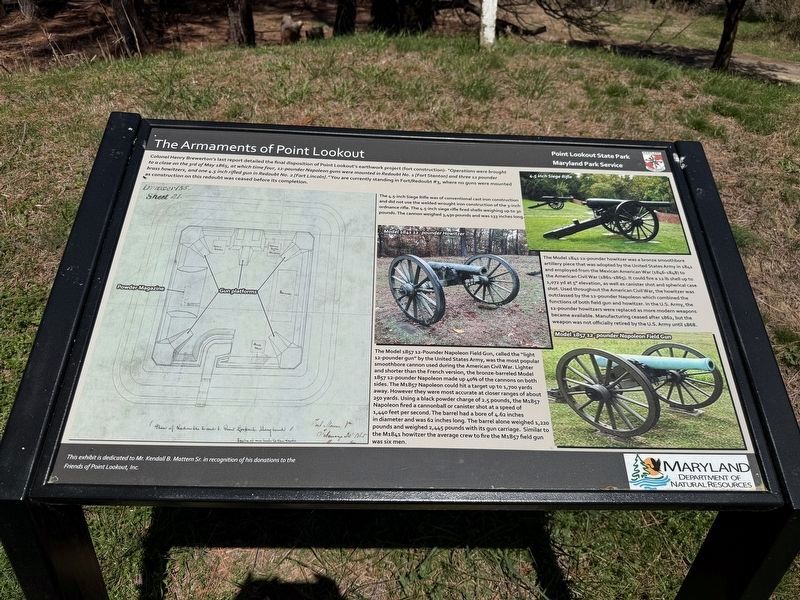
Colonel Henry Brewerton's last report detailed the final disposition of Point Lookout's earthwork project (fort construction)- "Operations were brought to a close on the 3rd of May 1865, at which time four, 12-pounder Napoleon guns were mounted in Redoubt No. 1 (Fort Stanton) and three 12 pounder brass howitzers, and one 4.5-inch rifled gun in Redoubt No. 2 (Fort Lincoln." You are currently standing in Fort/Redoubt #3, where no guns were mounted as construction on this redoubt was ceased before its completion.
The 4.5-inch Siege Rifle was of conventional cast iron construction and did not use the welded wrought iron construction of the 3-inch ordnance rifle. The 4.5 siege rifle fired shells weighing up to 30 pounds. The cannon weighed 3,450 pounds and was 133 inches long.
The Model 1841 12-pounder howitzer was a bronze smoothbore artillery piece that was adopted by the United States Army in 1841 and employed from the Mexican American War (1846-1848) to the American Civil War (1861-1865). It could fire a 12 lb shell up to 1,072 yd at 5° elevation, as well as canister shot and spherical case shot. Used throughout
this page online
The Model 1857 12-Pounder Napoleon Field Gun, called the "light 12-pounder gun" by the United States Army, was the most popular smoothbore cannon used during the American Civil War. Lighter and shorter than the French version, the bronze-barreled Model 1857 12-pounder Napoleon made up 40% of the cannons on both sides. The M1857 Napoleon could hit a target up to 1,700 yards away. However they were most accurate at closer ranges of about 250 yards. Using a black powder charge of 2.5 pounds, the M1857 Napoleon fired a cannonball or canister shot at a speed of 1,440 feet per second. The barrel had a bore of 4.62 inches in diameter and was 62 inches long. The barrel alone weighed 1,220 pounds and weighed 2,445 with its gun carriage. Similar to the M1841 howitzer the average crew to fire the 1857 field
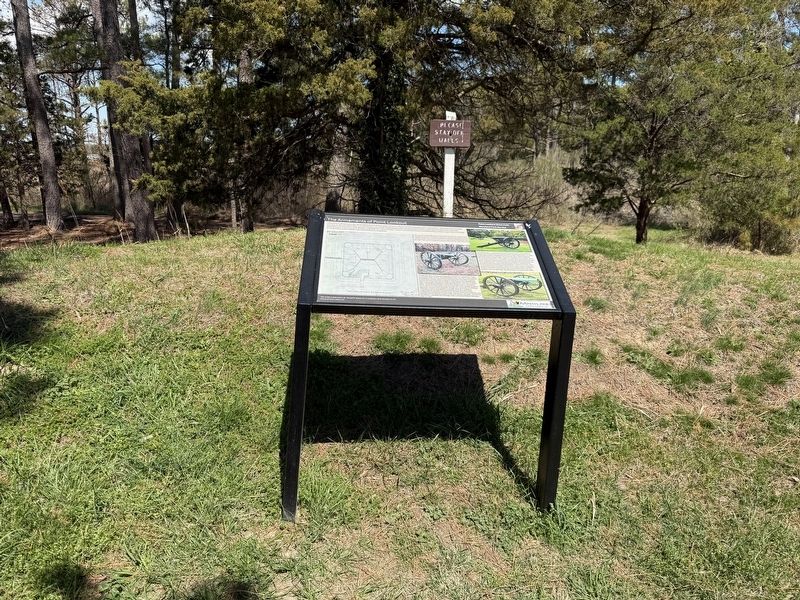
Erected by Maryland Park Service; Maryland Department of Natural Resources.
Topics. This historical marker is listed in these topic lists: Forts and Castles • War, US Civil. A significant historical date for this entry is May 3, 1865.
Location. 38° 2.931′ N, 76° 19.563′ W. Marker is in Scotland, Maryland, in St. Mary's County. It can be reached from Point Lookout Road (Maryland Route 5) 1½ miles south of 3rd Way, on the right when traveling south. Touch for map. Marker is at or near this postal address: 10510 Point Lookout Rd, Scotland MD 20687, United States of America. Touch for directions.

Regionally, this marker is in Southern Maryland. It is also in the American South, specifically in the Upper South, in the Mid-Atlantic, in the Tidewater, in the Chesapeake Bay Region, and on the Eastern Seaboard. Globally, it is in the North Atlantic Region, North America, the Western Hemisphere, the Western World, and the Anglosphere. Historically, it finds itself in what was once one of the original Thirteen Colonies and also the Antebellum South.
Other nearby markers. At least 8 other markers are within walking distance of this marker: Redoubt #3 (within shouting distance of this marker); The 5th Massachusetts Colored Cavalry (within shouting distance of this marker); The Veteran Reserve Corps (within shouting distance of this marker); United States Colored Troops (within shouting distance of this marker); Civil War Fort #3 (within shouting distance of this marker); Defense Strategies (about 300 feet away, measured in a direct line); A Crucial Point (about 300 feet away); Storm Blocks the Road to Freedom (about 300 feet away). Touch for a list and map of all markers in Scotland.
Another marker is no longer nearby. Fort Lincoln (was within shouting distance of this marker but has been replaced with another marker now near it).
Credits. This page was last revised on April 13, 2026. It was originally submitted on April 13, 2026, by Devry Becker Jones of Washington, District of Columbia. This page has been viewed 16 times since then. Photos: 1, 2. submitted on April 13, 2026, by Devry Becker Jones of Washington, District of Columbia.
