
Harry H. Lynn Home
1913
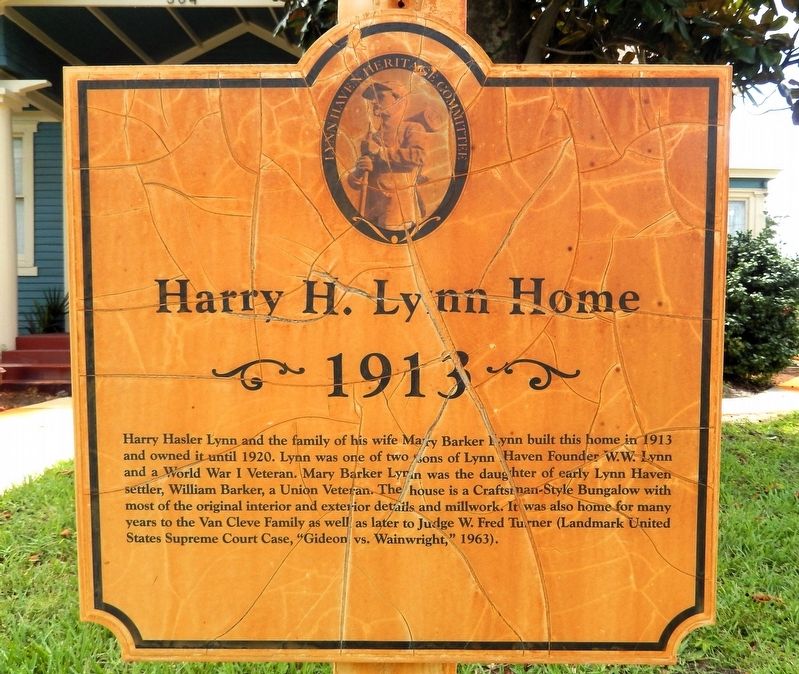
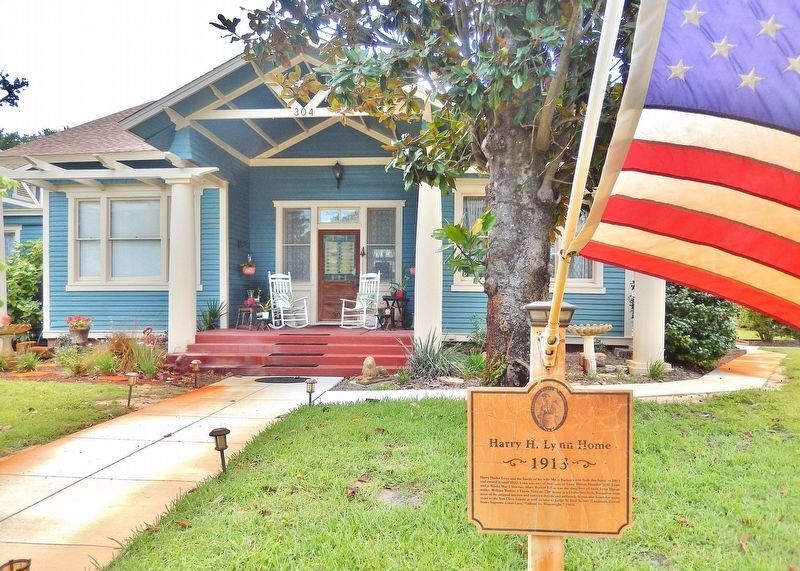
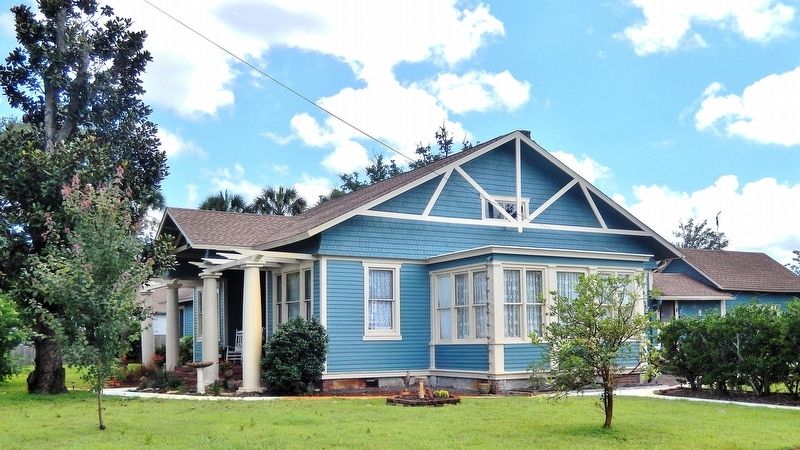
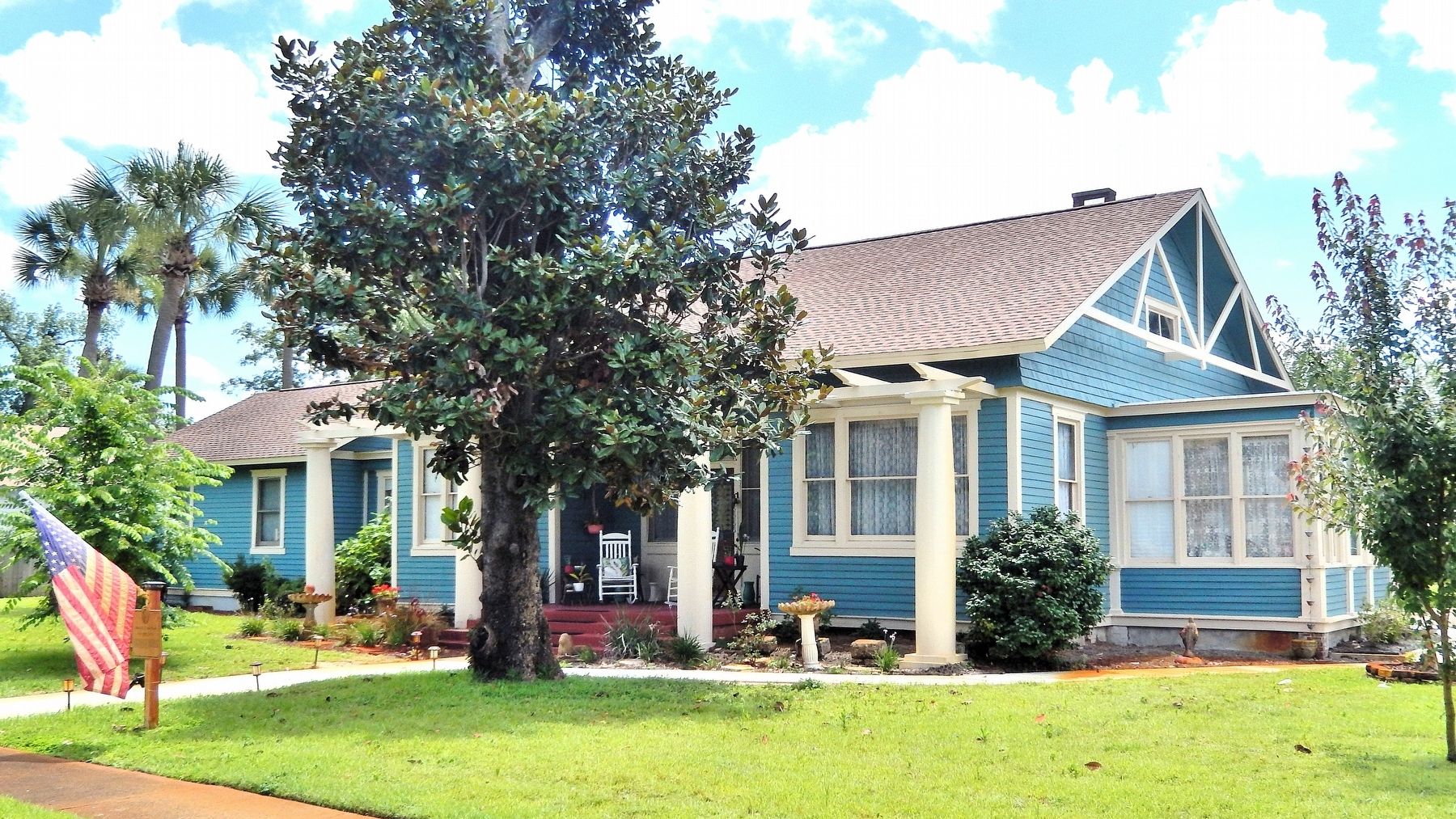
Harry Hasler Lynn and the family of his wife Marcy Barker Lynn built this home in 1913 and owned it until 1920. Lynn was one of two sons of Lynn Haven Founder W.W. Lynn and a World War I Veteran. Mary Barker Lynn was the daughter of early Lynn Haven settler, William Barker, a Union Veteran. The house is a Craftsman-Style Bungalow with most of the original interior and exterior details and millwork. It was also home for many years to the Van Cleve Family as well as later to Judge W. Fred Turner (Landmark United States Supreme Court Case, “Gideon vs. Wainwright,” 1963).
Erected by Lynn Haven Heritage Committee.
Topics. This historical marker is listed in these topic lists: Architecture • Law Enforcement • Settlements & Settlers. A significant historical year for this entry is 1913.
Location. 30° 15.162′ N, 85° 38.983′ W. Marker is in Lynn Haven, Florida, in Bay County. It is at the intersection of Florida Avenue and West 3rd Street, on the left when traveling north on Florida Avenue. Touch for map. Marker is at or near this postal address: 304 Florida Avenue, Lynn Haven FL 32444, United States of America.
this page online

Regionally, this marker is on the Florida Panhandle. It is also in the American South, specifically in the Deep South, and on the Gulf Coast. Globally, it is in the North Atlantic Region, North America, a Gulf of Mexico state, the Western Hemisphere, the Western World, and the Anglosphere. Historically, it finds itself in what was once New Spain, the territory of the Mississippian Culture, one of the Confederate States of America, and the Antebellum South.
Other nearby markers. At least 8 other markers are within walking distance of this marker: The Witbeck Cottage (within shouting distance of this marker); The Bates Home (within shouting distance of this marker); John & Retta Ackerson Home (about 700 feet away, measured in a direct line); John M. & Edna Cooley Home (approx. 0.2 miles away); Jerry & Stella Van Kleeck Home (approx. 0.2 miles away); Nina Roberts Van Kleeck House (approx. 0.2 miles away); James M. & Mary Ellis House (approx. 0.3 miles away); Alonzo Ogdon House (approx. 0.4 miles away). Touch for a list and map of all markers in Lynn Haven.
Also see . . .
1. History of Lynn Haven (City of Lynn Haven).
Excerpt: Lynn Haven was established in 1911 as the third of three Union Veterans Colonies in the South. Fitzgerald, Georgia was established in 1896. St. Cloud, Florida was established in 1909. Although each of the three “Old Soldiers Colonies” was organized separately by independent development companies, each site was chosen for “health, climate and productiveness of the soil” and each recruited future land owners through the use of The National Tribune, a newspaper of the Grand Army of the Republic veterans’ organization.(Submitted on April 19, 2026, by Cosmos Mariner of Cape Canaveral, Florida.)W. H. Lynn, A. J. Gay and R. L. McKenzie were the primary stockholders of the St. Andrews Bay Development Company. Lynn had been an associate of the National Tribune and the Grand Army of the Republic veterans’ organization; both A. J. Gay and R. L. McKenzie were also major investors in the Gulf Coast Development Company - creators of the new town of Panama City (incorporated in 1909). These three men purchased large tracts of land to the east and to the north of Panama City and hoped to use the nucleus of that small city to build a much larger community.
While the actual location of the “new soldiers’ colony”
was not announced until late December 1910, large numbers of Union Veterans had already started the trek down to North Florida to be ready for the opening of the new settlement. On January 11, 1911 the first offerings of land in the new “Lynn Haven” took place. One “town lot” and a five-acre plot outside of the new colony were offered as a package for just $150.Photographed by Cosmos Mariner, June 17, 20253. Harry H. Lynn Home (northeast elevation)
2. Gideon v. Wainwright (Wikipedia).
Excerpt: Gideon v. Wainwright, 372 U.S. 335 (1963), is a landmark U.S. Supreme Court decision in which the Court ruled that the Sixth Amendment of the U.S. Constitution requires U.S. states to provide attorneys to criminal defendants who are unable to afford their own. The case extended the right to counsel, which had been found under the Fifth and Sixth Amendments to impose requirements on the federal government, by imposing those requirements upon the states as well.(Submitted on April 19, 2026, by Cosmos Mariner of Cape Canaveral, Florida.)About 2,000 people were freed in Florida alone as a result of the Gideon decision. The decision did not directly result in Gideon being freed; instead, he received a new trial with
the appointment of defense counsel at the government's expense. Gideon chose W. Fred Turner to be his lawyer in his second trial. The retrial took place on August 5, 1963, five months after the Supreme Court ruling. During the trial, Turner picked apart the testimony of eyewitness Henry Cook. The jury acquitted Gideon after one hour of deliberation.Photographed by Cosmos Mariner, June 17, 20254. Harry H. Lynn Home
Credits. This page was last revised on April 19, 2026. It was originally submitted on April 17, 2026, by Cosmos Mariner of Cape Canaveral, Florida. This page has been viewed 19 times since then. Photos: 1, 2, 3, 4. submitted on April 19, 2026, by Cosmos Mariner of Cape Canaveral, Florida.
