Wandsworth in Greater London, England, United Kingdom — Northwestern Europe (the British Isles)
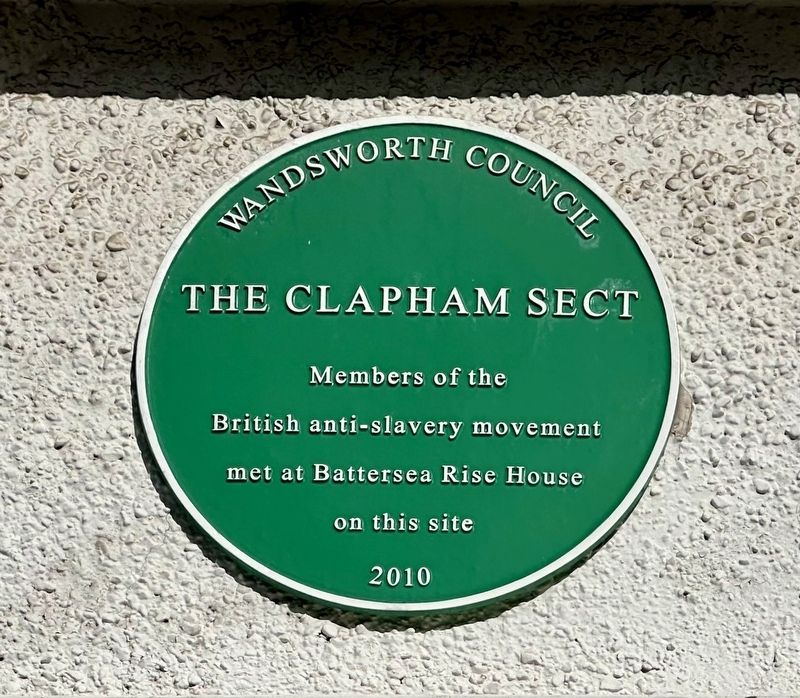
The Clapham Sect
Photographed by Andrew Ruppenstein, March 28, 2026
1. The Clapham Sect Marker
Members of the British anti-slavery movement met at Battersea Rise House on this site
Erected 2010 by Wandsworth Counvil.
Topics. This historical marker is listed in these topic lists: Abolition & Underground RR • Religion & Religious Structures.
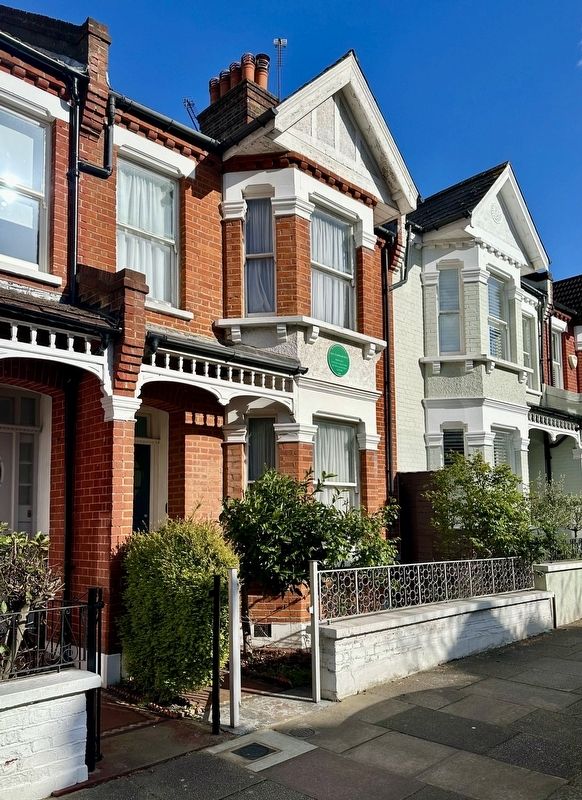
Location. 51° 27.564′ N, 0° 9.495′ W. Marker is in Wandsworth, England, in Greater London. It is on Canford Road south of Clapham Common West Side SW, on the right when traveling north. Touch for map. Marker is at or near this postal address: 5 Canford Road, Wandsworth, England SW11 6PA, United Kingdom. Touch for directions.

Regionally, this marker is in London and in the Greater South East. Globally, it is on the Atlantic Ocean, in the North Atlantic Region, in Europe, in Atlantic Europe, on one of the British Isles, in the Western World, and in the Anglosphere. Historically, it finds itself in what was once the Roman Empire.
Other nearby markers. At least 8 other markers are within walking distance of this marker: John Burns (about 240 meters away, measured in a direct line); John Walter (approx.
this page online
Also see . . . Clapham Sect (Wikipedia). Excerpt:
The Clapham Sect, or Clapham Saints, were a group of social reformers associated with Holy Trinity Clapham in the period from the 1780s to the 1840s. Despite the label "sect", most members remained in the established (and dominant) Church of England, which was highly interwoven with offices of state.(Submitted on April 17, 2026.)
The Clapham movement grew from 18th-century evangelical trends in the Church of England (the Anglican Church) and started to coalesce around residents of Clapham, especially during the rectorship there of John Venn (in office: 1792-1813) and came to engage in systematically advocating social reform.
The sect played leading roles in the abolitionist movement in Britain, advocating for the end of the transatlanticslave trade and, ultimately, the abolition of slavery within the British Empire. After years of sustained campaigning, Parliament passed the Slave Trade Act in 1807, outlawing the trade throughout the British Empire, and later the Slavery Abolition Act in 1833, which ended the institution of slavery itself.Photographed by Andrew Ruppenstein, March 28, 20262. The Clapham Sect Marker - wide view
Additional keywords. plaque
Credits. This page was last revised on April 17, 2026. It was originally submitted on April 17, 2026, by Andrew Ruppenstein of Lamorinda, California. This page has been viewed 16 times since then. Photos: 1, 2. submitted on April 17, 2026, by Andrew Ruppenstein of Lamorinda, California.
