West Windsor Township in Mercer County, New Jersey — The American Northeast (Mid-Atlantic)
Patterned Brick Farmhouses
A Quaker Specialty of the Delaware Valley
| — | John Rogers House | — |
Photographed by Richard Peterson, April 16, 2026
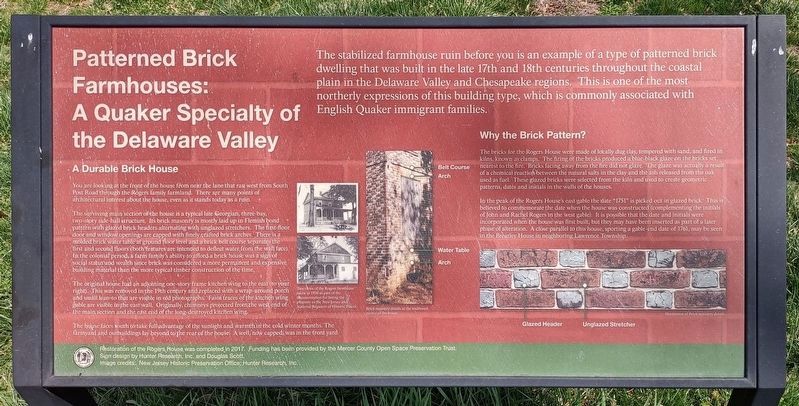
1. Patterned Brick Farmhouses Marker
The stabilized farmhouse ruin before you is an example of a type of patterned brick dwelling that was built in the late 17th and 18th centuries throughout the coastal plain in the Delaware Valley and Chesapeake regions. This is one of the most northerly expressions of this building type, which is commonly associated with English Quaker immigrant families.
A Durable Brick House
You are looking at the front of the house from near the lane that ran west from South Post Road through the Rogers family farmland. There are many points of interest about the house, even as it stands today as a ruin.
The surviving main section of the house is a typical late Georgian, three-bay, two-story side-hall structure. Its brick masonry is mostly laid up in Flemish bond pattern with glazed brick headers alternating with unglazed stretchers. The first-floor door and window openings are capped with finely crafted brick arches. There is a molded brick water table at ground floor level and a brick belt course separates the first and second floors (both features are intended to deflect water from the wall face). In the colonial period, a farm
this page online
The original house had an adjoining one-story frame kitchen wing to the east (to your right). This was removed in the 19th century and replaced with a wrap-around porch and small lean-to that are visible in old photographs. Faint traces of the kitchen wing gable are visible in the east wall. Originally, chimneys projected from the west end of the main section and the east end of the long-destroyed kitchen wing.
The house faces south to take full advantage of the sunlight and warmth in the cold winter months. The farmyard and outbuildings lay beyond to the rear of the house. A well, now capped, was in the front yard.
Why the Brick Pattern?
The bricks for the Rogers House were made of locally dug clay, tempered with sand, and fired in kilns, known as clamps. The firing of the bricks produced a blue-black glaze on the bricks set nearest to the fire. Bricks facing away from the fire did not glaze. The glaze was actually

Photographed by Richard Peterson, September 24, 2024
2. Rogers House behind Marker
In the peak of the Rogers House's east gable the date "1751" is picked out in glazed brick. This is believed to commemorate the date when the house was constructed (complementing the initials of John and Rachel Rogers in the west gable). It is possible that the date and initials were incorporated when the house was first built, but they may have been inserted as part of a later phase of alteration. A close parallel to this house, sporting a gable-end date of 1761, may be seen in the Brearley House in neighboring Lawrence Township.
Restoration of the Rogers House was completed in 2017. Funding has been provided by the Mercer County Open Space Preservation Trust. Sign design by Hunter Research, Inc. and Doudlas Scott. Image credits: New Jersey Historic Preservation Office; Hunter Research, Inc.
( photo captions )
1. Two views of the Rogers farmhouse taken in 1976 as part of

Photographed by Richard Peterson, April 16, 2026
3. John Rogers House Ruin
2. Brick masonry details at the southwest corner of the house.
Topics. This historical marker is listed in these topic lists: Architecture • Colonial Era. A significant historical year for this entry is 1751.
Location. 40° 15.739′ N, 74° 38.884′ W. Marker is in West Windsor Township, New Jersey, in Mercer County. It is on Paxson Avenue 1.6 miles east of Hughes Drive when traveling east. Located in Mercer County Park. Touch for map. Marker is in this post office area: Princeton Junction NJ 08550, United States of America. Touch for directions.

Regionally, this marker is in Central Jersey and in Greater Princeton. It is also in the American Northeast and in the Mid-Atlantic. Globally, it is in North America, the Western Hemisphere, the Western World, and the Anglosphere. Historically, it finds itself in what was once New Netherland and also one of the original Thirteen Colonies.
Other nearby markers. At least 8 other markers are within 3 miles of this marker, measured as the crow flies: The Farm Before the Park (within shouting distance of this marker); The Rogers Family: Roots and Branches (within shouting distance of this marker); Mercer County Vietnam Veterans Memorial (approx. 0.9 miles away); Route of Washington’s March (approx. 1.3 miles away); a different marker also named Route of Washington’s March (approx. 1½ miles away); Edinburg Historic Community (approx. 1.7 miles away); a different marker also named Route of Washington’s March (approx. 2 miles away); Dutch Neck Historic Community (approx. 2.3 miles away). Touch for a list and map of all markers in West Windsor Township.
Regarding Patterned Brick Farmhouses. The John Rogers House is listed on the National Register of Historic Places.
Also see . . . John Rogers House - Historical Society of West Windsor. (Submitted on April 21, 2026, by Michael Herrick of Southbury, Connecticut.)
Credits. This page was last revised on April 21, 2026. It was originally submitted on April 17, 2026, by Richard Peterson of East Windsor, New Jersey. This page has been viewed 24 times since then. Photos: 1, 2. submitted on April 17, 2026, by Richard Peterson of East Windsor, New Jersey. 3. submitted on April 18, 2026, by Richard Peterson of East Windsor, New Jersey. • Michael Herrick was the editor who published this page.
