Hollywood in St. Mary's County, Maryland — The American Northeast (Mid-Atlantic)
Sotterley's Slave Cabin
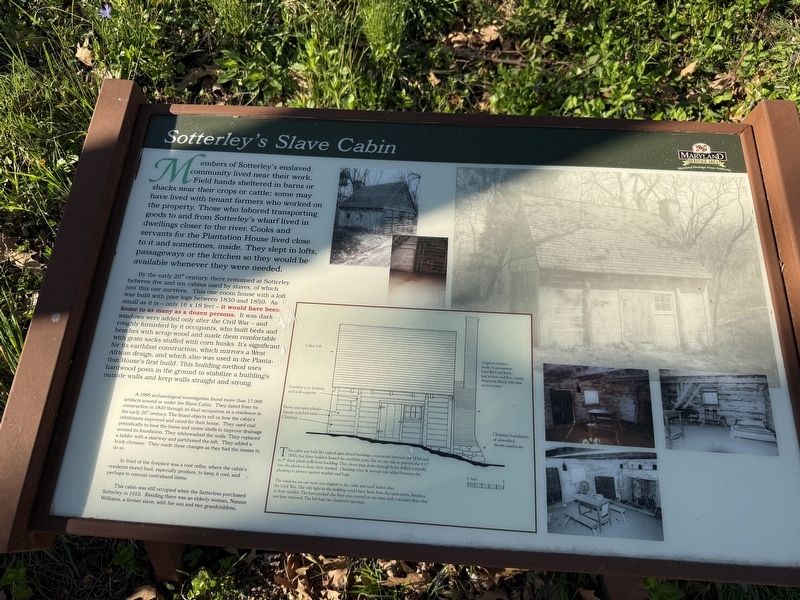
Members of Sotterley's enslaved community lived near their work. Field hands sheltered in barns or shacks near their crops or cattle; some may have lived with tenant farmers who worked on the property. Those who labored transporting goods to and from Sotterley's wharf lived in dwellings closer to the river. Cooks and servants for the Plantation House lived close to it and sometimes, inside. They slept in lofts, passageways or the kitchen so they would be available whenever they were needed.
By the early 20th century, there remained at Sotterley between five and ten cabins used by slaves, of which just this one survives. This one-room house with a loft was built with pine logs between 1830 and 1850. As small as it is – only 16 x 18 feet – it would have been home to as many as a dozen persons. It was dark – windows were added only after the Civil War – and roughly furnished by it occupants, who built beds and benches with scrap wood and made them comfortable with grain sacks stuffed with corn husks. It's significant for its earthfast construction, which mirrors a West African design, and which also was used in the Plantation
this page online
A 1995 archaeological investigation found more than 17,000 artifacts around or under the Slave Cabin. They dated from its construction in 1830 through its final occupation as a residence in the early 20th century. The found objects tell us how the cabin's inhabitants improved and cared for their home. They used coal periodically to heat the home and oyster shells to improve drainage around its foundation. They whitewashed the walls. They replaced a ladder with a stairway and partitioned the loft. They added a brick chimney. They made these changes as they had a means to do so.
In front of the fireplace was a root cellar, where the cabin's residents store food, especially produce, to keep it cool, and perhaps to conceal contraband items.
This cabin was still occupied when the Satterlees purchased Sotterley in 1910. Residing there was an elderly woman, Nannie Williams, a former slave, with her son and two grandchildren.
[Caption:]
This cabin was built like typical agricultural buildings constructed between the 1830s and 1850s, but these builders hewed the earthfast posts, flat on one side to prevent the 4 ½" to 5" thick plank walls from buckling. They drove pegs down through holes drilled vertically into the planks to keep them stacked. Chinking (clay and mortar) was added between the planking to protect against weather and bugs.
The windows you see were not original to the cabin and were added after the Civil War. The only light in the building would have been from the open doors, fireplace or from candles. The hard packed clay floor was covered at one time with a wooden floor that was later removed. The loft had two shuttered openings.
Erected by Maryland
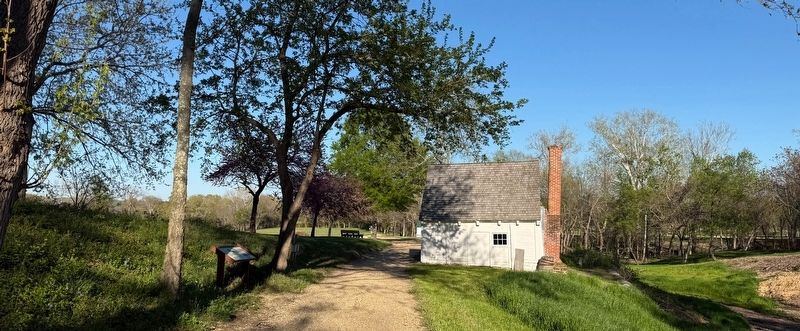
Topics. This historical marker is listed in these topic lists: African Americans • Agriculture • Architecture. A significant historical year for this entry is 1830.
Location. 38° 22.556′ N, 76° 32.475′ W. Marker is in Hollywood, Maryland, in St. Mary's County. It can be reached from Sotterley Lane north of Sotterley Wharf Road, on the right when traveling north. Touch for map. Marker is at or near this postal address: 44296 Sotterley Ln, Hollywood MD 20636, United States of America. Touch for directions.

Regionally, this marker is in Southern Maryland. It is also in the American South, specifically in the Upper South, in the Mid-Atlantic, in the Tidewater, in the Chesapeake Bay Region, and on the Eastern Seaboard. Globally, it is in the North Atlantic Region, North America, the Western Hemisphere, the Western World, and the Anglosphere. Historically, it finds itself in what was once one of the original Thirteen Colonies and also the Antebellum South.
Other nearby markers. At least 8 other markers are within walking distance of this marker: War Hits Home (within shouting distance of this marker); Food and Culinary Traditions at Sotterley (within shouting distance of this marker); Remembering Ancestors at the Sotterley Plantation (within shouting distance of this marker); Slavery at Sotterley (within shouting distance of this marker); a different marker also named Slavery at Sotterley (within shouting distance of this marker); Middle Passage Site, Sotterley (about 300 feet away, measured in a direct line); George Plater III (about 300 feet away); Visitors and Correspondents (about 300 feet away). Touch for a list and map of all markers in Hollywood.
Another marker is no longer nearby. Sotterley's Remaining Slave Cabin (was here, next to this marker but has been replaced with another marker now near it).
Credits. This page was last revised on April 19, 2026. It was originally submitted on April 19, 2026, by Devry Becker Jones of Washington, District of Columbia. This page has been viewed 22 times since then. Photos: 1, 2. submitted on April 19, 2026, by Devry Becker Jones of Washington, District of Columbia.
