Anacostia Park in Southeast Washington in Washington, District of Columbia — The American Northeast (Mid-Atlantic)
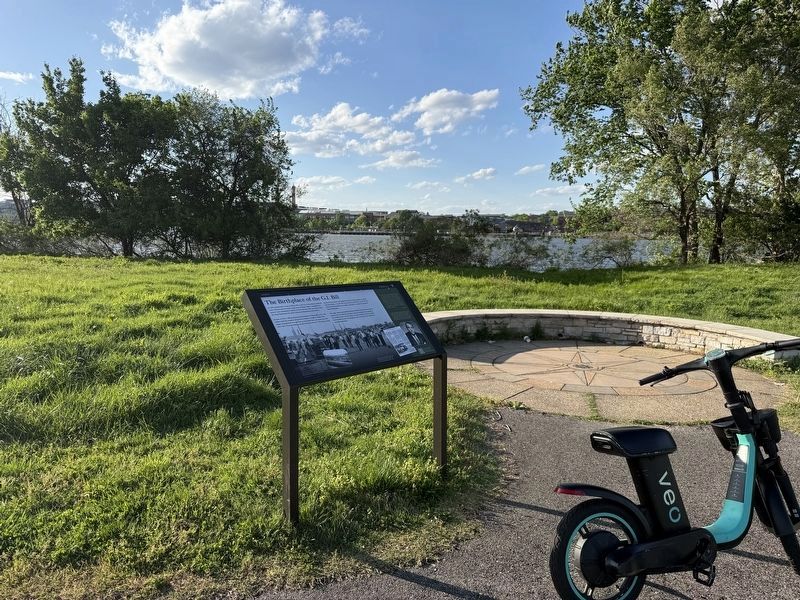
The Birthplace of the G.I. Bill
Anacostia Park
| — | National Park Service, U.S. Department of the Interior | — |

In 1924, shortly after victory in World War I, the U.S. Government promised every veteran a service bonus in the form of bonds. These "certificates of service" were scheduled to mature in 1945. Bust just a few years later, when the Great Depression hit, many veterans demanded an early payout.
By June of 1932, 1,500 protesters had descended on Washington, D.C. and within weeks the number had grown to between 10,000 to 20,000. The largest encampment was right here in Anacostia Park, just across from the Navy Yard. These protesting veterans became known as "The Bonus Army."
Swayed by the intense campaign, the House of Representatives voted to pay the veterans—but the bill was rejected by the Senate. On July 28, the Hoover Administration sent military and police to expel the marchers from Washington.
The tragic events surrounding the Bonus Army forced the government to rethink how it treated its returning veterans, resulting in the passage of the GI Bill on June 22, 1944. Black veterans, however, could not utilize their benefits because of segregation, Jim Crow laws, and widespread racial discrimination.
"At Anacostia, some Negroes had their own shacks and some slept with white boys. There was no residential segregation. A Negro "house" might be next door to a white "house" or across the street, and no one thought of passing an ordinance to "preserve property values."
—Roy Wilkins
[Captions:]
When protesters refused to leave, government forces, led by General Douglas MacArthur, Major Dwight D. Eisenhower, and Major George S. Patton, escalated their tactics. They attacked the crowds with tear gas and bayonets, threatened them with tanks, and set fire to the veterans' camps here in Anacostia Park and elsewhere in the city.
Bonus Army encampment in July 1932. USS Constitution "Old Ironsides" at dock at the Washington Navy Yard.
In June of 1932 Black journalist Roy Wilkins toured the Bonus Army on assignment for the magazine The Crisis. He reported that racial segregation—widespread in the US at the time—was rare in the camps. Wilkins went on to become a prominent civil rights leader and president of the NAACP.
Erected by National
this page online
Topics. This historical marker is listed in these topic lists: African Americans • Civil Rights • Government & Politics • War, World I. A significant historical date for this entry is July 28, 1932.
Location. 38° 52.096′ N, 76° 59.59′ W. Marker is in Southeast Washington in Washington, District of Columbia. It is in Anacostia Park. It is on Anacostia Drive Southeast 0.2 miles west of Marion Barry Avenue Southeast, on the right when traveling west. Touch for map. Marker is at or near this postal address: 1944 Anacostia Dr, Washington DC 20020, United States of America. Touch for directions.

Regionally, this marker is in the Washington Metropolitan Area. It is also in the American Northeast, in the Upper South, in the Mid-Atlantic, in the Tidewater, and in the Chesapeake Bay Region. Globally, it is in North America, the Western Hemisphere, the Western World, and the Anglosphere.
Other nearby markers. At least 8 other markers are within walking distance of this marker: Armaments & Aircraft (about 500 feet away, measured in a direct line); Out of Segregation (about 700 feet
Credits. This page was last revised on April 28, 2026. It was originally submitted on April 20, 2026, by Devry Becker Jones of Washington, District of Columbia. This page has been viewed 19 times since then. Photos: 1, 2. submitted on April 20, 2026, by Devry Becker Jones of Washington, District of Columbia.
