First Baptist Church
⎯⎯⎯
Elder Amasa Brown

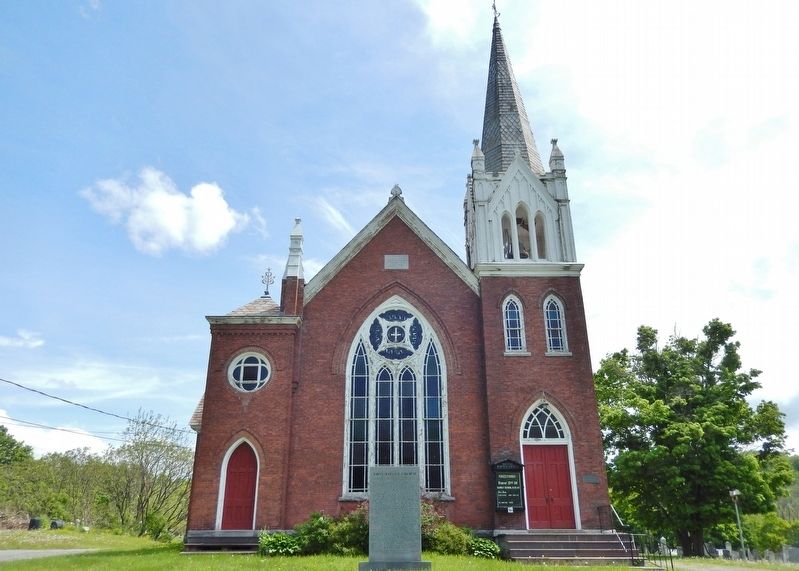
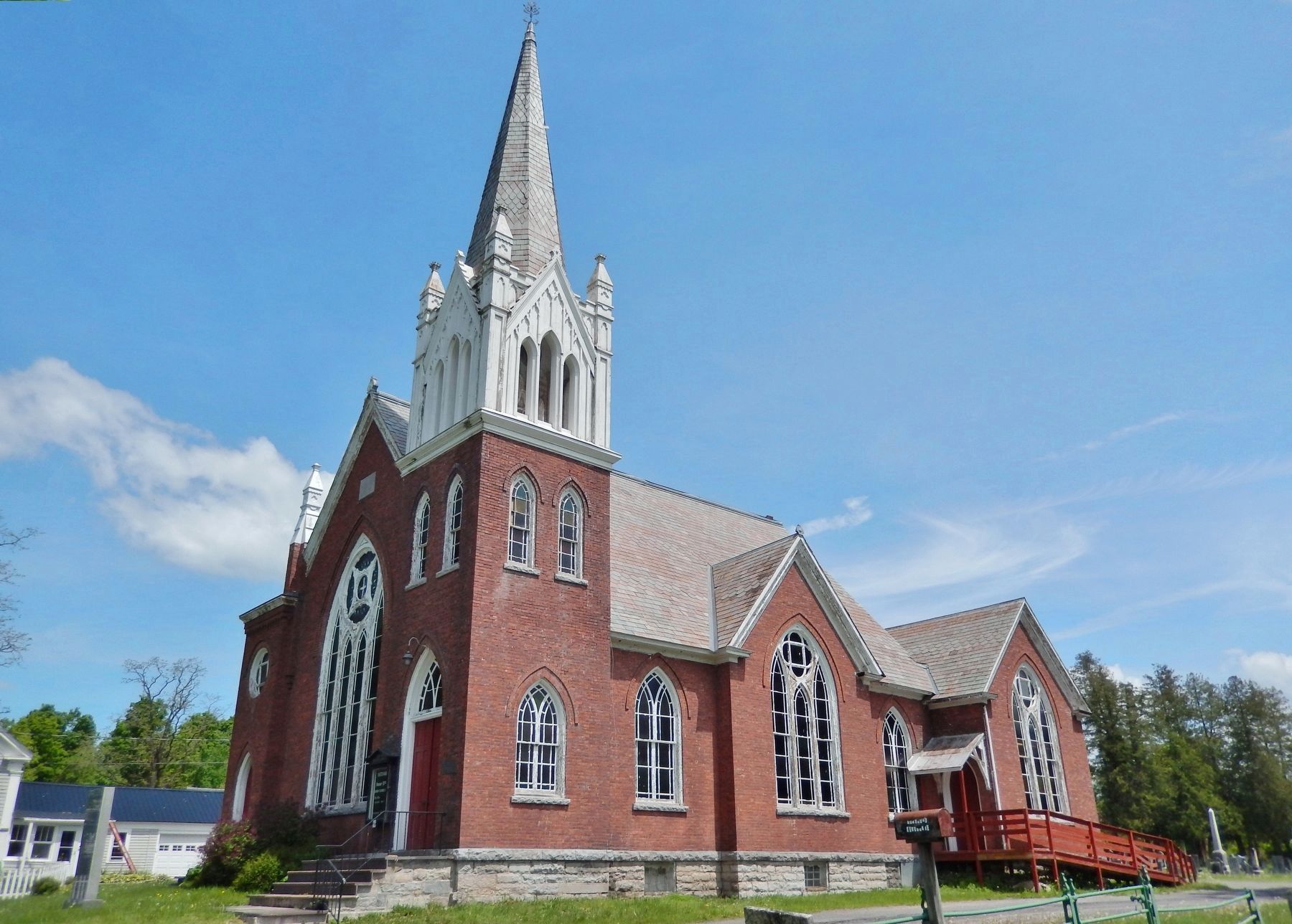
First Baptist Church (west side)
The history of the First Baptist Church of Hartford is a chronology of faithfulness, and its influence was commensurate with that of the New Nation. Shortly after the War for Independence, this area of Upstate New York witnessed an influx of new settlers. Families carved farms from the wilderness, and saints propagated the faith by planting churches.
Baptists had gathered a church in the town of Westfield by 1787. Services were held not far from this spot in a log barn, and converts were baptized in the nearby brook. Upon the division of the town of Westfield in 1788, the Baptist church took the name of the new town, Hartford. In 1798, Governor Dewitt Clinton gifted the church with land upon which to erect a new meetinghouse, and in 1805 a log building was raised. The property was also used as a burial ground for the Baptist Society.
Steady growth among the Baptists soon necessitated larger accommodations, and an additional lot was acquired for that purpose. In 1813, the third house of worship was erected; an impressive structure measuring 51' x 55' with galleries on three sides. Seven hundred
this page online
The names of Atwood, Barrel, Brayton, Brown, Bump, Carr, Covell, Cummings, Downs, Ingals, Ingelsbe, Mattison, Pickett, Pierce, Scott, Walling and Whitford are noted by church records as early members. Many sons and daughters of the Baptist church in Hartford served the lord in this community, while some were sent to labour in fields at home and abroad.
Jonathan Wade, converted under the ministry of Pastor Amasa Brown, was baptized into the membership of this church, August 4, 1816. He was the first student to enter and graduate from the Hamilton Literary and Theological Institute (Colgate University) in Hamilton, New York. Wade expressed his desire to preach the gospel in Burma. He and his wife, Deborah Lapham, were appointed missionaries. In 1823, they sailed to Burma, where for nearly fifty years they prosecuted their pioneer work. In spite of dangers, privations, sickness and the absence of friendship,

G.W. Hervey, in The Story of Baptist Missions, details Wade's faithfulness to his calling, as well as his great contributions to mankind: "The literary labours of Dr. Wade have been of the greatest importance. It was by him that the Karen dialects, both SGAU and PWO, were reduced to writing. His Karen thesaurus, a work in five volumes, is a monument to his patient study and knowledge of the language. To the revision of this great work, Dr. Wade gave his last days in this world. In several different stations and in diverse departments of labour; in Rangoon, Maulmain; Maubee, Matah, Tavoy and other places, he toiled with perseverance in his master's service until he was called home to heaven.”
Noah Barrell, native son of Hartford and pastor of the Baptist church in Cambray, was highly esteemed for his defence of Baptist principles. He pastored a number of churches in New York and Ohio before finishing his course in Lake Geneva, Wisconsin. Barrell's Records of Marriages remains a popular source for genealogical research.
The French-Canadian, John Baudin, was converted here late in the
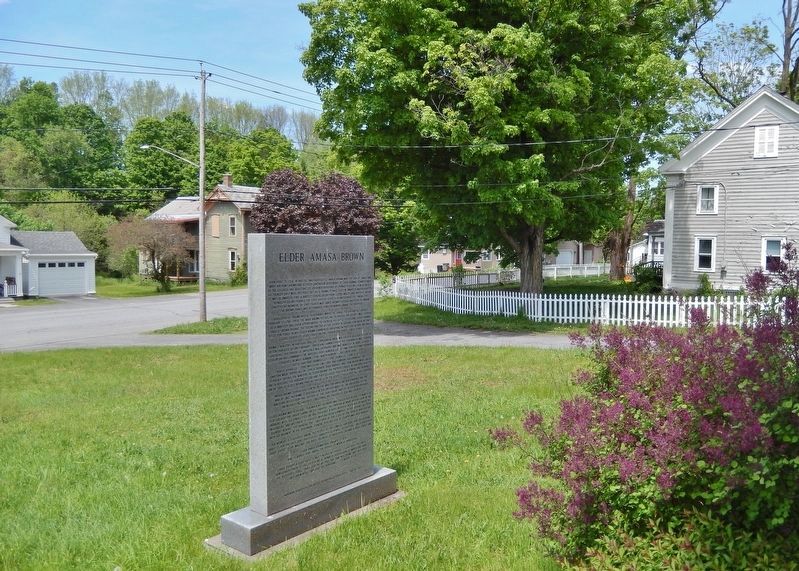
Elder Amasa Brown (east side)
Born April 21, 1754, in Bristol, Massachusetts, Amasa Brown was the son of James and Mary Anthony Brown and a sixth-generation descendant of John Browne, Commissioner to the Colonies and assistant to Governor Bradford of Plymouth Colony. Few details of his younger days were recorded, but he is known to have lived in Swansea, Massachusetts. It was in Swansea that a Baptist congregation from Ilston, Wales, and Baptists in the Plymouth Colony formed the first Baptist Church in Massachusetts. Among the constituent members of that church was James Brown, lateral ancestor of Amasa. The Brown family was afterwards very prominent among the Baptists.
Subsequently, Brown moved to Vermont, where he joined the Ira Baptist Church, February 17, 1786. There, he made known his calling to preach the Gospel, was licensed as a minister and given opportunities to exercise his gifts. Succeeding Elder Thomas Skeels, Brown became the second pastor of the church in Ira and continued
Brown's ministry in Hartford and the surrounding area was greatly blessed by God. He often traveled as an itinerant — preaching, administering the ordinances and planting churches. His sphere of influence was extensive and was manifest in home, church, association and community. He baptized eight hundred eighty-two converts and organized churches in West Hebron - 1792, North Hebron - 1793, Great Bend - 1793, South Hartford (Adamsville) - 1795, Granville - 1796, North Granville - 1799, Welch Hollow - 1810, and Cambray (Gouverneur) - 1811.
Jonathan Wade, Barna Allen, John H. Barker, Noah Barrell and John Baudin were called to preach during the ministry of Elder Brown. The faithful saints in Hartford assisted him in building the Kingdom of God and they rejoiced together in sowing and reaping. It can be said of Elder Brown that his praise is in the Gospel throughout all the churches.
Amasa Brown served his country in the War for American Independence and the War of 1812. His name

State & National Register of Historic Places
2004
Elder brown was a patriot, for when his regiment was called out in 1814, to march to Plattsburgh, the order coming on the Sabbath — as Chaplain he went into his desk in the morning with his epaulettes on, and preached a very patriotic discourse to incite his neighbours and brethren to fidelity, who had been summoned to the defence of their country against the invading foe — and then at the close of the service marched on with his regiment in the afternoon, evincing that his love of country was true-hearted.
His memory is cherished among the people of the town of Hartford and the regions about it, for the excellent traits of his character as a man — a Christian — and a minister of Jesus Christ. If he was not the most talented of preachers, he was a very useful one.
Elder Amasa Brown died January 21, 1830, and is buried here among the people to whom he ministered.
I have fought a good fight, I have finished my course, I have kept the

Hartford Baptist Church
Organized 1788,
Built 1815,
Rebuilt 1890.
Monument dedicated by the Baptist History Preservation Society — May 5, 2017
Erected 2017 by Baptist History Preservation Society.
Topics and series. This historical marker is listed in these topic lists: Architecture • Cemeteries & Burial Sites • Religion & Religious Structures • Settlements & Settlers. In addition, it is included in the National Register of Historic Places (NRHP) series list. A significant historical date for this entry is January 22, 1891.
Location. 43° 21.892′ N, 73° 23.558′ W. Marker is in Hartford, New York, in Washington County. It is on Hartford Main Street (County Road 23) just north of East Street, on the right when traveling north. The marker is located in front of the Hartford Baptist Church. Touch for map. Marker is at or near this postal address: 56 Hartford Main Street, Hartford NY 12838, United States of America. Touch for directions.

Regionally, this marker is in Upstate New York

Other nearby markers. At least 8 other markers are within 6 miles of this marker, measured as the crow flies: Civil War Enlistment Center (within shouting distance of this marker); Civil War Mound and Urn (within shouting distance of this marker); Clinton Gift (about 300 feet away, measured in a direct line); Site of Old Mills (approx. 0.2 miles away); Brown's Tavern (approx. 1.6 miles away); Adamsville (approx. 5.1 miles away); Great Indian Warpath (approx. 5.1 miles away); Smith's Basin (approx. 5.2 miles away). Touch for a list and map of all markers in Hartford.
Regarding First Baptist Church / Elder Amasa Brown. National Register of Historic Places № 04000875, as Hartford Baptist Church & Cemetery.
From the National Register Nomination prepared by Joseph A. Cutshall-King, L. Garofalini, and Svlvia B. VanAnden, 6/21/2004:
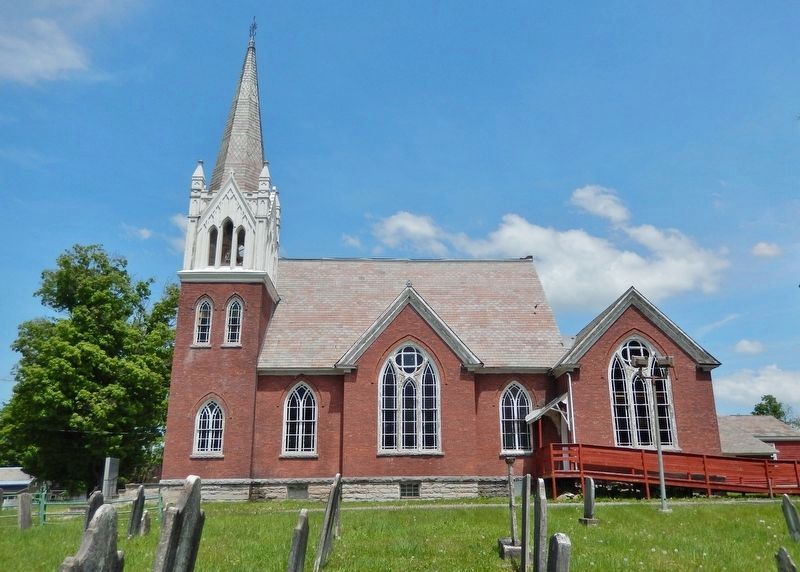
TheHartford Baptist Church and Cemetery comprise an architecturally and historically significant property that has been the focus within the Town of Hartford of major social issues and events that were also affecting the region, state and nation. These include the religious revivals of the late 18th to early 19th century; the Anti-Masonic movement, the Abolitionist Movement and the Civil War; and the Temperance Movement.Photographed by Cosmos Mariner, May 17, 20248. Hartford Baptist Church (south elevation)View from the cemetery — on the south side of the church.The largest church in the unincorporated village of Hartford, central to the Town of Hartford, the present church structure opened for worship January 22, 1891. It was built on the site of the original Baptist Church, constructed in 1789 on this site on land owned by then New York State Senator (and later Governor) DeWitt Clinton. In 1798, Clinton specifically deeded over the land to the church for its building and cemetery.
The Hartford Baptist Church structure is architecturally significant as a prime example of Victorian Gothic ecclesiastical architecture. The architecture, largely intact, is the only such example within the town and one of the few in all of Washington County. Its adjoining cemetery is historically
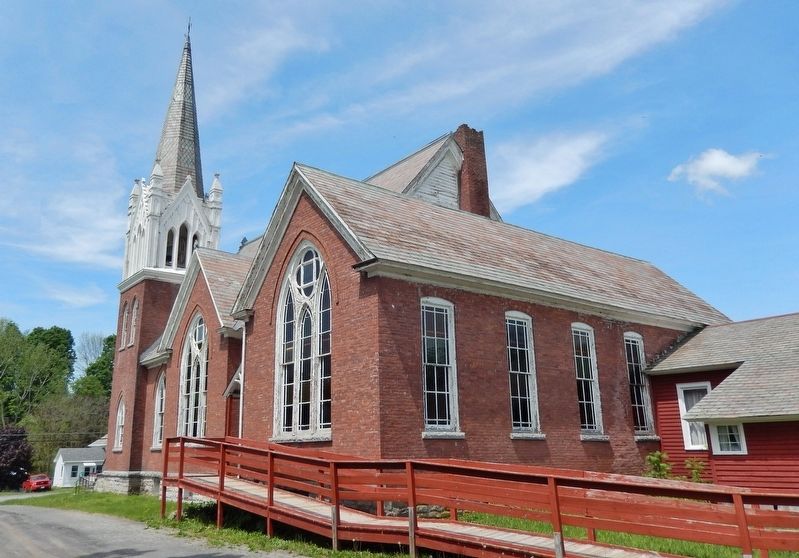
and architecturally significant, with its important examples of 18th and 19th century gravestones. Furthermore, the cemetery, active until the late 20th century, holds the burial places of 19 Revolutionary War soldiers, among the many citizens buried there. Together the church structure and cemetery form a significant property that is intrinsic to the history of Hartford.Photographed by Cosmos Mariner, May 17, 20249. Hartford Baptist Church (southeast elevation)The building, designed by architect Benjamin D. Price of Philadelphia, is an excellent example of Late Gothic Revival, representing the tastes of its major funders, William H. Rowe of Troy, and Abbie L. Cotton of Saratoga Springs, N.Y.; and the church’s main contractor, A. M. Wilson, of Poultney, VT. This is significant in that the church does not represent a vernacular style, but, rather, a mainstream example of Late Gothic Revival.
The church is composed of two gabled roofed wings placed perpendicularly. The sanctuary of the church is a gable-roofed structure 40 feet wide by 56 feet in length with the ridge of the main roof running east west. The exterior fabric of the entire building is brick veneer of locally made brick manufactured at Peppers’ of Middle Granville.
The masons who laid the brick were the Gibson brothers, presumably of Granville. It has a rubble foundation built almost entirely on solid rock.Photographed by Cosmos Mariner, May 17, 202410. Hartford Baptist Church (southwest elevation)The marker is visible, edge-on, in front of the church, on the far left.All elevations are pierced with both tracery and plate tracery windows. The church’s main (west) elevation fronts Main Street and is approximately 50 feet high at the ridge. The church bears two towers, the smaller, measuring 9.5 feet square and 27 feet high, at its northwest corner; and the larger, measuring 12 feet square, and 85 feet high, at its southwest corner. Both have main entry doors with tracery over each.
Also see . . . Hartford Baptist Church and Cemetery (Wikipedia).
Excerpt: It is a brick church with tall wooden bell tower built in the late 19th century on the same site as the congregation's original 1789 church on land deeded to it by Dewitt Clinton, the fourth of its churches to occupy the site. Designed by Philadelphia architect Benjamin Price, it is the only Victorian Gothic church in the town, and one of a few in the county. Next to the church is a cemetery with almost two centuries of graves, including those of early Hartford settlers and some Revolutionary War veterans.(Submitted on April 22, 2026, by Cosmos Mariner of Cape Canaveral, Florida.)Its members were active in a number of 19th century social causes. They passed anti-Masonic resolutions in the 1820s and 1830s, recruited local soldiers into the Union Army out of fervent abolitionism and later suffered the burning of their third church due to their advocacy of temperance and support for local dry laws. In 2004 the church and cemetery were added to the National Register of Historic Places.
The earliest recorded burial in the cemetery is that of Abraham Downs, an early settler of the Hartford area, in 1792. Other notable early burials include 19 men who fought in the Revolutionary War, including Col. John Buck, the first European settler of Hartford. He served under George Washington as a teenager for three years, seeing action at Bunker Hill and Groton Heights as well as surviving the difficult winter at Valley Forge. Also among the veterans of the Revolution in the cemetery is the Rev. Amasa Brown, the church's first pastor. The last burial took place in 1989, after which the cemetery was closed to any further occupants for maintenance reasons. In addition to the Revolution, veterans buried in it served in the French and Indian War, Civil War and World Wars I and II.
Credits. This page was last revised on April 22, 2026. It was originally submitted on April 20, 2026, by Cosmos Mariner of Cape Canaveral, Florida. This page has been viewed 42 times since then. Photos: 1, 2, 3, 4, 5, 6. submitted on April 21, 2026, by Cosmos Mariner of Cape Canaveral, Florida. 7, 8, 9, 10. submitted on April 22, 2026, by Cosmos Mariner of Cape Canaveral, Florida.
