The Mountain People
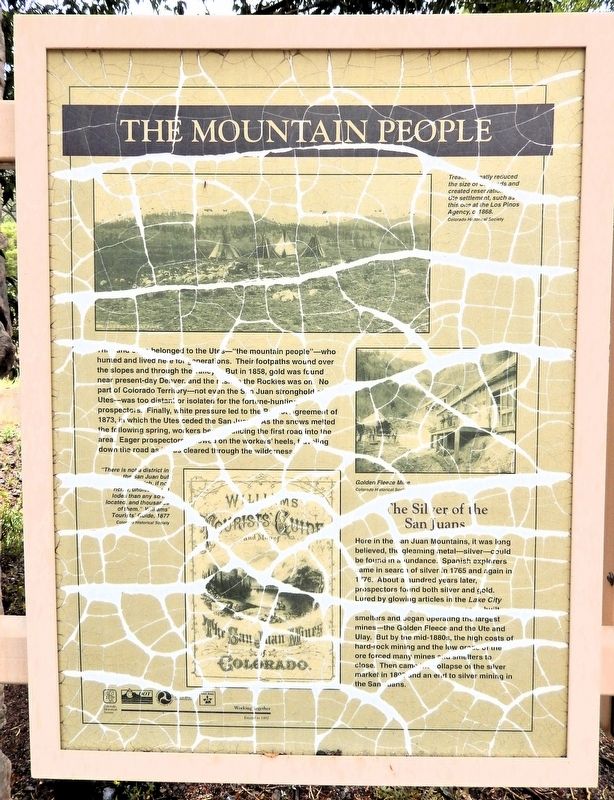
This land once belonged to the Utes — “the mountain people” — who hunted and lived here for generations. Their footpaths wound over the slopes and through the valleys. But in 1858, gold was found near present-day Denver, and the rush to the Rockies was on. No part of Colorado Territory — not even the San Juan stronghold of the Utes — was too distant or isolated for the fortune-hunting prospectors. Finally, white pressure led to the Brunot Agreement of 1873, in which the Utes ceded the San Juans. As the snows melted the following spring, workers began building the first road into the area. Eager prospectors followed on the workers’ heels, traveling down the road as it was cleared through the wilderness.
The Silver of the San Juans
Here in the San Juan Mountains, it was long believed, the gleaming metal — silver — could be found in abundance. Spanish explorers came in search of silver in 1765 and again in 1776. About a hundred years later, prospectors found both silver and gold. Lured by glowing articles in the Lake City Silver World, investors soon built smelters and began operating the largest mines — the Golden Fleece and
this page online
[image captions]
• Treaties greatly reduced the size of Ute lands and created reservations for Ute settlement, such as this one at the Los Pinos Agency, c. 1868.
• Golden Fleece Mine
• “There is not a district in the San Juan but contains as rich, if not richer, undiscovered lodes than any so far located, and thousands of them.” Williams’ Tourists’ Guide, 1877.
Erected 1997 by Colorado Historical Society, Colorado Department of Transportation and Federal Highway Administration.
Topics and series. This historical marker is listed in these topic lists: Indigenous Peoples and Communities • Industry & Commerce • Settlements & Settlers. In addition, it is included in the History Colorado series list. A significant historical year for this entry is 1858.
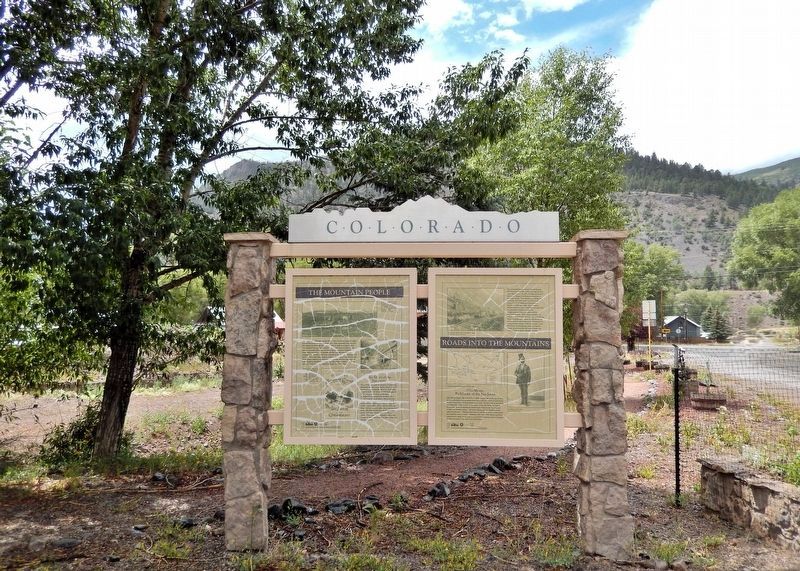
Location. 38° 2.062′ N, 107° 18.713′ W. Marker is in Lake City, Colorado, in Hinsdale County. It is at the intersection of Gunnison Avenue

Regionally, this marker is in the Colorado High Rockies. It is also in the American Mountain West. Globally, it is in North America, the Rocky Mountains, the Western Hemisphere, the Western World, and the Anglosphere.
Other nearby markers. At least 8 other markers are within walking distance of this marker: Silver Thread Country (here, next to this marker); Roads into the Mountains (here, next to this marker); Metropolis of the San Juans (here, next to this marker); Colorado's Largest Narrow Leaf Cottonwood Tree (about 500 feet away, measured in a direct line); Pioneer Education in Western Colorado (approx. 0.2 miles away); John S. Hough House — Built 1877 (approx. ¼ mile away); St. James Episcopal Chapel — 1876 (approx. ¼ mile away); Henry Kohler House — Built 1880-81 (approx. 0.3 miles away). Touch for a list and map of all markers in Lake City.
Also see . . .
1. Brunot Agreement (Colorado Encyclopedia).
(by Jonathon C. Horn) Excerpt: Miners first made their way into the San Juan Mountains in 1860–61, but it was not until 1869 that valuable minerals were discovered and not until 1871–72 that mine development took place. The Treaty of 1868 put the San Juan Mountains within a Ute reservation that encompassed almost the entire western third of Colorado. Although off limits to non-Indians, prospectors and miners entered the region. The growing mining activity drew the attention of the Utes, who were unhappy about the incursions but not openly hostile.(Submitted on April 22, 2026, by Cosmos Mariner of Cape Canaveral, Florida.)The Brunot Agreement between the Nuche (Ute) and the US government in 1873 led to the development of mining in the San Juan Mountains by taking 3.7 million acres (about 5,780 square miles) from the Ute Reservation in western Colorado. As white encroachment continued over the next decade, tensions escalated and the Utes were eventually force-marched to Utah in 1881.
2. Panic of 1893 (Colorado Encyclopedia).
Excerpt: The Panic of 1893 touched off a nationwide economic depression that lasted for at least three years, threw millions out of work, and caused banks and businesses to fail across the country. In Colorado and other silver-mining states, the panic was tied to the abrupt collapse of the silver industry after two decades of explosive growth. When silver prices dropped, not only did mines close, so did the businesses that supplied them. The farmers who grew food for mining towns also suffered.(Submitted on April 22, 2026, by Cosmos Mariner of Cape Canaveral, Florida.)The Panic of 1893 hit Colorado’s mining industry hard, throwing many miners out of work in places such as Leadville and Aspen. Overall, the Panic of 1893 was a major inflection point in Colorado’s long history of boom-and-bust economic cycles, which began with the fur trade in the early 1800s and continued through the Colorado Gold Rush, the Panic of 1893, and sporadic oil and real estate booms in the twentieth and twenty-first centuries.
Credits. This page was last revised on July 6, 2026. It was originally submitted on April 22, 2026, by Cosmos Mariner of Cape Canaveral, Florida. This page has been viewed 14 times since then. Photos: 1, 2. submitted on April 22, 2026, by Cosmos Mariner of Cape Canaveral, Florida.
