Near Montpelier Station in Orange County, Virginia — The American South (Mid-Atlantic)
Confederate Encampment
McGowan's South Carolina Brigade

Photographed by Evan Dwyer, March 28, 2026
1. Confederate Encampment Marker
Archaeology Reveals Hidden History
Excavations revealed a virtually untouched Confederate encampment at this location. The rich finds provide a picture of the soldiers' daily lives as they struggled through the harsh winter of 1863-64.
Archaeologists excavated sites of two Confederate huts (outlined in white) with the remains of a hearth (rock mounds) surrounding a fireplace (path of red clay) scorched by months of fires.
The borrow pits, the source of clay for daubing chimneys and walls, were later used to dispose of ash and trash.
Very few food containers or animal bones were found at this camp, indicating that the soldiers' sparse diet probably consisted of corn meal, salt pork, and hardtack. Archaeologists discovered this jug made in South Carolina (left) in one of the nearby borrow pits and reassembled it.
Confederate camps were designed to mirror the military units' organization, thereby strengthening company cohesion and discipline, and enabling rapid deployment—McGowan's soldiers assembled for the march to the Wilderness with only 30 minutes of preparation.
Soldiers camped in a line, forming a company
this page online
Approximately 400 of McGowan's soldiers and enslaved workers camped at this site. Latrines were located at the bottom of the hill, away from the soldiers' huts. Soldiers and enslaved laborers were issued only a tent and a handful of nails with which to construct their hut. They obtained the remainder of the materials—timbers, clay, and stone—from the woods around them. Each hut measured 12 feet square and held four soldiers.
(inset) McGowan Encampment Layout
Black squares represent approximate locations of hut sites
Erected by James Madison’s Montpelier.
Topics. This historical marker is listed in this topic list: War, US Civil. A significant historical year for this entry is 1864.
Location. 38° 13.821′ N, 78° 10.815′ W. Marker is near Montpelier Station, Virginia, in Orange County. It can be reached from Constitution Highway (Virginia Route 20) 0.2 miles west of Montpelier Road (County Route 693), on the left when traveling

Photographed by Evan Dwyer, March 28, 2026
2. Confederate Encampment
Hut sites and borrow pits are just beyond.

Regionally, this marker is in Northern Virginia and in the Piedmont. It is also in the American South and specifically in the Upper South. Globally, it is in North America, the Western Hemisphere, the Western World, and the Anglosphere. Historically, it finds itself in what was once the territory of the Mississippian Culture, one of the original Thirteen Colonies, one of the Confederate States of America, and the Antebellum South.
Other nearby markers. At least 8 other markers are within walking distance of this marker: A different marker also named Confederate Encampment (approx. 0.2 miles away); Civil War & Gilmore Farm Trail (approx. 0.2 miles away); Confederate Camp & Freedman's Farm Trail (approx. 0.2 miles away); Gilmore Family Cemetery (approx. ¼ mile away); Montpelier Train Station (approx. ¼ mile away); Madison-Barbour Rural Historic District (approx.
Photographed by Evan Dwyer, March 28, 2026
3. Confederate Encampment Borrow Pits
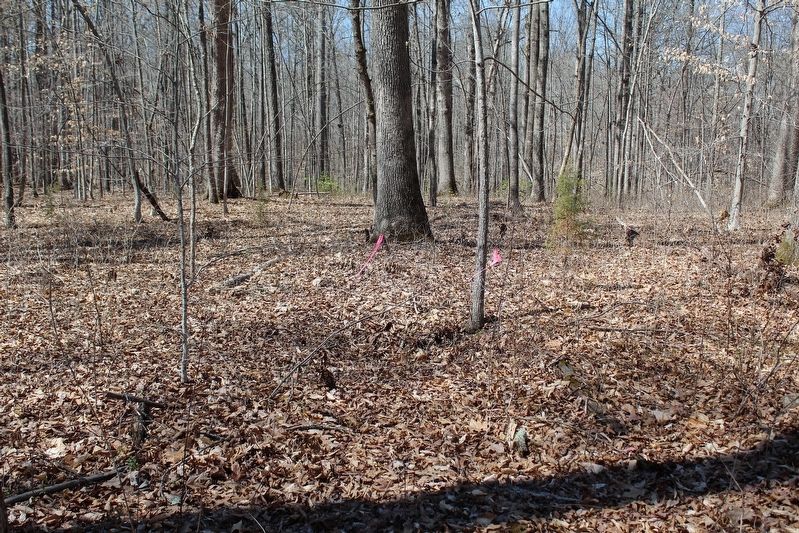
A couple of borrow pits are visible in the foreground by the slight shadow on the leaves indicating shallow depressions in the forest floor. The hut sits near the marker used to be outlined with fallen trees but they have largely rotted away and the stones indicating hearths, while still in the vicinity, are not where they lay when the predecessor marker was photographed in 2009.
Another marker is no longer nearby. Civil War Encampment (was within shouting distance of this marker but has been replaced with another marker now near it).
Related marker. Click here for another marker that is related to this marker. It preceded this marker in the same location and includes photos of the site when first opened to the public.

Photographed by Evan Dwyer, March 28, 2026
4. Confederate Encampment Borrow Pits
This fallen tree, on the south side of the trail across from the marker (and a little west), illustrates the shallow depressions formed by borrow pits thanks to its branches visibly bridging a low, long ditch. This was the officers' huts area.

Photographed by Evan Dwyer, March 28, 2026
5. Reconstructed Confederate Encampment
Just west on the trail, Montpelier reconstructed seven Confederate cabins but they have been allowed to rot - they now lie in ruins.
Credits. This page was last revised on April 28, 2026. It was originally submitted on April 22, 2026, by Evan Dwyer of Richmond, Virginia. This page has been viewed 20 times since then. Photos: 1, 2, 3, 4, 5. submitted on April 22, 2026, by Evan Dwyer of Richmond, Virginia. • Bernard Fisher was the editor who published this page.
