Montpelier Station in Orange County, Virginia — The American South (Mid-Atlantic)
Garden
"a paradise of roses and flowers"

Photographed by Evan Dwyer, March 28, 2026
1. Garden Marker
"at some distance from the house was the garden laid off in the shape of a horseshoe... It was a paradise of roses and other flowers, to say nothing of the strawberries, and vegetables."
Mary E.E. Cutts, Memoir II
The Madison era garden was larger than what you see within the brick wall. Rather than being strictly ornamental, it was partly a formal garden, and partly a kitchen garden where a ready supply of fresh herbs, fruits, nuts, and vegetables were cultivated by free and enslaved workers.
James and Dolley Madison were enthusiastic gardeners and both spent time tending prized plants. James experimented with new varieties of seeds sent to him by friends. Dolley often made gifts of fresh and preserved fruits and vegetables from Montpelier.
"We dismissed our gardener as soon as possible... and called in three black men, who understood the business - and we hope to have from them as many good things as usual."
Dolley Madison, January 22, 1825
Filling the pantry
The lifestyle of the Madisons, and the large number of people they entertained, required significant quantities of produce. Fresh fruits and vegetables
this page online
Enslaved workers provided the bulk of the work and expertise that made possible James and Dolley's legendary hospitality. Gardeners worked year round: planting, weeding, and harvesting in the spring and summer, and plowing and fertilizing in the winter.
The Madisons' terraced garden was designed by French emigre gardener Charles Bizet and sculpted by enslaved laborers who turned a gentle sloping hill with a natural hollow into a series of semi-circular falls bisected by a ramp. At the northern entrance was a flat semi-circular area extending into the back lawn, likely the site of the kitchen garden. Fruit trees along the terraces were trained to grow on trellises, while the lower end of the garden opened into an orchard.
"a wilderness of weeds and broken boxwood"
During the latter half of the nineteenth century the garden was altered to create an English landscape design. It later fell into disrepair. When the duPont family purchased the home in 1901, Annie duPont described the

Photographed by Evan Dwyer, March 28, 2026
2. Garden Marker
& Garden with brick wall and iron gate.
Photo Captions:
Overhead view of garden with Madison-era layout in yellow.
The garden as it appeared before Annie duPont's restoration.
Erected by James Madison’s Montpelier.
Topics. This historical marker is listed in these topic lists: Colonial Era • Horticulture & Forestry.
Location. 38° 13.082′ N, 78° 10.092′ W. Marker is in Montpelier Station, Virginia, in Orange County. It can be reached from Constitution Highway (Virginia Route 20) when traveling south. Marker is on the ground of James Madison's Montpelier, on the Montpelier-Grelen walking trail. Touch for map. Marker is at or near this postal address: 11350 Constitution Highway, Montpelier Station VA 22957, United States

Photographed by Evan Dwyer, March 28, 2026
3. Garden
View southwest from just inside the gate of the Annie duPont Formal Garden.

Regionally, this marker is in Northern Virginia and in the Piedmont. It is also in the American South and specifically in the Upper South. Globally, it is in North America, the Western Hemisphere, the Western World, and the Anglosphere. Historically, it finds itself in what was once the territory of the Mississippian Culture, one of the original Thirteen Colonies, one of the Confederate States of America, and the Antebellum South.
Other nearby markers. At least 5 other markers are within walking distance of this marker: Madison's Farm Complex (about 700 feet away); a different marker also named Madison's Farm Complex (approx. 0.2 miles away); Home Farm Complex (approx. 0.3 miles away); Mount Pleasant (approx. 0.3 miles away); Montpelier Flag Stop (approx. 0.9 miles away). Touch for a list and map of all markers in Montpelier Station.
Other markers no longer nearby. The Garden (was within shouting distance of this marker but has been replaced with another marker now near it); Homes for Enslaved Families (was within shouting distance of this marker but has been replaced with another
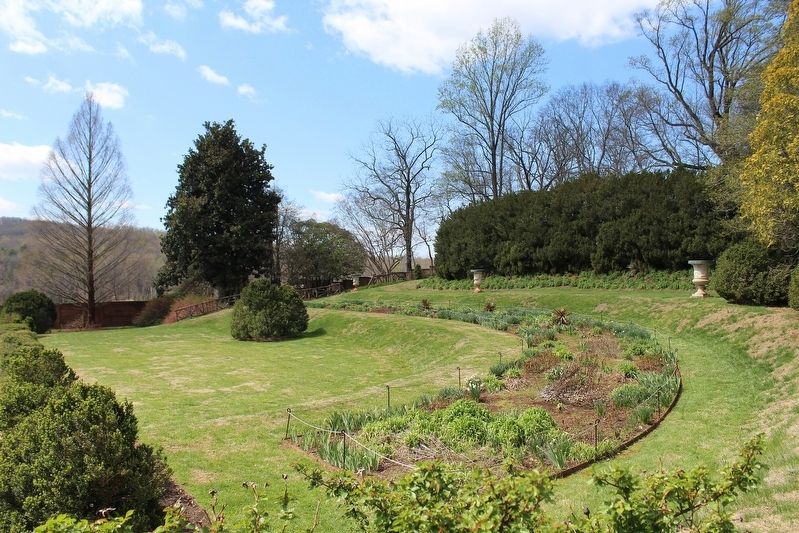
Photographed by Evan Dwyer, March 28, 2026
4. Garden Terracing

Photographed by Evan Dwyer, March 28, 2026
5. Garden Club of Virginia 1992 Restoration Marker
Installed in the ground at the southwest end of the Annie duPont Formal Garden.

Photographed by Evan Dwyer, March 28, 2026
6. Montpelier
View shows the proximity of the formal garden to the main house (background)
Credits. This page was last revised on April 24, 2026. It was originally submitted on April 23, 2026, by Evan Dwyer of Richmond, Virginia. This page has been viewed 12 times since then. Photos: 1, 2, 3, 4, 5, 6. submitted on April 23, 2026, by Evan Dwyer of Richmond, Virginia. • Bill Pfingsten was the editor who published this page.
