Boerne in Kendall County, Texas — The American South (West South Central)
Early Kendall County Farming and Ranching

Photographed by James Hulse, April 26, 2026
1. Early Kendall County Farming and Ranching Marker
George Wilkins Kendall, the Father of the Texas Sheep Industry and county namesake, was truly a renaissance man who was skilled in several professions and trades including animal husbandry. During the 1850's-60's Kendall, through trial and error, droughts, disease, fires and freezing northers at his Post Oak Spring Ranch, was able to persevere and raise tens of thousands of sheep that helped populate the Hill Country landscape. Twenty years after his passing, ranching in the region quickly expanded when ranchers no longer had to herd livestock to market, they could be loaded and shipped faster and safer via the Iron Horse.
Trains in Boerne
The industrial revolution arrived in Kendall County with the arrival of the San Antonio and Aransas Pass Railway Company (SA&AP) in 1887 along the northwest extension from San Antonio to Kerrville; passing through Leon Springs, Boerne, Waring, Comfort and Center Point. The SA&AP vigorously promoted farm and ranch development along their routes with a Farm Train that stopped at communities along the rails to promote progressive agricultural practices, setup farm equipment dealerships,
this page online
One of the primary promoters of the SA&AP and the line through Boerne was local resident Dr. William Gilliam Kingsbury, dentist and agriculturalist, later becoming the Texas Commissioner of Immigration. He is credited with having induced thousands of Europeans to immigrate to Texas by his speeches, pamphlets, articles, and books, published in several languages. Two such immigrants were William Michael Glynn Turquand and William George (Willy) Hughes.
William Turquand
Captain Turquand, former British Military and inventor, moved to Texas and acquired The Balcones Ranch in Kendall County. Turquand patented sheep-shearers and a shearing table both in England and the United States. Thereafter, Turquand was successful in breeding Arabian stallions with Texas mustangs which produced a hearty horse used by the U.S. Calvary and
Photographed by James Hulse, April 26, 2026
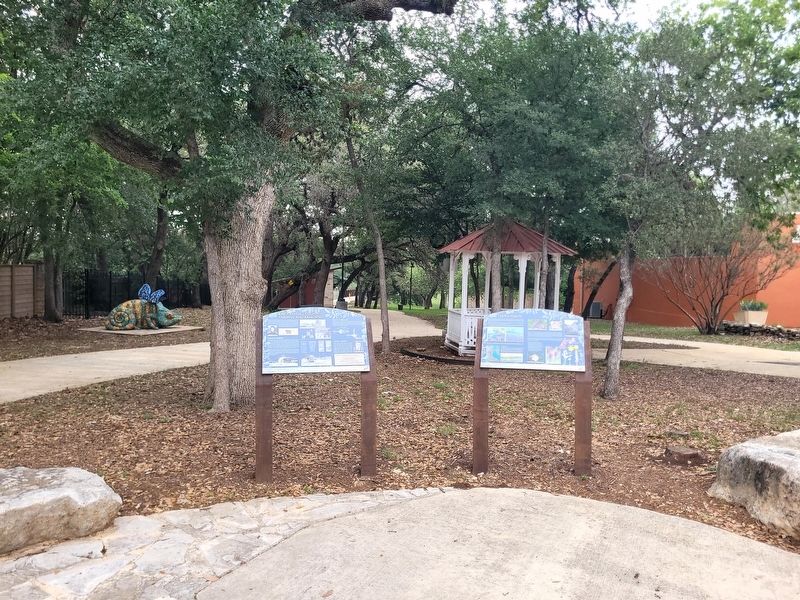
2. Early Kendall County Farming and Ranching Marker
The marker is the left marker of the two marker. The right side marker is the Native Plants marker.
William Hughes
Hughes arrived in 1878 and soon began his training in the sheep ranching business. Willy quickly imported Oxfordshire Downs and procured Merino sheep locally along with Angora goats and later bred horses. After creating a large ranching enterprise along the Boerne Road to Bandera County, he also opened the Hastings Post Office and School on his spread. William and his brothers assisted their uncle Thomas Hughes, famous English author, in the writing of their ranching experiences in a book entitled GTT-Gone to Texas (1884) that also promoted ranching in central Texas.
Captions:
George Wilkins Kendall
Boerne Depot Farm Train
Grain Threshing Machine - Minnich Farm
SA&AP Depot in Boerne, Image Surce: Robert Beckley
Boerne Depot Cedar Yard-1920
Willy Hughes
Erected by City of Boerne and Native Plant Society of Texas, Boerne Chapter.
Topics. This historical marker is listed in these topic lists: Agriculture • Animals • Railroads & Streetcars • Settlements & Settlers. A significant historical year for this entry is 1887.
Location. 29° 47.93′ N,

Photographed by James Hulse, April 26, 2026
3. Early Kendall County Farming and Ranching Marker
The trail marker for the Old No. 9. Trail is located in front of the Early Kendall County Farming and Ranching marker and Native Plants marker.

Regionally, this marker is in the Hill Country and in the San Antonio Metropolitan Area. Globally, it is in North America, a Gulf of Mexico state, the Western Hemisphere, the Western World, and the Anglosphere. Historically, it finds itself in what was once New Spain, the Republic of Texas, and one of the Confederate States of America.
Other nearby markers. At least 8 other markers are within walking distance of this marker: Native Plants (here, next to this marker); Wells and Windmills (within shouting distance of this marker); Civic Campus History (within shouting distance of this marker); Local Groundwater (within shouting distance of this marker); History of Boerne (within shouting distance of this marker); History of Kendall County (within shouting distance of this marker); Did Indians Ever Live Here? (about 400 feet away, measured in a direct line); One-Time Hill Country Health Capital (about 500 feet away). Touch for a list and map of all markers in Boerne.
Credits. This page was last revised on April 29, 2026. It was originally submitted on April 28, 2026, by James Hulse of Medina, Texas. This page has been viewed 24 times since then. Photos: 1, 2, 3. submitted on April 29, 2026, by James Hulse of Medina, Texas.
