St. John's Coalition in Pensacola in Escambia County, Florida — The American South (South Atlantic)
Burials
| — | St. John's Cemetery | — |
Photographed by Cosmos Mariner, June 19, 2025
1. Burials Marker
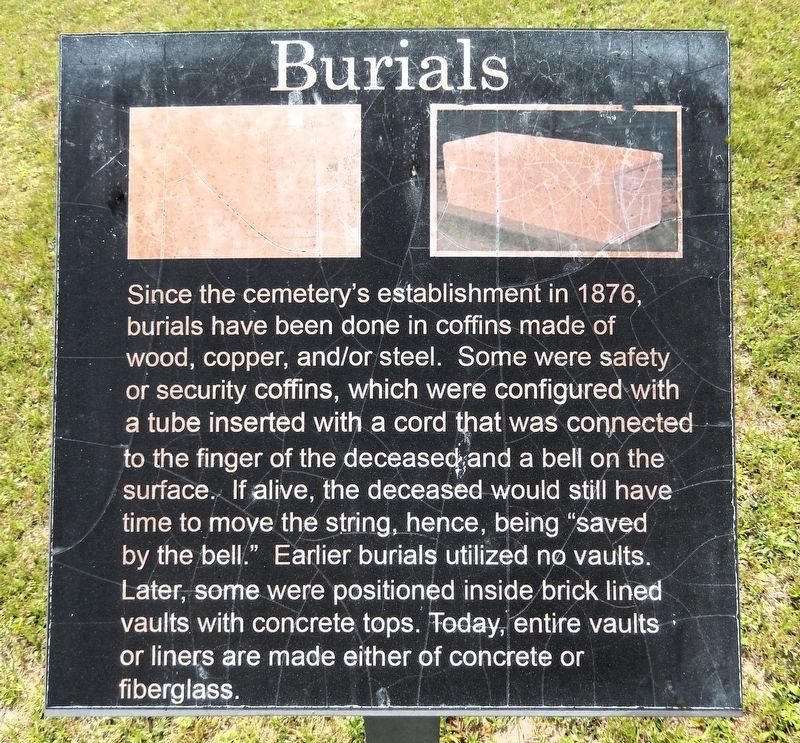
Since the cemetery's establishment in 1876, burials have been done in coffins made of wood, copper, and/or steel. Some were safety or security coffins, which were configured with a tube inserted with a cord that was connected to the finger of the deceased and a bell on the surface. If alive, the deceased would still have time to move the string, hence, being “saved by the bell.” Earlier burials utilized no vaults. Later, some were positioned inside brick lined vaults with concrete tops. Today, entire vaults or liners are made either of concrete or fiberglass.
Erected 2018 by Pensacola Bay Area Impact 100 and St. John's Cemetery Foundation.
Topics. This historical marker is listed in this topic list: Cemeteries & Burial Sites. A significant historical year for this entry is 1876.
Location. 30° 25.009′ N, 87° 14.132′ W. Marker is in Pensacola, Florida, in Escambia County. It is in St. John's Coalition. It can be reached from the intersection of North G Street and West Belmont Street, on the left when traveling north. The marker is located near the center of the St. John's Cemetery grounds. Touch for map. Marker is at
this page online

Regionally, this marker is on the Florida Panhandle. It is also in the American South, specifically in the Deep South, and on the Gulf Coast. Globally, it is in the North Atlantic Region, North America, a Gulf of Mexico state, the Western Hemisphere, the Western World, and the Anglosphere. Historically, it finds itself in what was once New Spain, the territory of the Mississippian Culture, one of the Confederate States of America, and the Antebellum South.
Other nearby markers. At least 8 other markers are within walking distance of this marker: Morris Slater (within shouting distance of this marker); Historic Colored Section (within shouting distance of this marker); Historic Greek Section (about 300 feet away, measured in a direct line); Samuel G. French (about 400 feet away); Helen Fisher (about 400 feet away); Mary W. Willis (about 500 feet away); Mary Lewis Willis (about 500 feet away); Former Goldfish Pond (about 500 feet away). Touch for a list and map of all markers in Pensacola.
Related markers.
Photographed by Cosmos Mariner, June 19, 2025
2. Burials Marker
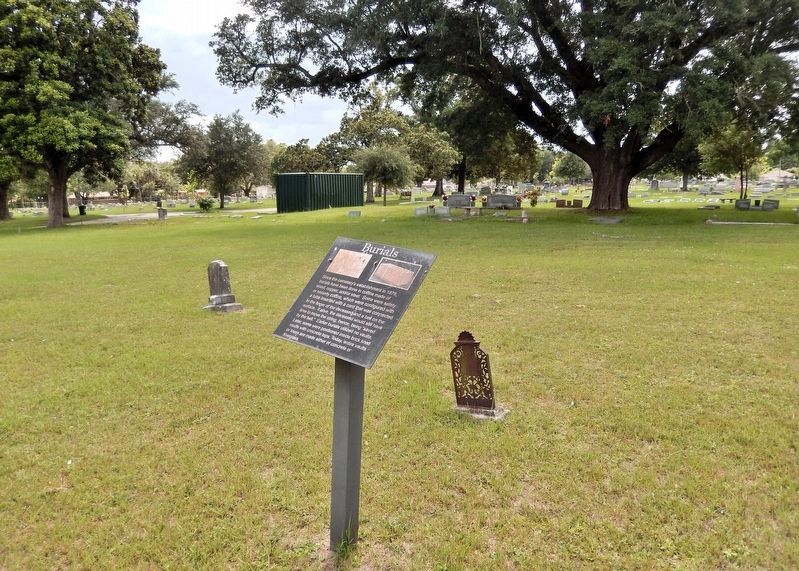
Looking southwest through the center of the St. John's Cemetery grounds.
Also see . . . What's the origin of the phrase 'Saved by the bell'? (phrases.org.uk).
Excerpt: There is a widespread notion that ‘saved by the bell’ originated as an expression that relates to people being buried alive. The idea was that, if someone were comatose and mistakenly pronounced dead and interred, they could, if they later revived, ring a bell that was attached to the coffin and be saved. The idea is certainly plausible as the fear of being buried alive was and is real.(Submitted on May 2, 2026, by Cosmos Mariner of Cape Canaveral, Florida.)Just as real were the devices themselves, several of which were patented in England and in the USA. These were known as ‘safety coffins’ and designs were registered in the 19th century and up to as late as 1955. There’s no evidence to show that anyone was ever saved by these coffins, and there’s a similar lack of evidence of the phrase ‘saved by the bell’ ever being used in that sense prior to it having been used in other contexts.
In fact, the expression is boxing slang and it came into being in the latter half of the 19th century. A boxer who is in danger
of losing a bout can be ‘saved’ from defeat by the respite signalled by bell that marks the end of a round.
Credits. This page was last revised on May 2, 2026. It was originally submitted on April 28, 2026, by Cosmos Mariner of Cape Canaveral, Florida. This page has been viewed 16 times since then. Photos: 1, 2. submitted on May 2, 2026, by Cosmos Mariner of Cape Canaveral, Florida.
