Richland in Benton County, Washington — The American West (Northwest)
The Manhattan Project
Hanford and the City of Richland
Photographed by Clayton Pickett, April 15, 2026
1. The Manhattan Project Marker, Side One
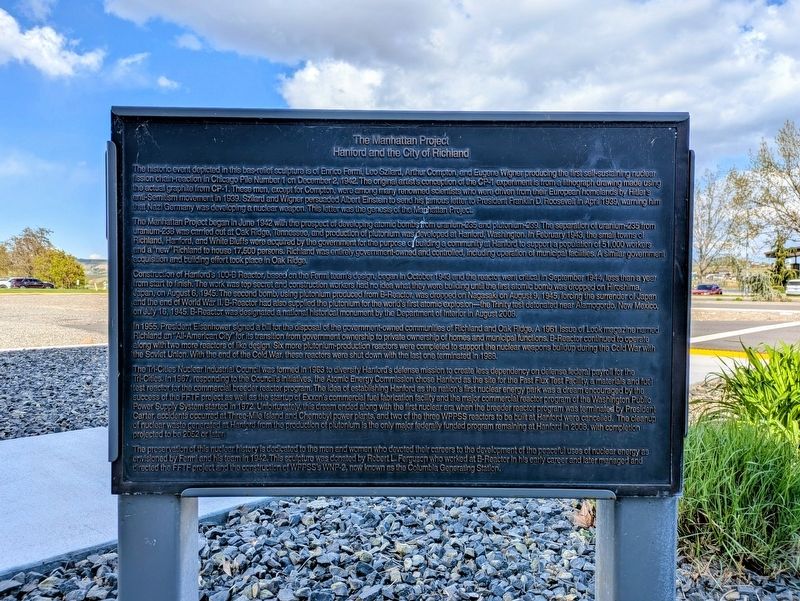
The historic event depicted in this bas-relief sculpture is of Enrico Fermi, Leo Szilard, Arthur Compton, and Eugene Wigner producing the first self-sustaining nuclear fission chain-reaction in Chicago Pile Number 1 on December 2, 1942. The original artist’s conception of the CP-1 experiment is from a lithograph drawing made using the actual graphite from CP-1. These men, except for Compton, were among many renowned scientists who were driven from their European homelands by Hitler’s anti-Semitism movement in 1939. Szilard and Wigner persuaded Albert Einstein to send his famous letter to President Franklin D. Roosevelt in April 1939, warning him that Nazi Germany was developing a nuclear weapon. This letter was the genesis of the Manhattan Project.
The Manhattan Project began in June 1942 with the prospect of developing atomic bombs from uranium-235 and plutonium-239. The separation of uranium-235 from uranium-238 was carried out at Oak Ridge, Tennessee, and production of plutonium was developed at Hanford, Washington. In February 1943, the small towns of Richland, Hanford, and White Bluffs were acquired by the government
this page online
Construction of Hanford’s 100-B Reactor, based on the Fermi team’s design, began in October 1943 and the reactor went critical in September 1944, less than a year from start to finish. The work was top secret and construction workers had no idea what they were building until the first atomic bomb was dropped on Hiroshima, Japan, on August 6, 1945. The second bomb, using plutonium produced from B-Reactor, was dropped on Nagasaki on August 9, 1945, forcing the surrender of Japan and the end of World War II. B-Reactor had also supplied the plutonium for the world’s first atomic explosion—the Trinity test detonated near Alamogordo, New Mexico, on July 16, 1945. B-Reactor was designated a national historical monument by the Department of Interior in August 2003.
In 1955, President Eisenhower signed a bill for the disposal of the

Photographed by Clayton Pickett, April 15, 2026
2. The Manhattan Project Marker, Side Two
The Tri-Cities Nuclear Industrial Council was formed in 1963 to diversify Hanford’s defense mission to create less dependency on defense federal payroll for the Tri-Cities. In 1967, responding to the Council’s initiatives, the Atomic Energy Commission chose Hanford as the site for the Fast Flux Test Facility, a materials and fuel test reactor for the commercial breeder reactor program. The idea of establishing Hanford as the nation’s first nuclear energy park was a dream encouraged by the success of the FFTF project as well as the startup of Exxon’s commercial fuel fabrication facility and the major commercial
Photographed by Clayton Pickett, April 15, 2026
3. The Manhattan Project Marker
The preservation of this nuclear history is dedicated to the men and women who devoted their careers to the development of the peaceful uses of nuclear energy as envisioned by Fermi and his team in 1942. This sculpture was donated by Robert L. Ferguson who worked at B-Reactor in his early career and later managed and directed the FFTF project and the construction of WPPSS’s WNP-2, now known as the Columbia Generating Station.
On December 2, 1942 man achieved the first self-sustaining controlled nuclear chain reaction in Chicago Pile number 1 (CP-1) at the University of Chicago. Artwork for this plaque adapted by Paula Turnbull, S.N.J.M. from original lithograph by Leo Vartanian.
Leo Szilard • Arthur H. Compton • Enrico Fermi • Eugene P. Wigner
Topics. This historical marker is listed in these topic lists: Science & Medicine • War, World II. A significant historical date for this entry is December 2, 1942.
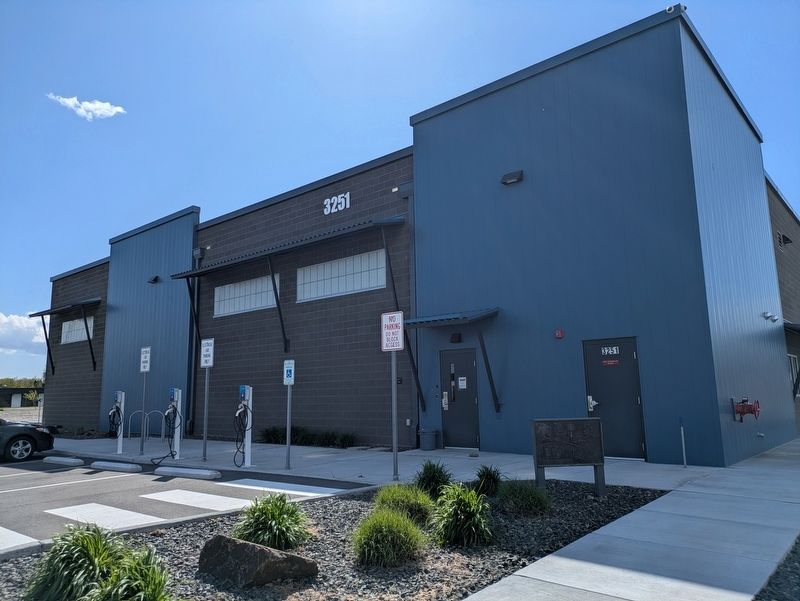
Location. 46° 20.865′ N, 119° 16.232′ W. Marker is in Richland, Washington, in Benton County. It is at the intersection of Port of Benton Boulevard and 11th Street, on the left when traveling north on Port of Benton Boulevard. Touch for map. Marker is at or near this postal address: 3251 Port of Benton Blvd, Richland WA 99354, United States of America. Touch for directions.

Regionally, this marker is in the Columbia Basin and in Yakima Valley. It is also in the American Mountain West and in the Lewis & Clark Corridor. Globally, it is in North America, on the Pacific Rim, in the Western Hemisphere, in the Western World, and in the Anglosphere.
Other nearby markers. At least 8 other markers are within 5 miles of this marker, measured as the crow flies: USS Triton Specifications (about 400 feet away, measured in a direct line); USS Triton (SSRN 586) History (about 400 feet away); First to Circumnavigate the Earth Submerged (about 400 feet away); Black Pioneers (approx. 1.1 miles away); F.A. Friermood House (approx. 2.9 miles away); Col. Thomas William Symons (approx. 4.1 miles away); In Honor of Central United Protestant Church (2016) (approx. 4½ miles away); A River of History (approx. 4.7 miles away). Touch for a list and map of all markers in Richland.
Credits. This page was last revised on April 29, 2026. It was originally submitted on April 17, 2026, by Clayton Pickett of Richland, Washington. This page has been viewed 46 times since then. Last updated on April 29, 2026, by Don L. Sorenson of Kennewick, Washington. Photos: 1, 2. submitted on April 17, 2026, by Clayton Pickett of Richland, Washington. 3. submitted on April 18, 2026, by Clayton Pickett of Richland, Washington. • Devry Becker Jones was the editor who published this page.
